Financial Ratio Analysis
Liquidity Ratios
Liquidity ratios measure the firm's ability to pay its short-term debts as they come due. These ratios are of special interest to the firm's creditors. The three main measures of liquidity are the current ratio, the acid-test (quick) ratio, and net working capital.
The current ratio is the ratio of total current assets to total current liabilities. Traditionally, a current ratio of 2 ($2 of current assets for every $1 of current liabilities) has been considered good. Whether it is sufficient depends on the industry in which the firm operates. Public utilities, which have a very steady cash flow, operate quite well with a current ratio well below 2. A current ratio of 2 might not be adequate for manufacturers and merchandisers that carry high inventories and have lots of receivables. The current ratio for Delicious Desserts for 2018, as shown in Table 14.4, is 1.4. This means little without a basis for comparison. If the analyst found that the industry average for small bakeries was 2.4, Delicious Desserts would appear to have low liquidity.
The acid-test (quick) ratio is like the current ratio except that it excludes inventory, which is the least-liquid current asset. The acid-test ratio is used to measure the firm's ability to pay its current liabilities without selling inventory. The name acid-test implies that this ratio is a crucial test of the firm's liquidity. An acid-test ratio of at least 1 is preferred. But again, what is an acceptable value varies by industry. The acid-test ratio is a good measure of liquidity when inventory cannot easily be converted to cash (for instance, if it consists of very specialized goods with a limited market). If inventory is liquid, the current ratio is better. Delicious Desserts' acid-test ratio for 2018 is 1.1. Because the bakery's products are perishable, it does not carry large inventories. Thus, the values of its acid-test and current ratios are fairly close. At a manufacturing company, however, inventory typically makes up a large portion of current assets, so the acid-test ratio will be lower than the current ratio.
| Ratio Analysis for Delicious Desserts at Year-End 2018 | |||
|---|---|---|---|
| Ratio | Formula | Calculation | Result |
| Liquidity Ratios | |||
| Current ratio |  |
 |
1.4 |
| Acid-test (quick) ratio |  |
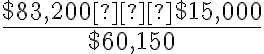 |
1.1 |
| Net working capital |  |
 |
$23,050 |
| Profitability Ratios | |||
| Net profit margin | 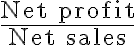 |
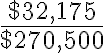 |
11.9% |
| Return on equity |  |
 |
40.9% |
| Earnings per share |  |
 |
$3.22 |
| Activity Ratio | |||
| Inventory turnover | 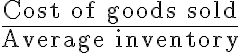 |
||
 |
 |
||
 |
6.8 times | ||
| Debt Ratio | |||
| Debt-to-equity ratio |  |
 |
89.1% |
Table 14.4
Net working capital, though not really a ratio, is often used to measure a firm's overall liquidity. It is calculated by subtracting total current liabilities from total current assets. Delicious Desserts' net working capital for 2018 is $23,050. Comparisons of net working capital over time often help in assessing a firm's liquidity.