The Study of Intercultural Communication
The Six Imperatives or Reasons Why We Study Intercultural Communication
When considering the various reasons for studying intercultural communication, most answers will fall into what scholars Martin & Nakayama (2011) call the six imperatives or reasons for studying intercultural communication. The six imperative categories are:
- Peace
- Demographic
- Economic
- Technology
- Self-awareness
- Ethics
Let's take a quick look at each imperative individually.

The Peace Imperative
History is full of conflict. Contemporary life is full of conflict. Conflict over politics, religion, human rights, climate change, wealth, medical care, plus food, water, and mineral resources are often in the news. It would be naïve to assume that simply understanding intercultural communication principles would end conflict, but there is a need for all of us to learn more about cultural groups other than our own if we wish to be competent communicators. The peace imperative begs the question as to whether individuals of different races, ethnicities, languages, and cultures can exist together on this planet? If so, what does that look like? If not, what does that mean?
The Demographic Imperative
Demographics are the characteristics of a population such as gender, age, race, ethnicity, economic status, educational status, and more. Demographics are generally those traits and characteristics that we can count. U.S. demographics, as well as those around the rest of the world, are changing quickly and dramatically. Migratory populations escaping from climate and economic issues are crossing borders in record numbers. Borders are becoming more fluid as countries go on land grabs in neighboring territory. Pandemics don't recognize borders at all. The demographic imperative is not only about immigration though, it's also about change. As demographics change, culture changes.
Vocabulary that describes groups of people and are associated with the demographic imperative include the terms, heterogeneous, homogeneous, diversity, and nativistic. If a population is considered heterogeneous, there are differences in the group, culture, or population. If a population is considered homogeneous, there are similarities in the group, culture, or population. Diversity is the quality of being different. A nativistic group is extremely patriotic to the point of being anti-immigrant.
The Economic Imperative
To compete and be effective in the global market, an accurate understanding of the economies and ways of doing business around the world is crucial. The interdependence of our world market in consumer goods, services, labor, and capital has been dramatically illustrated by the shortages produced by the COVID pandemic. Formerly efficient supply chains were disrupted. Economically affordable products became expensive for lack of local sources. Labor shortages around the world impacted everyone on the planet. The economic imperative is reflected by the impact that business globalization has on the average person.

The Technology Imperative
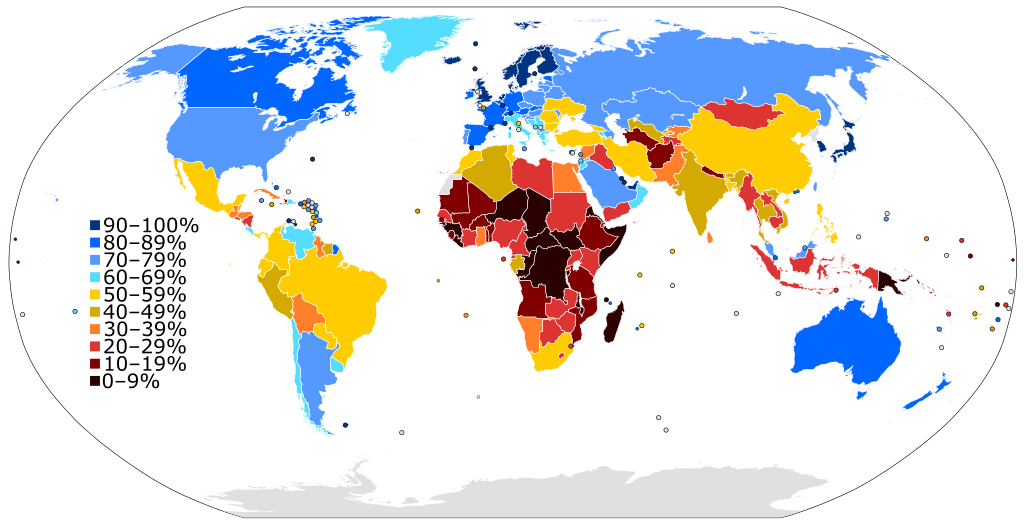
Technology has made communication easier than ever before. Information has become so easy to access and manipulate that we are now confronted with the impact of fake news and purposeful disinformation along with the closely related economic issue of the digital divide. The digital divide refers to people who grew up with access to technology versus those who did not have access to technology and did not develop the associated skills. Digital natives, or people who grew up using technology, are often citizens of wealthy nations that live lives of comparable privilege and often have better economic prospects. Technology is also used as an identity management tool and will be discussed as such in a later chapter.
The Ethical Imperative
Does the idea of a digital divide challenge your sense of social justice? If so, you are concerned with the ethical principles of conduct that help govern the behaviors of individuals and groups. Generally, there are two basic ways that humans apply ethical values to behavior—universally or relatively. If you are viewing a behavior as a relativist, you believe that no behavior is inherently right or wrong, rather everything depends on perspective. In other words, you might not make the same choice yourself, but are willing to understand why others would make that choice. If you are viewing a behavior as a universalist, you believe that cultural differences are only superficial, and that fundamental notions of right and wrong are universal. In other words, everyone should be making the same choices for the same reasons.
Although universalism and relativism are thought of as an either/or choice, realistically most people are a combination of both views. There are some issues you might hold strict opinion about while other issues you are willing to be more open about.
The Self Awareness Imperative
One of the most important reasons for studying intercultural communication is the awareness it raises of our own cultural identity and background. The self-awareness imperative helps us to gain insights into our own culture along with our own intercultural experiences. All cultures are ethnocentric by their very natures. Ethnocentrism is a tendency to think that our own culture is superior to other cultures. Most of us don't even realize that we think this way, but we do. Sure, we might admit that our culture isn't perfect, yet we still think that we are doing better than everyone else. Ethnocentrism can lead to stereotyping, prejudice, and discrimination. These ideas will be discussed in greater detail later in the book.
Learn A Little More!
Ever since I was very young - even before I could find it on a map - I have wanted to go to the People's Republic of China. For much of my lifetime, China was almost impossible to visit. There were no direct flights available. Invitations had to be issued from work units in the PRC. Various permissions and permits had to be arranged before entry. Special money called foreign exchange currency (FEC) was required for use. Upon return to your home country, many travelers were requested to describe their trip in great detail to their family and friends as well as various governmental agencies who were also interested in the PRC. It was quite an adventure!
For a long time, I thought that my interest in the PRC was based on the exotic and restricted nature of the location, but it turned out that wasn't. It was Bennett. Bennett's family was from the old Canton (now Guangzhou). Because of famine, political unrest, and civil war, they made their way to Hong Kong which was a leased British colony at the time. As a lone young man, Bennett immigrated first to Canada, and then to the United States. He worked with my father as a chemist in the Midwest for many years spending most weekends and holidays with my extended family. To my young ears, his thickly accented stories weren't that much different than my grandparents thickly accented stories. Histories, stories of adversity, and fairy tales are commonly shared at family gatherings.
Eventually, Bennett married Pat, started a family, and moved to another part of the Midwest. Slowly visits became yearly holiday cards and then we lost touch as Bennett faded from my conscious memory. Unconsciously, my early contact with Bennett fueled a lifelong desire to visit and learn more about the civilization that produced someone who was once so important to me.
So, what's your story? Why are you taking intercultural communication? What do you already know about this topic that could help guide your learning?