Nonverbal Communication
Types of Nonverbal Communication Codes
One reason that nonverbal communication is so rich with information is that humans use so many different aspects of behavior, appearance, and environment to convey meaning. Scholars call the different means used for transmitting information nonverbal communication codes. The seven general codes for nonverbal communication are: kinesics, vocalics, proxemics, haptics, chronemics, physical appearance, artifacts, and environment. The cultural patterns embedded in nonverbal codes should be used not as stereotypes for all members of particular cultures, but rather as tentative guidelines or examples to help you understand the great variation of nonverbal behavior in humans.
Kinesics
Kinesics are some to be the best nonverbal code in terms of its power to communicate meaning. The word kinesics comes from the Greek word, kinesis, meaning "movement," and includes facial expressions, eye contact, gestures, and posture.

Facial Expressions
Facial Expressions communicate an endless stream of emotions, and we make judgements about what others are feeling by assessing their faces. Our use of emoticons to communicate attitudes and emotions in electronic media testifies to the importance of this type of kinesics. In fact, some scholars argue that facial expressions rank first among all forms of communication.
Cultural rules often regulate facial expressions. You might have been taught that smiles are universal, but that simply is not true. Most human beings can smile, but cultures value and interpret smiles in different ways. In other words, the meaning behind a smile is not universal. For example, in Russian, people do not smile because it implies that you are foolish, or possibly sneaky and manipulative. Even family photos, adults often appear with flat or scowling faces. Many Hispanic cultures prefer a proud and elegant facial appearance, which does not include smiling. In Japan, smiling is a way to show respect or to hide what you are actually feeling. In the United States, we smile to show a pleasant face to the people around us, to express happiness, gratitude, and even when we are nervous. We also tend to smile for the purposes of getting along with others.
Eye Contact
Eye contact serves many purposes. We use our eyes to express emotions, regulate a conversation, indicate listening behavior, show interest in others, respect, status, hostility, and aggression. Patterns of eye contact vary significantly by culture. Generally, eye contact is considered a good thing in the United States. It can mean that you are interested, confident, and bold (a good thing), but people often avoid eye contact in crowded, impersonal situations such as walking down a busy street or riding a crowded bus. In France, however, someone may feel free to watch someone interesting on the street and consciously make eye contact to indicate interest. In the Middle East, direct eye contact is less common and generally less appropriate, whereas lack of eye contact in Asia is often a sign of respect and considered polite.
Gestures
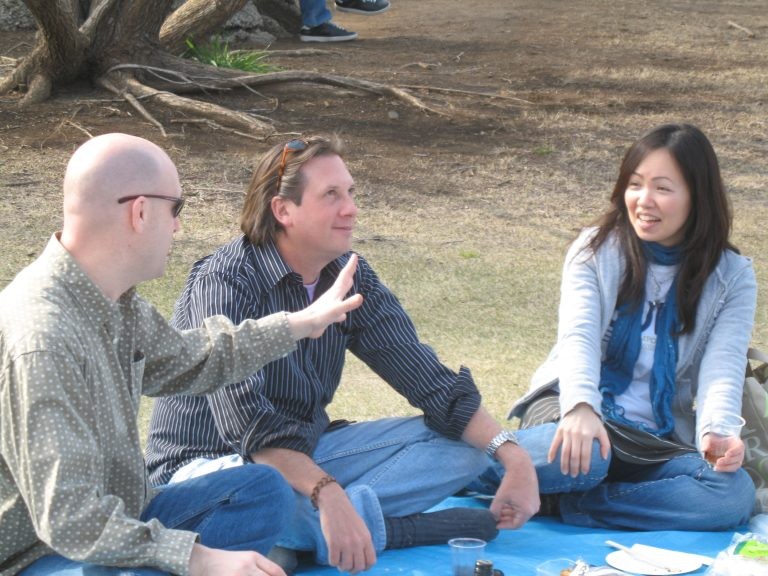
Gestures are arm and hand movements used for communication. There are at least four different kinds of gestures that we should consider: emblems, illustrators, regulators, and adaptors.
- The type of gesture known as emblems represent a specific verbal meaning and can replace or reinforce words. If you are driving down a busy highway in the United States, and another driver quickly changes lanes in front of your car, making you hit the brakes, you can flip them off to easily convey meaning without using any words at all. With emblems, gestures and its verbal meaning are interchangeable, but they are also very culturally specific. If the person who changed lanes abruptly is from another culture, they may have no idea what your emblem means.
- Illustrators are a nonverbal gesture used to communicate our message effectively and reinforce our point. Your grandfather may describe the fish he just caught and hold up his two hands 36 inches apart to illustrate exactly how big the fish was.
- Regulators are nonverbal messages which control, maintain or discourage interaction. For example, if someone is telling you a message that is confusing or upsetting, you may hold up your hand, a commonly recognized regulator that asks the speaker to stop talking.
- Adaptors help us feel comfortable or indicate emotions or moods. An adaptor could involve you meeting your need for security, by playing with your hair for example, or hugging yourself for warmth.
Posture
Posture is the last item in our list of kinesics. Humans can stand up straight or slouch, lean forward or backward, round or slump our shoulders, and tilt our heads. Mehrabian believed that posture communicates immediacy and power.
- Immediacy is the degree to which you find someone interesting and attractive. Typically, when someone from the United States finds someone attractive, they face the person when talking, hold their head up, and lean in. Whereas a reaction to someone they don't like might have them look away and lean back.
- Power is the ability to influence people or events. In the United States, high-status communicators typically use relaxed postures, but in Japan, the opposite is true. Japanese display power through erect posture with feel planted firmly on the floor.
Vocalics
Vocal characteristics we use to communicate nonverbal messages are called vocalics or paralanguage (with-language). Vocalics involves verbal and nonverbal aspects of speech that influence meaning, including rate, pitch, tone, volume, intensity, pausing, and even silence. As previously discussed, silence or vocal pauses can communicate hesitation, indicate the need to gather thought, or serve as a sign of respect. Sometimes we learn just as much, or even more, from what a person does not say as what they do say.
Proxemics
Coming from the Latin proximus, meaning "near," proxemics refers to communication through the use of physical distance or space. When we discuss space in a nonverbal context, we mean the space between objects and people. Space is often associated with social rank and is an important part of communication. Who gets the corner office? Who sits at the head of the table and why?
People from diverse cultures may have different normative space expectations. If you are from a large urban area, having people stand close to you may be normal. If you are from a culture where people expect more space, someone may be standing "too close" for comfort and not know it.
Anthropologist Edward T. Hall, served in the Corps of Engineers during World War II. As he moved from one place to another, he noticed that people in different countries kept different distances from each other. In France, they stood closer to each other than they did in England. Hall wondered why that was and came up with a theory on spatial relations and boundaries.
The first aspect, Hall called "territory" and it is related to control. As a way of establishing control over your own room, maybe you painted it your favorite color, or put up posters that represent your interests or things you consider unique about yourself. Territory means the space you claim as your own, are responsible for, or are willing to defend.
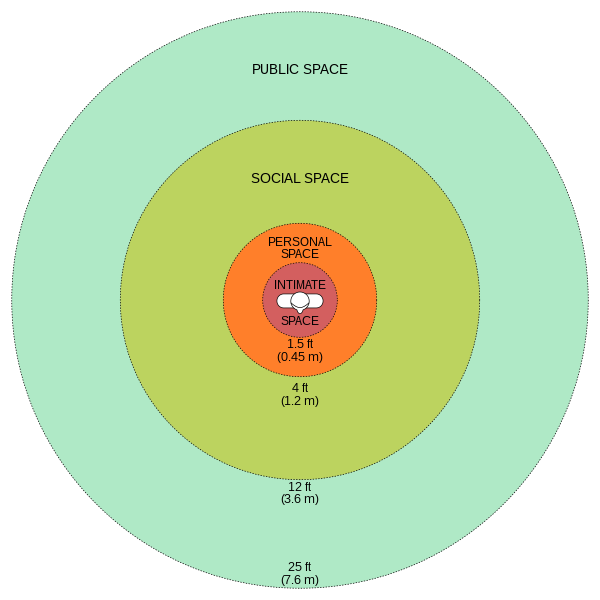
The second aspect Hall highlights is conversation distance, or the "bubble" of space surrounding each individual. We recognize the basic need for personal space, but the normative expectations for space vary greatly by culture. In the United States, intimate space ranges from 0-18 inches. Personal space is the distance we occupy during encounters with friends and ranges from 18 inches to 4 feet. Many people use social space in social situations or with strangers, and ranges from 4 to 12 feet. In public space, the distance ranges from 12 feet and beyond. North American use of space tends to be much larger than most other cultures, especially people from Latin America and the Middle East where such vast use of personal space will make you seem aloof or distant.
Haptics
Touch in communication interaction is called haptics, from the ancient Greek word "haptien". Touch can vary based on its duration, the part of the body being touched, and the strength of the contact.
Cultural norms have a strong impact on how people use and perceive touch. For example, Hispanic cultures tend to hug more than do Europeans. Researchers in a study at outdoor cafes in London, England and San Juan, Puerto Rico found that Puerto Ricans touched each other an average of 180 times per hour whereas the British average was zero.
Hall (1963) suggested that the use of proxemics and haptics merge within a culture to create what researchers now call contact and noncontact cultures. In contact cultures, people stand closer together while talking, make more direct eye contact, touch more frequently, and speak in louder voices. Some examples of contact cultures would be South America, the Middle East, and Eastern Europe with the Middle East being the highest contact.
In noncontact cultures, people stand farther apart while talking, maintain less eye contact, and touch less. Some examples of noncontact cultures would be Great Britain, the United States, and Japan.
Chronemics
Chronemics is the study of how we refer to and perceive time. Cultures vary widely in their time orientation, although context can also play a major role as well. "Time is money" is a common saying across cultures that display a high value for time. In social contexts, time often reveals social status and power. Who are you willing to wait for? A doctor for an office visit when you are sick? A potential employer for a job interview? Your significant other or children?
Poly and Monochronic
Some Mexican American friends may invite you to a barbecue at 8 p.m., but when you arrive you are the first guest, because it is culturally understood that the gathering doesn't start until after 9 p.m. Similarly in France, an 8 p.m. party invitation would be understood to indicate you should arrive around 8:30, but in Sweden 8 p.m. means 8 p.m., and latecomers may not be welcome.
In the United States, we perceive time as linear, flowing along in a straight line. We did one task, we're doing another task now, and we are planning on doing something else later. In monochronic time orientation, time is a commodity. Being punctual, completing tasks, and keeping schedules is valued, and may be more important than building or maintaining personal relationships.
In polychronic time orientation, time is more holistic and circular. It is expected that many events happen at once, and things get done because of personal relationships, not in spite of personal relationships. The Euro Railways trains in Germany are famous for departing and arriving according to the schedule no matter what. In contrast, if you take the train in Argentina, you'll find that the schedule is more of an approximation of when the train will leave or arrive. Engineers, conductors, and even passengers influence the schedule, not a clock.

Past, Present, and Future
Cultures also differ in the way that they perceive the past, the present, and the future. This was a question mentioned in Kluckhohn & Strodtbeck's Value Orientation Theory. Some cultures seem to emphasize the future. Perhaps this reflects the optimistic idea that things will get better in the future, or the future will be "new and improved". Such cultures might have less concern about saving "historical" buildings, and more about modernizing or updating. Having calendars or appointments that stretch several years in the future is not uncommon. The US is very future oriented.
Cultures that emphasize the importance of the present, recognize the value of living in the here and now. The potential of the present moment is strong. Spain, Greece, and many African countries tend to be present time oriented. Some countries, like Russia and Mexico, emphasize the present, but also recognize the influence of the past on the present.
Many European and Asian cultures place a strong emphasis on the past. They believe that history has a greater influence on what has happened to us than current life. Destiny or karma from the past is what happens to us in the present.
Physical Appearance
Visible attributes such as hair, clothing, body type, personal grooming, jewelry, glasses, backpacks, briefcases, and purses profoundly influence our communication encounters. In other words, how you look conveys as much about you as what you say. Across cultures, people credit individuals they find physically attractive with higher levels of intelligence, persuasiveness, poise, sociability, warmth, power, and employment success than they credit to unattractive individuals. Communication researchers call this tendency to make a blanket judgment of a person based on one trait either the halo (positive) or horns (negative) effect. As physical attractiveness is variable across cultures, and constantly being redefined, beauty is in the eye of the beholder.
Artifacts
Artifacts are the things we possess that influence how we see ourselves and that we use to express our identity to others. They can include rings and tattoos but may also include brand names and logos. From clothes to cars, watches, briefcases, purses, and even eyeglasses, what we choose to surround ourselves with communicates something about our sense of self. They may project gender, role or position, class or status, personality, and group membership or affiliation.
Environment
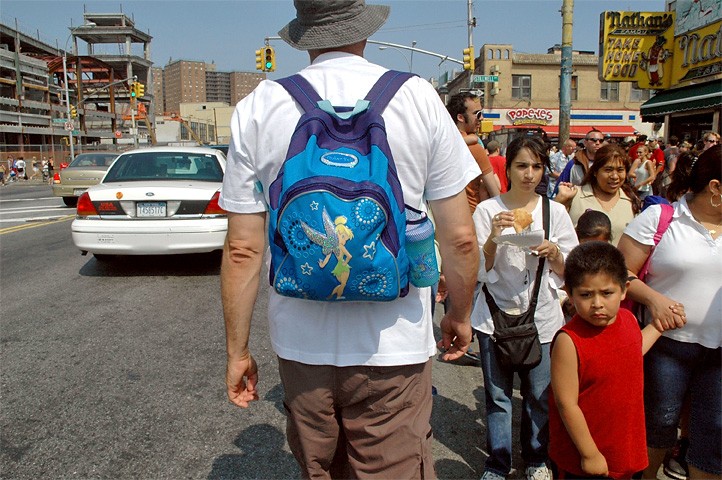
A final way in which we communicate nonverbally is through our environment. Environment involves the physical aspects of our surroundings. More than the tables and chairs in an office, environment is an important part of the dynamic communication process. The perception of one's environment influences one's reaction to it. For example, Google is famous for its work environment, with spaces created for physical activity and even in-house food service around the clock. The expense is no doubt considerable, but Google's actions speak volumes. The results produced in the environment, designed to facilitate creativity, interaction, and collaboration, are worth the effort.
Other Codes of Interest
Although not as heavily researched as the other codes, smell/scent, is another way to send nonverbal messages. You may use lemon-scented cleaning products because lemon is associated with health and cleanliness. Mint is used in toothpaste and hygiene products in the US to eliminate odors. Root beer flavoring is common in German medicine to combat the bitter taste. Stinky tofu is rarely eaten by foreigners in China because of the strong, unpleasant smell.
The use of color is also a powerful nonverbal message across cultural boundaries. Colors can have distinct meanings and relationships in various cultures. Yellow is often associated with cowardice in the US. Red is associated with good fortune in China. Purple is associated with royalty in the West but mourning in Brazil. Green is associated with corruption in North Africa.