Self and Identity
Culture Shock
When a person moves to a cultural environment that is different than their own, they often experience personal disorientation called culture shock. It's common to experience culture shock when you are an immigrant, visit a new country, move between social environments, or simply become stressed by trying to deal with lots of new cultural information all at once. The impact of culture shock intensifies due to the "need to operate" in unfamiliar and difficult contexts. Functioning without a clear understanding of how to succeed or avoid failure, along with modifying your normal behavior tends to compound the problem. As symptoms of culture shock intensify, your ability to function declines making culture shock an intensely disorienting.


Common symptoms of culture shock can include: homesickness, feelings of helplessness, disorientation, isolation, depression, irritability, sleeping and eating disturbances, and loss of focus. Although most people recover from culture shock fairly quickly, a few take much longer to recover, particularly if they are unaware of the sources of the problem, and have no idea of how to counteract it.
Many studies have been done culture shock. Most look at culture shock as steps or stages. There is the U-Curve Model that introduced the honeymoon, shock, recovery and adjustment stages. Or the W-Curve Model suggested the stages of honeymoon, culture shock, initial adjustment, mental isolation, and plus acceptance & integration.
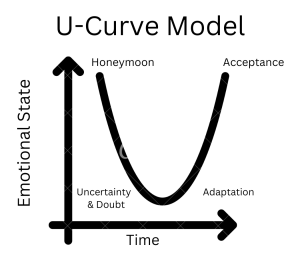
Adler proposed a "contact-disintegration-reintegration-autonomy-independence" model. Recently, it has been suggested that the curve models do not reflect reality and that there are factors or traits (e.g. routines, reactions, roles, relationships, and reflections) that are disrupted when moving across cultural boundaries.
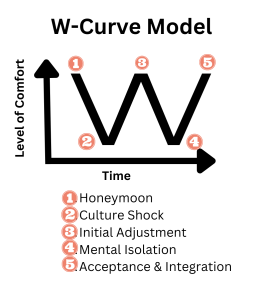
While the idea of culture shock remains a useful term, some people never experience symptoms of culture shock while others become paralyzed and quickly flee back to their home cultures. There appears to be no one-size-fits-all model. Some people might skip certain stages, experience stages in a different order, or have a longer or shorter adjustment period. What researchers do agree upon is that it is natural to feel some degree of culture shock.
Advice for dealing with culture shock varies as much the symptoms and is dependent upon individual traits.
Helpful tips include:
- Be flexible and try new things.
- Get involved in the things that you already like.
- Do not expect to adjust overnight.
- Process your thoughts and feelings.
- Use the resources available to help you handle the stress.