Scandinavian Cultures in the Workplace
Indirect vs. Direct Communication
How indirect or direct we are can also be culturally conditioned. In high-context cultures, the style is often indirect because the context gives plenty of meaning to the message. Some countries with such high-context cultures are China, Korea, and Saudi Arabia. On the other hand, in more Western cultures, such as in the United States or Scandinavia, which tend to be more low-context cultures, the meaning of the information lies in what is said, not in the context. A manager from the U.S. is generally more direct when communicating compared to a supervisor from East Asia.
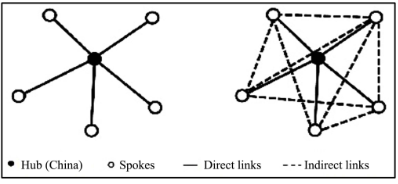
In Figure 3, the left panel depicts the Chinese network. It showcases the links between the hub (China) and its spokes (other countries); the right panel shows the links between six countries. Direct and indirect links influence the communication process. It can be more challenging when there are more indirect links; they act as noise in the communication process. In Japan, similarly to China, communication is often high context, which means that much of the meaning is conveyed through nonverbal cues, context, and indirect language. In this cultural context, saying "no" directly and explicitly can be considered rude and confrontational. Instead, the Japanese often use indirect language, such as saying, "it is difficult" or "let me think about it," to convey a negative answer without explicitly saying "no". This is because preserving harmony and avoiding conflict is highly valued in high-context cultures like Japan. Saying "no" directly can be seen as a direct challenge to another person's position or request, damaging relationships and creating tension. By using indirect language, the Japanese can convey a negative answer while maintaining the relationship and respecting the other person's feelings. Additionally, in high-context cultures like Japan, relationships and social hierarchies are also highly valued. Saying "no" directly can be seen as a challenge to authority or a lack of respect for a higher-ranking individual. By using indirect language, the Japanese can show respect for the other person's position while still conveying their negative answer. In Japan's highcontext culture, saying "no" directly can be perceived as rude and confrontational. Indirect language allows the Japanese to preserve harmony and relationships while conveying a negative answer.
Figure 3. Direct and indirect links in a network of countries
Scandinavian communication is generally known for being direct and straightforward rather than indirect. However, there are situations where indirectness may be used, particularly in social situations or when trying to avoid confrontation. One reason for indirectness in Scandinavian communication could be the desire to maintain social harmony and avoid conflict. In some situations, being too direct or confrontational may be seen as impolite or aggressive, potentially damaging relationships or social cohesion. As a result, people in Scandinavian cultures may use indirect language or non-verbal cues to convey their meaning more subtly or tactfully.
Another reason for indirectness in Scandinavian communication could be the desire to respect other people's feelings or privacy. For example, in some situations where a person may be in a vulnerable position or dealing with a problematic issue, it may be seen as impolite or invasive to ask direct questions or press for details. In these situations, people in Scandinavian cultures may use indirect language or non-verbal cues to show support or concern while still respecting the other person's boundaries. While directness is generally valued in Scandinavian communication, there may be situations where indirectness is used to maintain social harmony, respect other people's feelings or privacy, or avoid confrontation.