Computer-Mediated Communication: UK and Arab Samples
Results
Results: Communication Styles in Arab and UK Samples
About these results. This study surveyed UK and Arab participants on how they use different communication styles and how comfortable they feel with them — both for themselves and when observing others. The sections below report the statistical models; Table 3 lists the within-sample post-hoc comparisons, and Figures 1–2 compare the two samples directly.
Key to terms
- Mode
- Use (how often a style is used) vs. Comfort (how at ease the person feels with it).
- Person
- Self (one's own communication) vs. Others (how others communicate).
- Conditions
- The communication-style contrasts compared: Direct/Indirect, Ordered/Unordered, Being-centred/Doing-centred, and Literate/Oral.
- pbonf
- A p value adjusted with the Bonferroni correction; values below .05 indicate a statistically significant difference.
4.1. Participants' demographics
A total of 599 participants completed the online survey, including 272 from the UK (Mean age = 38.81, SD = 11.19, 41.91 % males) and 327 from Arab countries (Mean age = 34.28, SD = 7.97, 45.57 % males).
4.2. Use of and comfort with communication styles
Before conducting the data analysis, we performed a correlation analysis to explore the relationships between all variables for both the Arab and UK samples. The analysis showed that most items assessing communication styles and comfort levels were interrelated. These correlations are visualized as heat maps in the Supplementary Material. Although many of these correlations showed a mild effect size, they were consistent across all variables. Consequently, to account for shared variance, all variables were included in a single model.
4.3. Comparisons of communication styles within Arab and UK samples
Two separate LMM models were performed to test the effects of Mode (Use, Comfort), Person (Self, Other) and Conditions (Being, Direct, Doing, Indirect, Literate, Oral, Ordered, Unordered) on participants’ rating in Arab and UK samples.
In the Arab sample, there was no effects of Mode or Person (F(1, 10,106) = 1.63, p = .202; F(1, 10,106) = 1.76, p = .184, respectively). Additionally, there was no interaction between Mode and Person (F(1, 10,106) = 1.91, p = .167). However, there was a fixed effect of Conditions (F(7, 10,106) = 326.16, p < .001). The omnibus test revealed two interactions: between Mode and Conditions (F(7, 10,106) = 12.86, p < .001), and a three-way interaction between Mode, Person, and Conditions (F(7, 10,106) = 3.40, p = .001). These results suggest that the effect of conditions on the outcome varied depending on both Mode and Person, highlighting the nuanced relationships between these variables. The Post-Hoc tests performed on the three-way interaction indicated a stronger preference for direct communication over indirect, both in their own use and in how they perceived others' use of communication (Table 3). Similarly, the ordered communication style was favoured over unordered in both contexts. Moreover, Arab participants were significantly more comfortable using direct communication than indirect, both when considering their own communication and when reflecting on others’ communication. Similarly, they expressed a greater level of comfort with ordered communication styles compared to unordered ones, in both self-use and others' use (Table 3).
Post-hoc t-tests comparing pairs of communication styles for every combination of sample (Arab, UK), perspective (self-use, others-use), and mode (Use, Comfort). Each cell gives the t value and the Bonferroni-adjusted p value (pbonf). Degrees of freedom are 10,106 for the Arab sample and 8,401 for the UK sample.
| Communication styles | Use | Comfort | ||
|---|---|---|---|---|
| t(df) | pbonf | t(df) | pbonf | |
| Arab — Self-use | ||||
| Direct - Indirect | 17.86 | < 0.001 | 21.25 | < 0.001 |
| Ordered - Unordered | 10.31 | < 0.001 | 13.25 | <0.001 |
| Being-centred – Doing-centred | 7.13 | < 0.001 | 7.03 | <0.001 |
| Literate - Oral | −3.22 | .648 | −2.73 | 1.000 |
| Arab — Others-use | ||||
| Direct - Indirect | 10.73 | < 0.001 | 22.23 | <0.001 |
| Ordered - Unordered | 7.03 | < 0.001 | 13.84 | <0.001 |
| Being-centred – Doing-centred | 4.96 | < 0.001 | 7.86 | <0.001 |
| Literate - Oral | −4.16 | .016 | −3.57 | .181 |
| UK — Self-use | ||||
| Direct - Indirect | 7.64 | < 0.001 | 6.58 | < 0.001 |
| Ordered - Unordered | 2.78 | 1.000 | 5.53 | <0.001 |
| Being-centred – Doing-centred | 4.56 | .003 | 2.70 | 1.000 |
| Literate - Oral | −2.45 | 1.000 | 0.17 | 1.000 |
| UK — Others-use | ||||
| Direct - Indirect | 2.62 | 1.000 | 8.52 | <0.001 |
| Ordered - Unordered | −1.65 | 1.000 | 6.75 | <0.001 |
| Being-centred – Doing-centred | 1.77 | 1.000 | 3.16 | .774 |
| Literate - Oral | −4.01 | .031 | 0.000 | 1.000 |
| Note: The degrees of freedom (df) for all comparisons are 10,106 for the Arab sample and 8,401 for the UK sample. Detailed analysis is presented in the Supplementary Material. | ||||
In the UK sample, there was also no effect of Person (F(1, 8401) = 1.97, p = .161) or interaction between Mode and Person (F(1, 8401) = 1.32, p = .250). However, a fixed effect of Mode (F(1, 8401) = 62.08, p < .001) and of Conditions (F(7, 8401) = 39.04, p < .001) were identified, alongside an interaction between Mode and Conditions (F(7, 8401) = 9.14, p < .001) and the three-way interaction between Mode, Person, and Conditions (F(7, 8401) = 3.52, p < .001). Similar to the Arab sample, the ordered communication style was favoured over unordered in both contexts (Table 3). UK participants also preferred direct communication over indirect, displaying similar levels of comfort in both their own communication and when observing others. Additionally, they favoured ordered communication over unordered styles. However, they showed a more nuanced patterns, with differences emerging depending on whether they were the ones communicating or observing others. For instance, when communicating themselves, they preferred direct over indirect styles and being-centred communication over doing-centred (Table 3).
4.4. Comparisons of communication styles between Arab and UK samples
We compared communication styles between Arab and UK participants by modelling fixed effects and interactions between Country (Arab, UK), Conditions (Being, Direct, Doing, Indirect, Literate, Oral, Ordered, Unordered), and Person (Self, Others) separately for the Use and Comfort modes.
For the Use mode, there were fixed effects for Country (F(1, 597) = 4.51, p = .034) and Conditions (F(7, 8955) = 93.00, p < .001), as well as significant interactions between Country and Conditions (F(7, 8955) = 32.75, p < .001) and between Conditions and Person (F(7, 8955) = 8.76, p < .001). However, the remaining terms were non-significant: Person (F(1, 8955) = 1.68, p = .20), Country*Person (F(1, 8955) = 1.54, p = .21), and the three-way interaction between Country, Conditions, and Person (F(7, 8955) = 0.30).
For the Comfort mode, there were a fixed effect of Conditions (F(7, 8955) = 207.31, p < .001) and an interaction between Country and Conditions (F(7, 8955) = 45.60, p < .001). The remaining terms were non-significant: Country (F(1, 597) = 3.71, p = .055), Person (F(1, 8955) = 1.47, p = .226), Country*Person (F(1, 8955) = 2.13, p = .145), Condition*Person (F(7, 8955) = 0.54, p = .806), and the three-way interaction between Country, Conditions, and Person (F(7, 8955) = 0.32, p = .944).
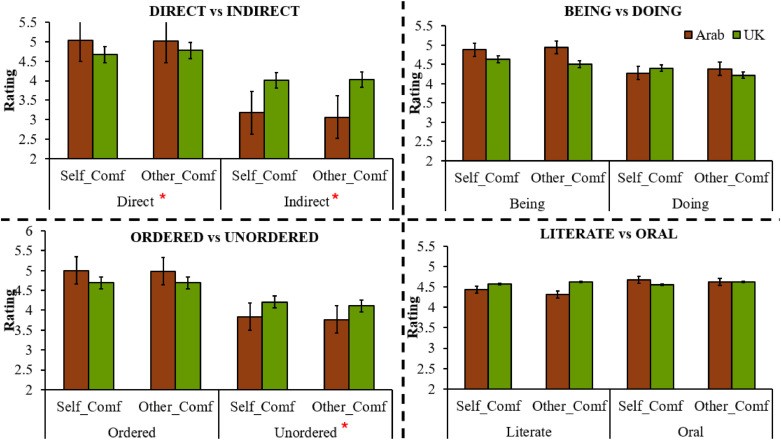
Since there was no interaction between Country and Person in either mode, we re-ran the analysis for each mode and Person, comparing Conditions between countries. The results are summarised in Fig. 1, Fig. 2 (detailed analyses are reported in Supplementary Materials).
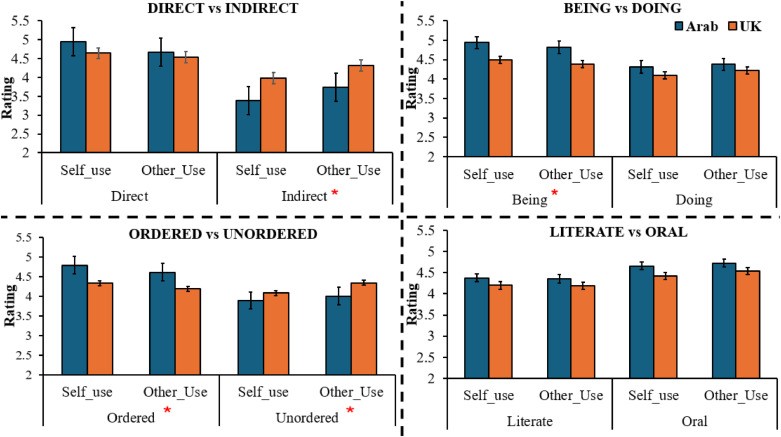
The mean ratings for the use of communication styles between Arab and UK are presented in Fig. 1. In this section, only statistically significant comparisons are discussed and other results are available in Supplementary Materials (Table 4). UK participants significantly showed a higher mean rating for self-use (MD = −0.60, t = −5.91, Pbonf: <0.001) and others use (MD = −0.58, t= −6.13, Pbonf: <0.001) of indirect communication than Arab. Moreover, Arab showed a significant preference than UK in using the ordered communication style in both self-use (MD = 0.46, t = 4.59, Pbonf: <0.001) and others (MD= 0.42, t = 4.46, Pbonf = 0.001). However, UK participants showed significant preference to other use of unordered communication style (MD = −0.34, t = −3.59, Pbonf = 0.04) than the Arab. In addition, Arab participants showed a significant preference for the use of being communication styles, for both self-use and others-use (MD = 0.44, t = 4.30, Pbonf = 0.002) and (MD = 0.44, t = 4.69, Pbonf <0.001), respectively.
As expected, Arab participants indicated the higher comfort levels with the use of direct communication, for self-use (MD = 0.37, t = 3.71, Pbonf = 0.03), compared to UK participants (Fig. 2). Morover, UK participants were more comfortable with using indirect communication themselves (MD = −0.92, t = −9.19, Pbonf = <0.001) and others using it (MD = −0.97, t = −9.75, Pbonf = <0.001) than Arab. UK particpants reported being more comfortable with self use of unordered communication style (MD = −0.37, t = −3.70, Pbonf = 0.03), than Arab, other results are available in Supplementary Materials (Table 4).