Public Speaking in the Twenty-First Century
| Site: | Saylor University |
| Course: | COMM101: Public Speaking |
| Book: | Public Speaking in the Twenty-First Century |
| Printed by: | Guest user |
| Date: | Tuesday, 27 October 2026, 9:22 PM |
Description
- 1a Identify the three most common types of public speaking (CLO 6)
Public Speaking in the Twenty-First Century

Insider Secrets of Public Speaking.
Public speaking is the process of designing and delivering a message to an audience. Effective public speaking involves understanding your audience and speaking goals, choosing elements for the speech that will engage your audience with your topic, and delivering your message skillfully. Good public speakers understand that they must plan, organize, and revise their material in order to develop an effective speech. This book will help you understand the basics of effective public speaking and guide you through the process of creating your own presentations. We'll begin by discussing the ways in which public speaking is relevant to you and can benefit you in your career, education, and personal life.
In a world where people are bombarded with messages through television, social media, and the Internet, one of the first questions you may ask is, "Do people still give speeches?" Well, type the words "public speaking" into Amazon.com or Barnesandnoble.com, and you will find more than two thousand books with the words "public speaking" in the title. Most of these and other books related to public speaking are not college textbooks. In fact, many books written about public speaking are intended for very specific audiences: A Handbook of Public Speaking for Scientists and Engineers (by Peter Kenny), Excuse Me! Let Me Speak!: A Young Person's Guide to Public Speaking (by Michelle J. Dyett-Welcome), Professionally Speaking: Public Speaking for Health Professionals (by Frank De Piano and Arnold Melnick), and Speaking Effectively: A Guide for Air Force Speakers (by John A. Kline). Although these different books address specific issues related to nurses, engineers, or air force officers, the content is basically the same. If you search for "public speaking" in an online academic database, you'll find numerous articles on public speaking in business magazines (e.g., BusinessWeek, Nonprofit World) and academic journals (e.g., Harvard Business Review, Journal of Business Communication). There is so much information available about public speaking because it continues to be relevant even with the growth of technological means of communication. As author and speaker Scott Berkun writes in his blog, "For all our tech, we're still very fond of the most low tech thing there is: a monologue". People continue to spend millions of dollars every year to listen to professional speakers. For example, attendees of the 2010 TED (Technology, Entertainment, Design) conference, which invites speakers from around the world to share their ideas in short, eighteen-minute presentations, paid six thousand dollars per person to listen to fifty speeches over a four-day period.
Technology can also help public speakers reach audiences that were not possible to reach in the past. Millions of people heard about and then watched Randy Pausch's "Last Lecture" online. In this captivating speech, Randy Pausch, a Carnegie Mellon University professor who retired at age forty-six after developing inoperable tumors, delivered his last lecture to the students, faculty, and staff. This inspiring speech was turned into a DVD and a best-selling book that was eventually published in more than thirty-five languages.
We realize that you may not be invited to TED to give the speech of your life or create a speech so inspirational that it touches the lives of millions via YouTube; however, all of us will find ourselves in situations where we will be asked to give a speech, make a presentation, or just deliver a few words. In this chapter, we will first address why public speaking is important, and then we will discuss models that illustrate the process of public speaking itself.
Source: University of Minnesota
View original source.
 This work is licensed under a Creative Commons Attribution-NonCommercial-ShareAlike 3.0 License.
Why Is Public Speaking Important?
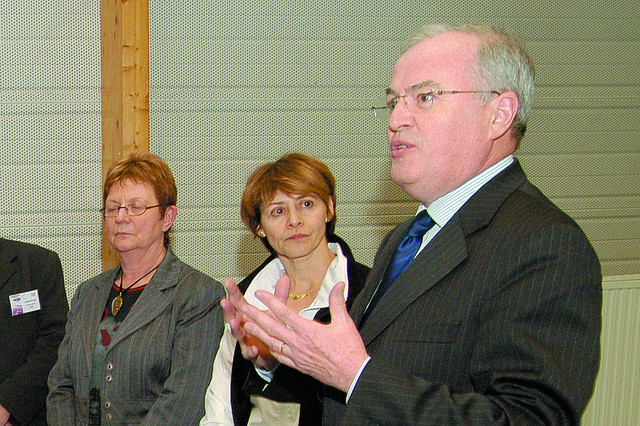
Christian Pierret
In today's world, we are constantly bombarded with messages both good and bad. No matter where you live, where you work or go to school, or what kinds of media you use, you are probably exposed to hundreds. if not thousands, of advertising messages every day. Researcher Norman W. Edmund estimates that by 2020 the amount of knowledge in the world will double every seventy-three days. Because we live in a world where we are overwhelmed with content, communicating information in a way that is accessible to others is more important today than ever before. To help us further understand why public speaking is important, we will first examine public speaking in everyday life. We will then discuss how public speaking can benefit you personally.
Everyday Public Speaking
Every single day people across the United States and around the world stand up in front of some kind of audience and speak. In fact, there's even a monthly publication that reproduces some of the top speeches from around the United States called Vital Speeches of the Day (http://www.vsotd.com). Although public speeches are of various types, they can generally be grouped into three categories based on their intended purpose: informative, persuasive, and entertaining.
Informative Speaking
One of the most common types of public speaking is informative speaking. The primary purpose of informative presentations is to share one's knowledge of a subject with an audience. Reasons for making an informative speech vary widely. For example, you might be asked to instruct a group of coworkers on how to use new computer software or to report to a group of executives how your latest project is coming along. A local community group might wish to hear about your volunteer activities in New Orleans during spring break, or your classmates may want you to share your expertise on Mediterranean cooking. What all these examples have in common is the goal of imparting information to an audience.
Informative speaking is integrated into many different occupations. Physicians often lecture about their areas of expertise to medical students, other physicians, and patients. Teachers find themselves presenting to parents as well as to their students. Firefighters give demonstrations about how to effectively control a fire in the house. Informative speaking is a common part of numerous jobs and other everyday activities. As a result, learning how to speak effectively has become an essential skill in today's world.
Persuasive Speaking
A second common reason for speaking to an audience is to persuade others. In our everyday lives, we are often called on to convince, motivate, or otherwise persuade others to change their beliefs, take an action, or reconsider a decision. Advocating for music education in your local school district, convincing clients to purchase your company's products, or inspiring high school students to attend college all involve influencing other people through public speaking.
For some people, such as elected officials, giving persuasive speeches is a crucial part of attaining and continuing career success. Other people make careers out of speaking to groups of people who pay to listen to them. Motivational authors and speakers, such as Les Brown (http://www.lesbrown.com), make millions of dollars each year from their ability to persuade audiences. No matter what you think of Tracy, another professional speaker and author, specializes in helping business leaders become more productive and effective in the workplace (http://www.briantracy.com).
Whether public speaking is something you do every day or just a few times a year, persuading others is a challenging task. If you develop the skill to persuade effectively, it can be personally and professionally rewarding.
Entertaining Speaking
Entertaining speaking involves an array of speaking occasions ranging from introductions to wedding toasts, to presenting and accepting awards, to delivering eulogies at funerals and memorial services in addition to after-dinner speeches and motivational speeches. Entertaining speaking has been important since the time of the ancient Greeks, when Aristotle identified epideictic speaking (speaking in a ceremonial context) as an important type of address. As with persuasive and informative speaking, there are professionals, from religious leaders to comedians, who make a living simply from delivering entertaining speeches. As anyone who has watched the words the Atonement or has seen an incoherent best man deliver a wedding toast can attest, speaking to entertain is a task that requires preparation and practice to be effective.
Personal Benefits of Public Speaking
Oral communication skills were the number one skill that college graduates found useful in the business world, according to a study by sociologist Andrew Zekeri. That fact alone makes learning about public speaking worthwhile. However, there are many other benefits of communicating effectively for the hundreds of thousands of college students every year who take public speaking courses. Let's take a look at some of the personal benefits you'll get both from a course in public speaking and from giving public speeches.
Benefits of Public Speaking Courses
In addition to learning the process of creating and delivering an effective speech, students of public speaking leave the class with a number of other benefits as well. Some of these benefits include:
- developing critical thinking skills,
- fine-tuning verbal and nonverbal skills, and
- overcoming fear of public speaking.
Developing Critical Thinking Skills
One of the very first benefits you will gain from your public speaking course is an increased ability to think critically. Problem solving is one of many critical thinking skills you will engage in during this course. For example, when preparing a persuasive speech, you'll have to think through real problems affecting your campus, community, or the world and provide possible solutions to those problems. You'll also have to think about the positive and negative consequences of your solutions and think your ideas through before presenting them. At first, it may seem easy to come up with solutions to a campus problem such as a shortage of parking spaces: build more spaces. But after thinking and researching further you may find out that building costs, environmental impact from loss of green space, maintenance needs, or limited locations for expansion could make this solution impractical. Being able to examine problems from multiple angles and determine the best possible solutions is an essential part of critical thinking and of public speaking aimed at persuading others. These skills will help you not only in public speaking contexts but throughout your life as well. As we stated earlier, college graduates in Zekeri's study rated oral communication skills as the most useful for success in the business world. The second most valuable skill they reported was problem-solving ability, so your public speaking course is doubly valuable!
Another benefit to public speaking is that it will enhance your ability to conduct and analyze research. Public speakers must provide credible evidence within their speeches if they are going to persuade various audiences. So your public speaking course will further refine your ability to find and utilize a range of sources.
Fine-Tuning Verbal and Nonverbal Skills
A second benefit of taking a public speaking course is that it will help you fine-tune your verbal and nonverbal communication skills. Whether you competed in public speaking in high school or this is your first time speaking in front of an audience, having the opportunity to actively practice communication skills and receive professional feedback will help you become a more polished communicator. Often, people don't even realize that they twirl their hair or repeatedly mispronounce words while speaking in public settings until they receive feedback from a teacher during a public speaking course. People around the United States will often pay speech coaches over one hundred dollars an hour to help them enhance their speaking. You may have a built-in speech coach right in your classroom, so it is to your advantage to use the opportunity to improve your verbal and nonverbal communication skills.
Overcoming Fear of Public Speaking
An additional benefit of taking a public speaking class is that it will help reduce your fear of public speaking. Whether they've spoken in public a lot or are just getting started, most people experience some anxiety when engaging in public speaking. Hack man and Andrew (2004) studied students' levels of public speaking anxiety during both the first and last weeks of their public speaking class and found that those levels decreased over the course of the semester. One explanation is that people who practice speaking improve their responses to public speaking. By participating in class, students become better acquainted with the public speaking process, making them more confident and less apprehensive. In addition, you will learn specific strategies for overcoming the challenges of speech anxiety.
Benefits of Engaging in Public Speaking
Once you've learned the basic skills associated with public speaking, you'll find that being able to effectively speak in public has profound benefits, including:
- influencing the world around you,
- developing leadership skills, and
- becoming a thought leader.
Influencing the World around You
If you don't like something going on in your local government, then speak out about your issue! One of the best ways to get our society to change is through the power of speech. Common citizens in the United States and around the world, like you, are influencing the world in real ways through the power of speech. Just type the phrase "citizens speak out" in a search engine and you'll find numerous examples of how common citizens use the power of speech to make real changes in the world - for example, by speaking out against "fracking" for natural gas (a process in which chemicals are injected into rocks in an attempt to open them up for fast flow of natural gas or oil). And even if you're not interested in something that's affecting parts of society you don't like, there may be things you're dying for others to speak out, which is a luxury many people in the world do not have. So if you don't like something, be the force of change you're looking for through the power of speech.
Developing Leadership Skills
If you dream of climbing the corporate or local government ladder and eventually finding yourself in a management or leadership position? If so, then public speaking skills are very important. Hackman and Johnson assert that effective public speaking skills are a necessity for all leaders. If you want people to follow you, you must be able to speak effectively and clearly what direction you want others to follow. "Successful leadership comes from knowing what matters to you. Powerful presentations come from expressing this effectively. It's important to develop both". One of the most important skills for leaders to develop is their public speaking skills, which is why executives spend millions of dollars every year going to public speaking workshops; hiring public speaking coaches; and buying public speaking books, CDs, and DVDs.
Becoming a Thought Leader
Even if you are not in an official leadership position, effective public speaking can help you become a "thought leader". Joel Kurtzman, editor of Strategy & Business, coined this term to call attention to individuals who contribute new ideas to the world of business. According to business consultant Ken Lizotte, "when your colleagues, prospects, and customers come to see you as one very smart guy or gal to know, then you're a thought leader". Typically, thought leaders engage in a range of behaviors, including enacting and conducting research on business practices. To achieve thought leader status, individuals must communicate their ideas to others through both writing and public speaking. Lizotte demonstrates that becoming a thought leader can be personally and financially rewarding at the same time: when others look to you as a thought leader, you will be more desired and make more money as a result. Business gurus often refer to "intellectual capital," or the importance of your knowledge and ability to communicate that knowledge to others. Whether that knowledge is best communicated through carefully discussing the next great trend in business or delivering a seminar (or seminar over the web), thought leaders use public speaking every day to create the future that the rest of us live in.
Key Takeaways
- People have many reasons for engaging in public speaking, but the skills necessary for public speaking are applicable whether someone is speaking for informative, persuasive, or entertainment reasons.
- Taking a public speaking class will improve your speaking skills, help you be a more critical thinker, fine-tune your verbal and nonverbal communication skills, and help you overcome public speaking anxiety.
- Effective public speaking skills have many direct benefits for the individual speaker, including influencing the world around you, developing leadership skills, and becoming a go-to person for ideas and solutions.
Exercises
- Talk to people who are currently working in the career you hope to pursue. Of the three types of public speaking discussed in the text, which do they use most commonly in their work?
- Read one of the free speeches available at http://www.vsotd.com. What do you think the speaker was trying to accomplish? What was her or his reason for speaking?
- Which personal benefit are you most interested in receiving from a public speaking class? Why?