Sampling Distribution of p
| Site: | Saylor University |
| Course: | MA121: Introduction to Statistics |
| Book: | Sampling Distribution of p |
| Printed by: | Guest user |
| Date: | Tuesday, 27 October 2026, 3:40 PM |
Description
 buttons.
Sampling Distribution of p
Assume that in an election race between Candidate \(A\) and Candidate \(B, 0.60\) of the voters prefer Candidate \(A\). If a random sample of \(10\) voters were polled, it is unlikely that exactly \(60 \%\) of them \((6)\) would prefer Candidate \(A\). By chance the proportion in the sample preferring Candidate \(A\) could easily be a little lower than \(0.60\) or a little higher than \(0.60\). The sampling distribution of \(p\) is the distribution that would result if you repeatedly sampled \(10\) voters and determined the proportion \((p)\) that favored Candidate \(A\).
The sampling distribution of \(p\) is a special case of the sampling distribution of the mean. Table 1 shows a hypothetical random sample of \(10\) voters. Those who prefer Candidate \(A\) are given scores of \(1\) and those who prefer Candidate \(B\) are given scores of \(0\). Note that seven of the voters prefer candidate \(A\) so the sample proportion \((\mathrm{p})\) is
\(p=7 / 10=0.70\)
As you can see, \(p\) is the mean of the \(10\) preference scores.
Table 1. Sample of voters.
| Voter | Preference |
|---|---|
| 1 | 1 |
| 2 | 0 |
| 3 | 1 |
| 4 | 1 |
| 5 | 1 |
| 6 | 0 |
| 7 | 1 |
| 8 | 0 |
| 9 | 1 |
| 10 | 1 |
The distribution of \(\mathrm{p}\) is closely related to the binomial distribution. The binomial distribution is the distribution of the total number of successes (favoring) Candidate \(A\), for example) whereas the distribution of \(p\) is the distribution of the mean number of successes. The mean, of course, is the total divided by the sample size, \(N\). Therefore, the sampling distribution of \(p\) and the binomial distribution differ in that \(p\) is the mean of the scores \((0.70)\) and the binomial distribution is dealing with the total number of successes (7).
The binomial distribution has a mean of:
\(\mu=N \Pi\)
Dividing by \(N\) to adjust for the fact that the sampling distribution of \(p\) is dealing with means instead of totals, we find that the mean of the sampling distribution of \(p\) is:
\(\mu_{\mathrm{p}}=\Pi\)
The standard deviation of the binomial distribution
is:
\(\sqrt{N \pi(1-\pi)}\)
Dividing by \(N\) because \(p\) is a mean not a total, we find the standard error of \(p\):
\(\sigma_{p}=\frac{\sqrt{N \pi(1-\pi)}}{N}=\sqrt{\frac{\pi(1-\pi)}{N}}\)
Returning to the voter example, \(\Pi=0.60\) and \(N=10\). (Don't confuse \(\Pi=0.60\), the population proportion and \(p=0.70\), the sample proportion.) Therefore, the mean of the sampling distribution of \(\mathrm{p}\) is \(0.60\). The standard error is
\(\sigma_{p}=\sqrt{\frac{0.60(1-.60)}{10}}=0.155\)
The sampling distribution of \(\mathrm{p}\) is a discrete rather than a continuous distribution. For example, with an \(N\) of \(10\), it is possible to have a \(p\) of \(0.50\) or a \(p\) of \(0.60\) but not a \(p\) of \(0.55\).
The sampling distribution of \(p\) is approximately normally distributed if \(N\) is fairly large and \(\pi\) is not close to \(0\) or \(1\). A rule of thumb is that the approximation is good if both \(\mathrm{N} \pi\) and \(\mathrm{N}(1-\pi)\) are greater than \(10\). The sampling distribution for the voter example is shown in Figure 1. Note that even though \(N(1-\pi)\) is only \(4\), the approximation is quite good.
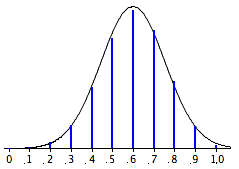
Figure 1. The sampling distribution of
\(p\). Vertical bars are the probabilities; the smooth curve
is the normal approximation.
Source: David M. Lane, https://onlinestatbook.com/2/sampling_distributions/samp_dist_p.html This work is in the Public Domain.
Video
Questions
Question 1 out of 3.
The binomial distribution is the distribution of the total number of successes whereas the distribution of \(p\) is:
- the distribution of the mean number of successes
- the distribution of the total number of failures
- the distribution of the ratio of successes to failures
- a distribution with a mean of \(.5\)
Question 2 out of 3.
Out of \(300\) students in the school, \(225\) passed an exam. What would be
the mean of the sampling distribution of the proportion of students who
passed the exam in the school?
Question 3 out of 3.
Out of \(300\) students in the school, \(225\) passed an exam. You take a
sample of \(10\) of these students. What is the standard error of \(p\)?
Answers
-
The distribution of the mean number of successes
The sampling distribution of \(p\) is the distribution of the mean number of successes. It has a mean equal to the population proportion.
-
\(.75\)
The mean of the sampling distribution of \(p\) is equal to the population proportion. It is \(225/300 = .75\).
-
\(.137\)
The standard error of \( p = \sqrt[p(1-p)/N] = \sqrt[(.75)(.25)/10] = .137 \)