Conflict
- 2d Explain four ways to deal with conflict in intercultural interactions (CLO 1, CLO 4)
- 2e Apply the four-skills model to intercultural conflict management (CLO 4, CLO 6)
Two General Approaches to Managing Conflict
Ways of naming and framing vary across cultural boundaries. People generally deal with conflict in the way that they learned while growing up. For those accustomed to a calm and rational discussion, screaming and yelling may seem to be a dangerous conflict. Yet, conflicts are subject to different interpretations, based on cultural preference, context, and facework ideals.
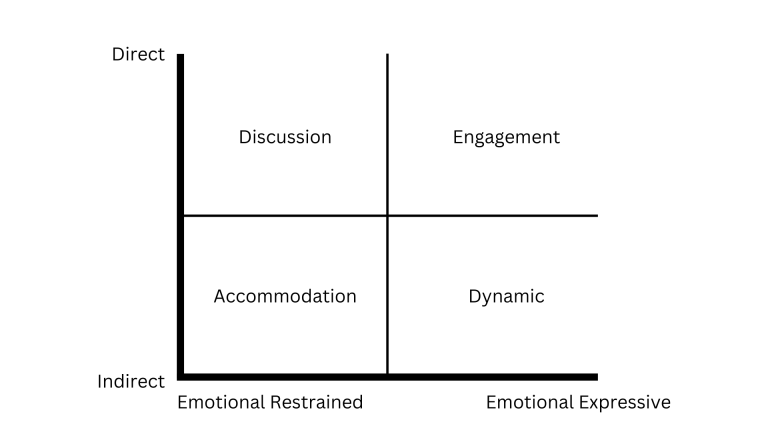
Cultures generally take two general approaches to managing conflict. There is a choice made between directly or indirectly approaching conflict and being emotionally expressive or emotionally restrained.
Direct or Indirect Approach
Direct Approaches are favored by cultures that think conflict is a good thing, and that conflict should be approached directly because working through conflict results in more solid and stronger relationships. This approach emphasizes using precise language, and articulating issues carefully. The best solution is based on solving for set of criteria that has been agreed upon by both parties beforehand.
Indirect Approaches on the other hand are favored by cultures that view conflict as destructive for relationships and prefer to deal with conflict indirectly. These cultures think that when people disagree, they should adapt to the consensus of the group rather than engage in conflict. Confrontations are seen as destructive and ineffective. Silence and avoidance are viewed as effective tools to manage conflict. Intermediaries or mediators are used when conflict negotiation is unavoidable, and people who undermine group harmony may face sanctions or ostracism.
Emotionally Expressive or Emotionally Restrained Approach
Emotionally Expressive people or cultures are those who value intense displays of emotion during disagreement. Outward displays of emotion are seen as indicating that one cares and is committed to resolving the conflict. It is thought that it is better to show emotion through expressive nonverbal behavior and words than to keep feelings inside and hidden from the world. Trust is gained through the sharing of emotions, and sharing is necessary for credibility.
Emotionally Restrained people or cultures are those who think that disagreements are best discussed in an emotionally calm manner. Emotions are controlled through "internalization" and few, if any, verbal or nonverbal expressions will be displayed. A sensitivity to hurting feelings or protecting the face or honor of the other is paramount. Trust is earned through what is seen as emotional maturity, and that maturity is necessary to appear credible.