
Conflict Resolution in Intercultural Communication
Results
Experiment Results: Managing Intercultural Conflict
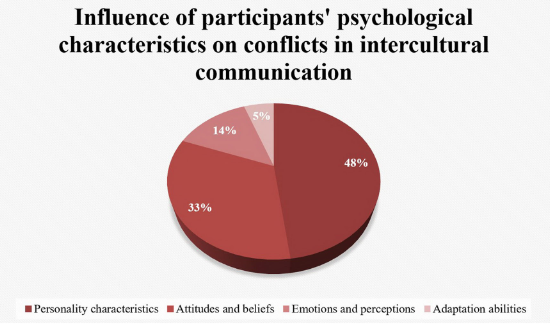
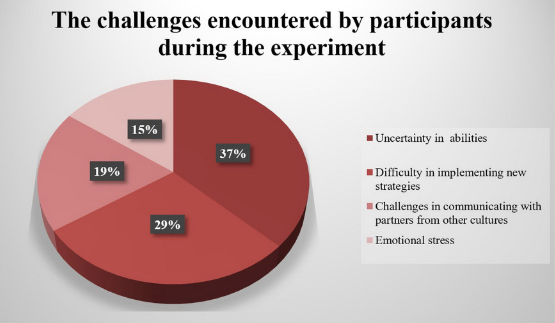
What the results show. The experimental group — trained in active-listening and cooperation strategies — resolved intercultural conflicts more successfully than the control group, a difference confirmed as statistically significant (Tables 2–3). The findings also rank the psychological factors behind conflict (Fig. 1), the challenges participants faced (Fig. 2), and the effectiveness of several conflict-management strategies and virtual training tools (Tables 4–5).
Upon analyzing the experiment results, it was determined that participants in the control group noted that their ability to manage conflicts in intercultural communication was at a satisfactory level. They believe that to improve these skills, it is important to conduct more practical exercises and training sessions. Conversely, participants in the experimental group observed positive changes in their approach to conflict management. They utilized active listening and cooperation strategies, which facilitated conflict resolution and improved relationships. Participants also noted that participation in the experiment changed their perception of intercultural conflicts; they no longer consider them an integral part of international communication and understand that with the right strategies, they can be successfully resolved or even avoided (Table 2).
The mean value in the group that used these strategies (75) was significantly higher than in the control group (70), indicating a more successful resolution of conflicts by the participants of the experimental group. The t-statistic, approximately 8.66, indicates that the difference between the mean values of the two groups is statistically significant. These results demonstrate the significant impact of using specific conflict management strategies on the effectiveness of resolving intercultural conflicts. Therefore, the use of specific conflict management strategies contributes to the improvement of intercultural conflict resolution. These defined results underscore the importance of considering cultural peculiarities and employing adaptive strategies for successful interaction in intercultural environments (Table 3 and Fig. 1).
The research results indicate that the psychological and cultural characteristics of participants in intercultural communication significantly impact the emergence of conflicts. Personality traits (48%) emerged as the most important factor. This suggests that individuals with different personality traits may react differently to cultural differences. For example, individuals with high levels of openness may more easily perceive and understand other cultures, thereby reducing the likelihood of conflicts.
Attitudes and beliefs (33%) also have a significant impact. People with an open attitude towards other cultures are generally more tolerant and less prone to conflicts.
Adaptability skills (15%) proved to be important, as they determine how quickly and successfully a person can adapt to new cultural conditions.
Emotions and perceptions (14%) were found to be less significant factors, but they can also influence the emergence of conflicts. For example, positive emotions and curiosity can contribute to positive interaction, while negative emotions, such as fear or discomfort, can lead to conflicts (Fig. 2).
Student’s t-test comparing the control and experimental groups on sample size, mean, and standard deviation, with the resulting t-statistic and p-value.
| Control group |
Experimental group |
t-statistics | р-value | |
|---|---|---|---|---|
| Sample size | 73 | 73 | ||
| Mean value | 70 | 75 | ||
| Standard deviation |
12 | 10 | ||
| t-statistic | t ≈ 8.66 | |||
| р-value | <0.05 |
Parameters of the t-test used to compare the two groups: degrees of freedom, significance level, critical t-value, and the obtained t-statistic.
| Value | |
|---|---|
| Degrees of freedom | 144 |
| Level of significance | 0.05 |
| Critical t-value | ±1.976 |
| t-statistic value | 8.66 |
These results indicate that participants in the experiment encountered various challenges in resolving conflicts in intercultural communication. They experienced uncertainty in their abilities (37%), difficulty in implementing new strategies (29%), challenges in communicating with partners from other cultures (19%), and emotional stress (15%). These difficulties underscore the importance of further developing conflict management skills and intercultural communication for effective interaction in international contexts.
Table 4 indicates the effectiveness of various strategies for managing cultural conflicts in intercultural communication, emphasizing that the use of active listening and cooperation strategies can be highly beneficial in understanding the perspectives of other cultures and seeking mutually beneficial solutions. It also highlights the effectiveness of the compromise strategy in finding compromise solutions and the relationship-building strategy for supporting dialog and collaboration. The teaching strategy, which demonstrates the advantages of both approaches, can also be effective. However, each of these strategies has its limitations and requires careful selection depending on the specific situation and the needs of the conflict participants. The analysis of the table on the effectiveness of using virtual applications in the experiment on managing cultural conflicts in intercultural communication indicates varying degrees of acceptability and usefulness of these tools for participants (Table 5). Virtual Reality Diversity Training and Talaera received the highest ratings, indicating their great potential to reduce conflicts and enhance communication effectiveness in intercultural contexts. Meanwhile, Kwema received the lowest ratings, suggesting its limited utility for the experiment participants. CultureMee and Cultural Detective mostly received average ratings, indicating that participants considered these applications less effective compared to other options. These results are important for the further development of virtual conflict management tools and the enhancement of cultural sensitivity in intercultural communication.
Three conflict-management strategies rated for effectiveness, each with its advantages and disadvantages.
| Strategy | Effectiveness | Advantages | Disadvantages |
|---|---|---|---|
| Active listening and cooperation | High | Facilitates understanding and collaboration | Requires time and effort for effective implementation |
| Compromise | Medium | Reaches a consensus quickly | May lead to dissatisfaction from either party with the outcome |
| Relationship building | Medium | Supports dialog and collaboration in the future | Requires time and effort to build trust and understanding |
Five virtual applications used in the experiment, each with a description and the share of participants who rated it high, average, or low.
| Application | Description | Participants Assessment |
|---|---|---|
| CultureMee | Provides access to information about cultures of different countries, including advice on cultural differences and exercises for developing cultural sensitivity. | High 47% Average 36% Low 17% |
| Talaera | An online platform with training in intercultural communication and leadership, aimed at reducing conflicts and increasing communication effectiveness. | High 58% Average 27% Low 15% |
| Virtual Reality Diversity Training | Software that utilizes virtual reality to simulate cultural situations and teach cultural sensitivity. | High 64% Average 19% Low 17% |
| Cultural Detective | An interactive tool that helps identify and understand cultural beliefs and values, promoting better understanding. | High 29% Average 54% Low 17% |
| Kwema | A safety application that allows quick contact with support services in emergency situations, useful for intercultural travel. | High 3% Average 20% Low 77% |