
Scandinavian Cultures in the Workplace
- 4c Evaluate the outcomes of interpersonal interactions between people of different cultures (CLO 1, CLO 3, CLO 4)
The Impact of Worldviews
Worldviews are also an important part of the cultural context and are a factor that affects communication. They are comprehensive ideas about how the world works, which influence how we understand phenomena in everyday life, for example, various religious ideas. Worldview affects what we mean, how we attribute meaning to other people's statements, and trust (Ibrahim, 1991). Having different worldviews can significantly affect communication because it shapes how individuals perceive and interpret messages and how they express themselves. Worldviews are shaped by factors such as culture, religion, personal experiences, and values and can vary significantly between individuals and groups. When communicating with individuals who hold different worldviews, misunderstandings can occur due to differences in interpretation and expression. For example, a person from a collectivist culture may prioritize group harmony and avoid conflict, while a person from an individualistic culture may prioritize personal expression and assertiveness. This can lead to misinterpreting messages and a mismatch of expectations between the communicators.
Moreover, different worldviews can lead to differences in beliefs and values, further impacting communication. For example, someone who values honesty and directness may find it challenging to communicate with someone who prioritizes saving face or avoiding conflict. Additionally, differences in religious beliefs or cultural practices can impact communication, such as when certain topics or behaviors are considered taboo or disrespectful.
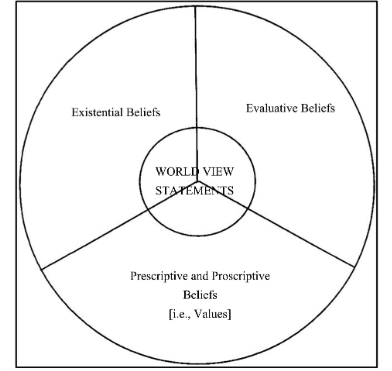
As seen in Figure 4, one can divide worldviews into three different kinds: conceptual relationships among beliefs, values, and worldview statements. The model divides worldviews into three types of beliefs. Existential beliefs are statements that describe entities that are believed to exist in the world; the second form of belief, the evaluative, refers to assertions made about people or acts that are evaluated; lastly, worldview assertions, such as "The thing to do in life is to live in the moment," are prescriptive or proscriptive. Worldviews involve ideals while also extending to other types of ideas. What way one views the world greatly impacts the way one communicates.
Figure 4. The three types of worldview statements.
A Scandinavian worldview can impact the style of communication used in Scandinavian cultures. Scandinavian cultures are, as mentioned earlier, often characterized by a strong emphasis on equality, social harmony, and consensus-building. This worldview is shaped by the region's history of democracy, social welfare, and egalitarian values. In communication this worldview is reflected in the Scandinavian style of communication, which is often characterized by directness, honesty, and an emphasis on mutual respect. Communication in Scandinavian cultures tends to be informal and egalitarian, with people addressing each other by their first names and avoiding titles or honorifics. The use of indirect language or euphemisms is also uncommon, as Scandinavians tend to value honesty and directness in communication. Moreover, the Scandinavian style of communication often emphasizes consensus-building and collaboration. This is reflected in decision-making processes, which tend to be participatory and democratic, emphasizing reaching a consensus and avoiding conflict. People in Scandinavian cultures also tend to be skilled at conflict resolution, using open communication and negotiation to find mutually beneficial solutions. The Scandinavian worldview and values shape the communication style used in Scandinavian cultures. Directness, honesty, and mutual respect are prioritized, and collaboration and consensus-building are emphasized. Understanding the values and worldviews of Scandinavian cultures is vital for effective communication, diversity management, and teamwork with people from this region and others around the world.
Recognizing and respecting different worldviews is important to minimize misunderstandings and promote effective communication. This involves developing cultural competency and being aware of cultural differences in values, beliefs, and communication styles. By doing so, individuals can better understand and appreciate different perspectives and communicate in ways that are respectful and effective across cultures.
Religion as a Part of Cultural Diversity
One area of conflict that has been widely discussed is religious symbols and expressions or religiously based behavior. This applies not only in the public sphere but also in the countries' labor markets. Freedom of religion and belief includes, among other things, the right to communicate one's religious beliefs. The core of freedom of religion and outlook on life can be expressed as the individual's right to have the faith or perspective on life they want and to practice it freely, alone or with others. In the United States of America, Title VII of the Civil Rights Act of 1964 prohibits harassment on the grounds of religion and requires the employer to work actively, purposefully, and systematically to avoid it. It states, "Title VII prohibits employment discrimination based on race, color, religion, sex, and national origin" The Civil Rights Act of 1991.
Religion has significantly impacted Scandinavian culture, particularly in the past, but its influence has decreased in recent years. The earliest religions in Scandinavia were paganism and mythology, with beliefs in gods and goddesses such as Odin, Thor, and Freya. These beliefs were integral to Scandinavian culture and shaped how people lived, with rituals and practices centered around these deities. However, with the arrival of Christianity in the region in the Middle Ages, the dominant religion shifted to Christianity, and over time, the old pagan beliefs were largely abandoned. Christianity significantly impacted Scandinavian culture and society with the establishment of churches, monasteries, and religious institutions. The Christian faith brought new values and beliefs, including the importance of forgiveness, charity, and humility, which have had a lasting impact on Scandinavian culture.
Figure 5. Graphical representation of the interactive religious experience Model (IREM)
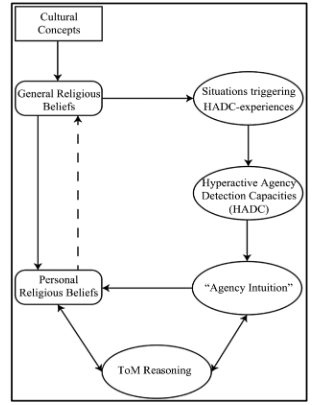
As showcased in Figure 5, those who follow certain religions tend to look for circumstances that will set off their hyperactive agency detection capacities (HADC). Similar representations would show analogous linkages for various socio-cognitive biases. The graphic highlights the pertinent relationships for examples of personal belief formation in which agency intuitions are at work. This goes to show how religion can impact the communication process. However, religion has become less influential in Scandinavian culture in recent years, with many people identifying as atheists or agnostics. This shift has been reflected in changes to social and cultural norms, with more emphasis on secularism, individualism, and progressive social policies. Religion has significantly impacted Scandinavian culture throughout history, and its influence has diminished in recent years as the region has become more secular and individualistic. Nonetheless, the cultural heritage and traditions associated with the Scandinavian religion continue to be an important part of the region's identity and history.
Scandinavian societies have been successful in reducing discrimination based on religion for several reasons. First, the Nordic model of social democracy, which prioritizes social welfare and equality, has played a significant role in reducing discrimination. By ensuring that all members of society have access to basic human needs and services, regardless of their religion or ethnicity, Scandinavian societies have reduced inequality and promoted social cohesion. Second, Scandinavian societies have a strong tradition of human rights and tolerance, which has helped to create an inclusionary environment that is more accepting of diversity. This tolerance is reflected in laws that protect individual rights and social norms that promote respect for different cultures and religions. Third, Scandinavian societies have a high level of education and literacy, which has helped to promote critical thinking and a greater understanding of different cultures and religions. This has helped to reduce stereotypes and misconceptions and has contributed to a more open and inclusive society. Finally, the relatively homogenous population of Scandinavia has also played a role in reducing discrimination based on religion. With a small number of minority religious groups, there is less opportunity for discrimination to occur and a greater sense of shared identity and culture among the population. The combination of social welfare policies, human rights, tolerance, education, and literacy, and a relatively homogenous population has helped create an environment where discrimination based on religion is less prevalent in Scandinavian societies.
Interaction between Factors
Social factors influence communication, such as identity, roles, class, norms, and values; these can also vary across cultural contexts. The interaction between these factors can be very complex. In some cases, social status or class will be what characterizes communication most, while in other cases, gender will be what is most prominent.
One key social factor affecting communication is social status or power. People with higher social status or power are given more respect and attention in many societies, and their opinions and perspectives are often valued more highly. This can impact communication by leading to unequal exchanges, with those in lower social status or power feeling less able to express themselves or challenge the views of those in positions of authority.
Cultural norms and values are also important social factors that influence communication. Different cultures may have different expectations for how communication should take place, such as whether it should be direct or indirect, involve a lot of nonverbal cues, or prioritize individual or collective goals. These differences can lead to misunderstandings and conflicts when people from different cultures interact.
Gender is another social factor that can affect communication. In many societies, gender roles and expectations can influence how men and women communicate, with men being socialized to be more assertive and dominant and women being socialized to be more accommodating and nurturing. This can lead to gender-based differences in communication styles, with men more likely to interrupt or dominate conversations and women more likely to use indirect language and avoid confrontation. Finally, social relationships and contexts are also important factors that affect communication. The nature of the relationship between communicators and the social context in which communication takes place can impact how messages are perceived and interpreted. For example, communication between friends may be more casual and informal than communication between a boss and an employee, and communication in a public setting may be more formal and constrained than communication in a private setting. Social factors play a critical role in shaping communication, and understanding these factors is essential for effective and respectful communication across diverse social contexts.
Scandinavian social factors have a significant impact on communication styles in the region. One crucial social factor is the emphasis on equality and consensus-building, which is reflected in communication practices. In Scandinavian societies, there is a strong emphasis on treating everyone with respect and avoiding any behavior that could be seen as confrontational or hierarchical. This leads to an often-indirect communication style, with speakers using polite and euphemistic language to convey their message rather than being direct and assertive. Another important social factor in Scandinavian communication is the emphasis on collectivism and social responsibility. This can be seen in how Scandinavian societies prioritize the needs of the group over the needs of the individual. In communication, this emphasis on collectivism means that speakers are often focused on building consensus and finding solutions that benefit the group rather than promoting individual interests or achievements.
The use of nonverbal cues also reflects the emphasis on social equality and collectivism in Scandinavian communication. Eye contact, tone of voice, and other nonverbal cues signal respect and attention to the speaker and build rapport and understanding between communicators. Additionally, Scandinavians tend to avoid interrupting others and may frequently pause during a conversation to show that they are listening and considering the other person's perspective. Overall, the social factors of equality, collectivism, and social responsibility emphasized in Scandinavian societies significantly impact communication styles in the region. This leads to a communication style that is often indirect, focused on consensus-building, and reliant on nonverbal cues to convey respect and understanding.
Cross-cultural communication is a vital aspect of global business, and it requires a thorough understanding of cultural differences to communicate effectively with people from different backgrounds. Sometimes, specific policies can help employees effectively communicate face-to-face and digitally through social media platforms with customers, suppliers, and vendors. The Scandinavian region is culturally unique and requires particular attention regarding cross-cultural communication. Suggestions for effective communication with Scandinavians include understanding their cultural norms, values, and beliefs, such as their preference for equality and consensus in decision-making. Comparing Scandinavian culture to others, such as Japan and the United States, it is evident that culture varies and affects the communication process, proving that it is crucial to have intercultural communication skills. Additionally, learning some basic phrases in their language, such as hello and thank you, can demonstrate respect and help establish a positive rapport. In summary, effective cross-cultural communication with Scandinavians requires a deep understanding of their culture, values, and beliefs, which can ultimately lead to successful business relationships.