
Tourism
- 4c Evaluate the outcomes of interpersonal interactions between people of different cultures (CLO 1, CLO 3, CLO 4)
- 4d Analyze how popular culture and media impact intercultural communication (CLO 1, CLO 4)
Communication Challenges with Tourism
Coping with tourists can be a complex process involving social, political, and economic contexts. As such, this book will only introduce general topic areas. Valid questions exist about the ethics of resource consumption, power inequities, standard of living, and cost-benefit distribution along with the consequences of a culture becoming public property. From a communication studies perspective, the challenges we are concerned with involve attitudes of hosts/tourists, characteristics of tourist/host encounters, language issues, social norms, and culture shock.
Attitudes of Hosts and Tourists
Tourism acts as a vehicle to provide direct encounters between people of diverse cultural backgrounds; therefore, tourism is a social activity in which the relationship between hosts and guests is fundamental to the experience.
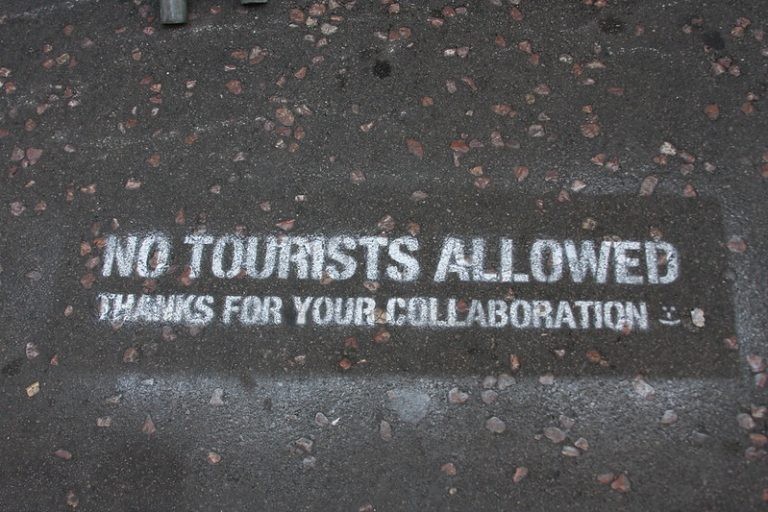
Traditionally, a host is a person who invites and receives visitors. In the tourist context, we refer to the people who live in the tourist region as hosts. Please remember that most hosts have not invited the tourist, nor do they particularly welcome them.
Hosts reflect four general attitudes towards tourists.
- One attitude of hosts towards tourists is retreatism. A host reflecting retreatism basically means that the host actively avoids contact with tourists by looking for ways to hide their everyday lives. Tourists may not be aware of this attitude because the host economy may be dependent upon tourism. Such dependence could possibly force the host community to accommodate tourists with tolerance. Hawaii is a place that depends heavily on tourism and often uses various forms of retreatism to cope with the huge number of tourists. Several students have noted that other than people who worked at restaurants or tourist attractions, they didn't see many locals when vacationing in Hawaii.

- Another attitude of hosts towards tourists is resistance. This attitude can be passive or aggressive. Passive resistance may include grumbling, gossiping about, or making fun of tourists behind their backs. Aggressive resistance often takes more active forms, such as pretending not to speak a language or giving incorrect information or directions. Deserved or not, the French have a reputation of tourist resistance. As Paris has been the number one city for international tourists in the world for many years, plus during the tourist season the population doubles or triples with visitors, it is not surprising that Parisians have developed a resistant attitude.

- Boundary maintenance is also a common way to regulate the interaction between hosts and tourists. This attitude is a common response by hosts who do not want a lot of interaction with tourists. A community may be dependent upon the economics of tourism but prefers to encounter tourists on a limited level–possibly only in specific locations or only with specific people. Many Native American tribes and First Nations people prefer to have visitors start at a tribal welcome center or museum before wandering around their reservations or traditional lands. All-to-common horror stories exist of tourists walking into private homes to meet "real Indians" and see how they live.
- Not all host attitudes are protective or negative. Some communities may capitalize on tourism and accept it as the social fabric of their community. Other communities actively invest money to draw tourists to create economic opportunities. Other communities passively accept community members who actively develop tourism opportunities to keep the community from dying. This attitude is called revitalization. Residents do not always share equally in the revitalization, but sometimes it does lead to pride in the re-discovery of community history and traditions. Dolly Parton's "Dollywood" located in Pigeon Forge, Tennessee was created to revitalize the community that she loved. Disneyland serves a similar function in Southern California.
Within the same community, hosts can have a variety of attitudes towards tourists. These differences can be major sources of conflict that cause on-going strife throughout the community. It's important that tourists be aware of their own attitudes towards tourism and acknowledge the cultural differences between hosts and tourists.
Characteristics of Tourist and Host Interactions
Much has been written about the characteristics of tourist and host encounters in all the various shapes and forms it occurs. The newest research tends to focus not on the encounter itself, but rather the context in which the encounter occurs. In general, there are a few concepts that are basic to tourist/host encounters from an intercultural perspective.
First, most encounters are very predictable and ritualistic because they are business transactions and nothing more. If you are thirsty, you can buy something to drink from a vendor, market, or restaurant. You ask as politely as you know how, exchange money, and receive a product. Once you have learned the ritual, you use it repeatedly throughout your visit.
Most tourists don't have time for lengthy interactions, which leads to fewer opportunities to authentically engage with the hosts. Package tours are infamous for short time schedules, but free-range tourists often try to fit in as many local attractions as they can in one day before moving to the next location. Such commodification leads to great Instagram pictures, but little time to interact with the locals on a meaningful level.
Another characteristic of the tourist/host encounter is that tourists are often - but not always–more economically and socially privileged than their hosts. Traveling can be expensive so tourists are often looking for a good deal or places where their money can go farther than at home. Maybe they splurge on something normally inaccessible to them at home, but within their budget as a tourist. Such actions are part of normal tourist expectations but can lead to power imbalances between hosts and tourists.
Research indicates that contact between hosts and tourists is significantly more positive if tourists slow down and take an interest in the country they are visiting and the culture they are experiencing. It is also clear that when hosts have the time and space to treat tourists like guests, while taking pride in their own communities, hosts are most likely to welcome interaction with tourists.
Language Challenges
Not surprisingly, language is often a problem for both hosts and tourists. No one can learn all the languages of the places they might visit or of the people who visit them. Perceptions of service, inability to interact, and the lack of language resources are all huge frustrations for both sides.
Host cultures often have very different expectations of tourists regarding language usage as well. Some host cultures expect tourists to use the host language in interactions whereas other host cultures believe that they should provide language assistance for tourists. Language difficulties are often the basis for culture shock experienced by both the host culture and the tourists.
Social Norms and Expectations
People do not behave randomly; they have been taught the social norms and expectations of their home culture. For example, people visiting a tourist site may avoid littering because the site is clean, because they have been taught to be environmentally responsible. Whereas the community may support recycling programs at the site because they believe that tourists are willing to pay extra for eco-friendly practices.
Social interaction in public ranges from informal to very formal from culture to culture. Most cultures have expectations for gender- and age-related interactions. Some accepted conventions may have speakers address status with a formal relational title such as "honored grandmother" or "small friend" whereas a more informal convention would be "Florence" and "Ryann". Social interaction norms may also be related to religious beliefs, traditions, politeness, and more.
Norms for shopping experiences also vary from culture to culture. One culture might be expecting that consumers touch the merchandise before buying it, but in other cultures touching might be forbidden until after the purchase. Bargaining might be the norm, and initial prices are given as higher than the expected purchase price or the price on the tag is the price you pay, and bargaining is not an option.
Communication styles (see the verbal chapter) also dictate how people act in public. Direct cultures will still ask questions that they want to know the answer for and expect to hear a direct answer. Indirect cultures will still avoid asking direct questions but strive to provide clues in the context of the situation. Some cultures value elaborate speakers and some value being concise. Conversations might involve grabbing a hand or arm to emphasize sincerity or avoidance of physical contact with others is expected. Information about the appropriate behavior is all around you. Observe what the host/tourists usually do and act accordingly.
Learn a little more!
10 Grocery Store Etiquette Rules in the United States
- Don't yell at the checker.
- Bring a reusable tote instead of one-use bags provided by the store.
- Children sometimes have a mind of their own, so parents are not always to blame.
- If you break it, you buy it.
- Ask for a mop if you make a mess.
- Don't judge the contents in the cart of someone else.
- If using a check, pre-write as much as you can while waiting.
- It's okay to avoid people you know if you don't have time to talk.
- Don't text and push a cart at the same time.
- When you are done, park your cart in a designated place.
HowStuffWorks.com (Curran, retrieved 7/30/19)

Cultural Dimensions
People from different cultures are different in their behavior and value systems. These differences have been discussed in greater depth other places in the book, but just as a reminder, tourism can bring out some significant differences of cultural dimensions. Individualism and collectivism will account for many differences, but differences in power distance, uncertainty avoidance, and masculinity/femininity can also be present. Time orientation such as future versus past-oriented can matter as well. Not to forget being verbally direct or verbally indirect and high or low context plays a part. Nonverbally, cultures use space, territory, and gestures differently. They can also be tight or loose.
In the relationship chapter, we discussed relationship attractors where the idea that people prefer to develop relationships (help, work, play, trust, and live) with people that they perceive are like themselves compared to persons who are seen as different also applies to tourists. Both hosts and tourists will characterize the other as either an in-grouper or an out-grouper.
Cultural value dimensions and orientations matter in all aspects of intercultural communication, but are especially influential in tourist-host interactions.
Culture Shock
Being in new cultural contexts can lead to culture shock and feelings of disorientation. Even the physical aspects of traveling (crossing time zones, changes in food, etc.) can be difficult for some tourists. One student mentioned experiencing culture shock as a naive 16-year-old in Mexico. She didn't understand the language and was freaked out by all the lizards in her room. She couldn't wait to get home and feel "normal".
Not all tourists experience culture shock. Many variables, including purpose of the trip, power dynamics, mental & physical health, and types of contact influence whether of culture shock occurs or not. New research proposes that culture shock can be negotiated at home before the trip even begins. An important issue to note is that when tourists do experience culture shock, they often take it out on the host community.
Although culture shock has already been discussed in greater depth in a previous chapter, it's important to remember that both hosts and tourists can experience culture shock. When hosts encounter new values and behaviors, they can reach a point of uncertainty and confusion as well. Researchers who examined culture shock experienced by host cultures noted higher incidence of alcoholism, depression, and minor psychiatric illness.