Understanding Financial Statements
- 4b Describe components of the income statement and balance sheet (CLO 5)
What If You Want to Make More Money?
You're quite relieved to see that you made a profit during your first month, but you can't help but wonder what you'll have to do to make even more money next month. You consider three possibilities:
- Reduce your cost of goods sold (say, package four toys instead of five)
- Reduce your operating costs (salaries, advertising, table rental)
- Increase the quantity of units sold
In order to consider these possibilities fully, you need to generate new income statements for each option. And to do that, you'll have to play a few "what-if" games. Because possibility #1 - packaging four toys instead of five - is the most appealing, you start there. Your cost of goods sold would go down from $6 to $5 per unit (4 toys at $1 each + 1 plastic treasure chest at $1). Figure 12.6 "Proposed Income Statement Number One for Stress-Buster Company" is your hypothetical income statement if you choose this option.
Figure 12.6 Proposed Income Statement Number One for Stress-Buster Company
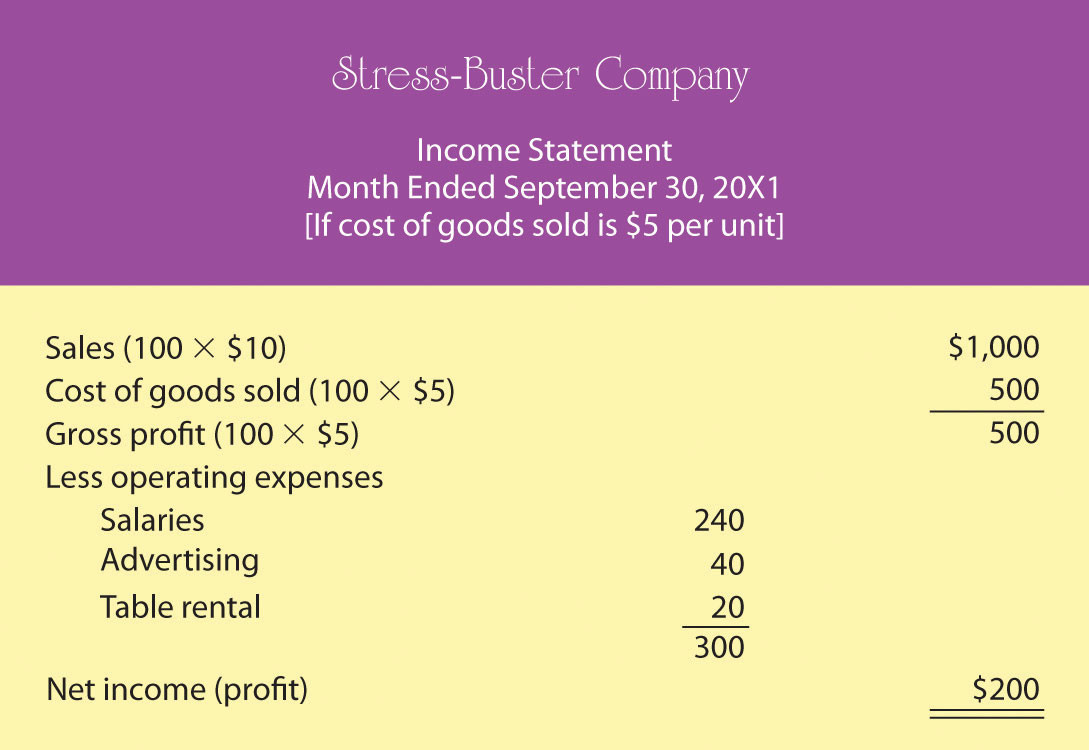
Possibility #1 seems to be a good idea. Under this scenario, your income doubles from $100 to $200 because your per-unit gross profit increases by $1 (and you sold 100 stress packs). But there may be a catch: If you cut back on the number of toys, your customers might perceive your product as a lesser value for the money. In fact, you're reminded of a conversation that you once had with a friend whose father, a restaurant owner, had cut back on the cost of the food he served by buying less expensive meat. In the short term, gross profit per meal went up, but customers eventually stopped coming back and the restaurant nearly went out of business.
Thus you decide to consider possibility #2 - reducing your operating costs. In theory, it's a good idea, but in practice - at least in your case - it probably won't work. Why not? For one thing, you can't do without the table and you need your workers (because your grades haven't improved, you still don't have time to sit at the table yourself). Second, if you cut salaries from, say, $6 to $5 an hour, you may have a hard time finding people willing to work for you. Finally, you could reduce advertising costs by running an ad every two weeks instead of every week, but this tactic would increase your income by only $20 a month and could easily lead to a drop in sales.
Now you move on to possibility #3 - increase sales. The appealing thing about this option is that it has no downside. If you could somehow increase the number of units sold from 100 Stress-Buster packs per month to 150, your income would go up, even if you stick with your original five-toy product. So you decide to crunch some numbers for possibility #3 and come up with the new "what-if" income statement in Figure 12.7 "Proposed Income Statement Number Two for Stress-Buster Company".
Figure 12.7 Proposed Income Statement Number Two for Stress-Buster Company
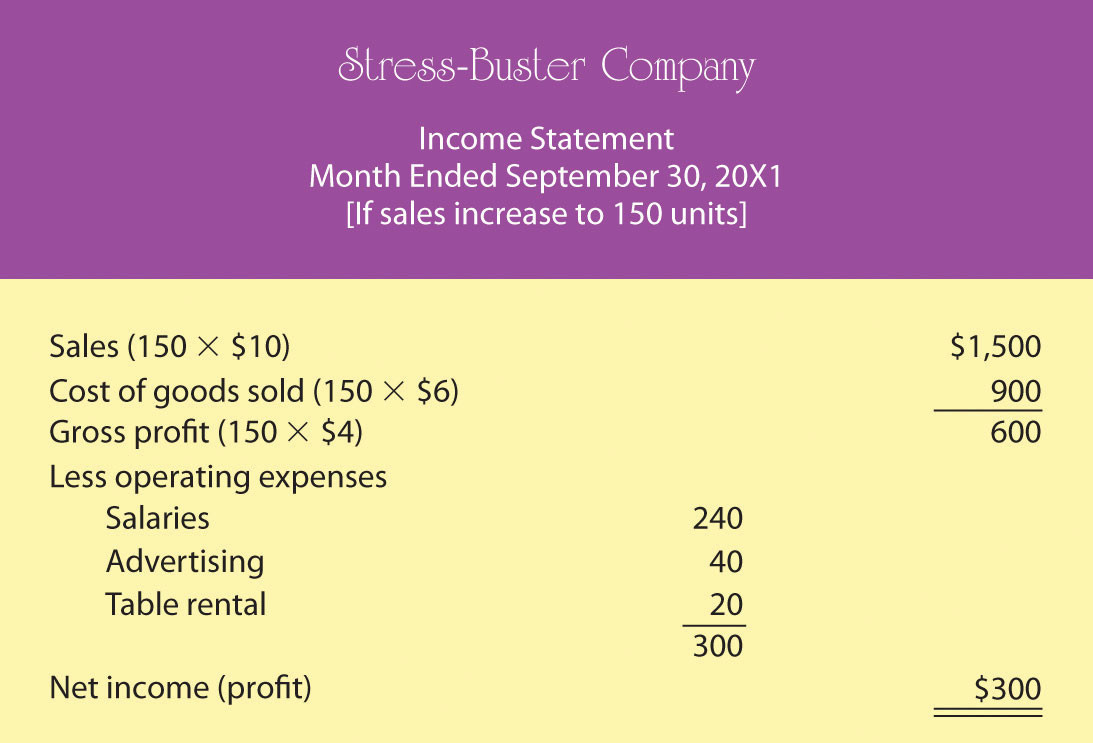
As you can see, this is an attractive possibility, even though you haven't figured out how you're going to increase sales (maybe you could put up some eye-popping posters and play cool music to attract people to your table. Or maybe your workers could attract buyers by demonstrating relaxation and stress-reduction exercises).