
The Delta Model
Discovering New Sources of Growth and Profitability in a Networked Economy
The Delta Model
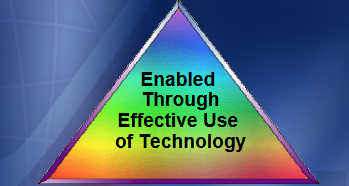
Three distinct strategic options:
1. System Lock-in:
- System economics
- Market dominance
- Achieving complementor share
2. Total Customer Solutions:
- Customer economics
- Cooperation
- Achieving customer share
3. Best Product
- Product economics
- Rivalry
- Achieving product share
The Triangle
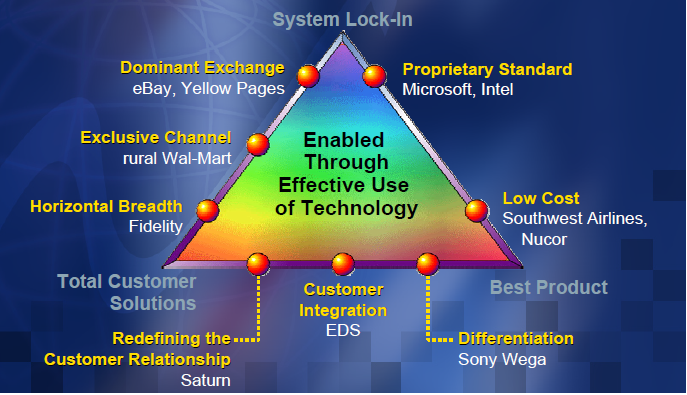
Options for strategic positioning:
Dominant Exchange: eBay, Yellow Pages
Proprietary Standard: Microsoft, Intel
Exclusive Channel: rural Wal-Mart
Horizontal Breadth: Fidelity
Low Cost: Southwest Airlines, Nucor
Redefining the Customer Relationship: Saturn
Customer Integration: EDS
Differentiation: Sony Wega
Delta Model Strategies
| Strategy | Description | Challenge/Limitations |
|---|---|---|
| Low Cost | Focus on being the lowest cost provider in an undifferentiated product category. | Since there is only one lowest-cost producer, this strategy leaves very little space as a competitive position. It also tends to standardize the product offering, commoditize the customer, and intensify rivalry. |
| Differentiation | While maintaining effective production economics, focus on key differentiation in product features and functionalities so that the products are unique, desired, and command price premiums. | The problem with this strategic position is that as soon as the differentiated product emerges, competitors tend to imitate them. A competitive advantage is therefore non-sustainable. |
| Strategy | Description | Benefit |
|---|---|---|
| Redefining the Customer Experience | Focus is placed on considering the full experience of the customer from the point of acquisition through to the complete lifecycle of ownership of the product. | This positioning is based upon an intimate knowledge of the customer base leading toward an effective customer segmentation and a differentiated treatment of the customer tiers. |
| Horizontal Breadth | A complete set of product and service offerings that fulfill the entire customer needs are customized and provided. "One-stop shopping for a unique solution." | We are seeking a dominant position in "share of the wallet of the customer." |
| Customer Integration | This strategy seeks to effectively substitute for or leverage activities currently performed by the customer. It is outsourcing in its extreme form and represents a complex web of connections with the customer that enhance their ability to do business and use your product. | The firm is regarded as a bundle of competencies that will be brought to the customer to enhance customer economics. |
| Strategy | Description | Challenge/Key Note |
|---|---|---|
| Restricted Access | Significant barriers are in place that make it difficult for competitors to compete for the acquisition of customers. | This is a difficult position to achieve and to sustain. Regulatory practices tend to be deployed to prevent it. |
| Dominant Exchange | The company provides an interface between buyers and sellers that is very hard to displace once it achieves critical mass. | This is the most accessible of all of the system lock-in options. The first mover advantage is critical. |
| Proprietary Standard | The customer is drawn to your product because of the extensive network of third-party complementors that are designed to work with your product. | This option isn't available in most industries. If it can be achieved, the rewards are enormous. |
The Challenge to Decommoditization
Transforming the organization from best product to total customer solutions, while seeking opportunities for System Lock-In.
Central Lessons
If the heart of strategy is the customer, an appropriate customer segmentation and a creative value proposition is often the most important critical step in strategic thinking. Be creative, be bold, be fast.
The winning formula is to have the overall network as your primary scope. Don't play the game alone. It is not just you serving the customer. It is you, your critical suppliers and the key complementors. In a large, diversified corporation often the most important complementors are in your own firm.
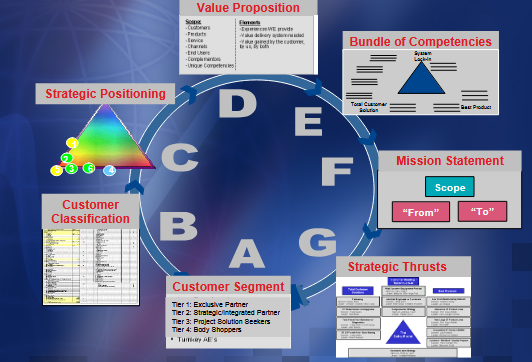
From the Customer Segmentation to Strategic Agenda
- Value Proposition
| Scope | Elements |
|---|---|
|
|
- Bundle of Competencies
- Mission Statement
(Scope, From, To) - Strategic Thrusts
- Customers Segment
- Customer Classification
Tier 1: Exclusive Partner
Tier 2: Strategic/Integrated Partner
Tier 3: Project Solution Seekers
Tier 4: Body Shoppers - Strategic positioning
Source: Arnoldo Hax,
http://ocw.mit.edu/courses/sloan-school-of-management/15-902-strategic-management-i-fall-2006/lecture-notes/deltamodel.pdf
 This work is licensed under a Creative Commons Attribution-NonCommercial-ShareAlike 4.0 License.