PHYS101: Introduction to Mechanics
Topic outline
-
Physics is the branch of science that explores the physical nature of matter and energy. Physicists examine the story behind our universe, which includes the study of mechanics, heat, light, radiation, sound, electricity, magnetism, and the structure of atoms. They study the events and interactions that occur among the elementary particles that make up our material universe. In this course, we study the physics of motion from the ground up – learning the basic principles of physical laws and their application to the behavior of objects. Classical mechanics studies statics, kinematics (motion), dynamics (forces), energy, and momentum developed before 1900 from the physics of Galileo Galilei and Isaac Newton. We encourage you to supplement what you learn here with the next Saylor Academy course in Physics, PHYS102: Introduction to Electromagnetism. Since mathematics is the language of physics, you should be familiar with high-school-level algebra, geometry, and trigonometry. We will develop a small amount of additional math and calculus that you will need to succeed during the course.
-
First, let's gain a basic understanding of the language and analytical techniques that are specific to physics. This unit presents a brief outline of physics, measurement units and scientific notation, significant figures, and measurement conversions.
Completing this unit should take you approximately 2 hours.
-
A scientific law briefly and succinctly describes an observed natural phenomenon or pattern. We often describe scientific laws as a single equation. For example, we describe one of Newton's Laws of Motion as
 . Because this is a brief, single equation, it is a law. Laws are supported by multiple, repeat experiments performed by different scientists over time.
A scientific theory also describes an observed natural phenomenon or pattern, but in a less succinct manner. We cannot describe theories as a single simple equation. Rather, they explain the phenomenon or pattern. Charles Darwin's Theory of Evolution in an example of a scientific theory. The Theory of Evolution describes natural patterns, but cannot be described by a single equation. Like laws, theories must be verified by multiple, repeat experiments performed by different scientists.
A scientific model is a representation of an object or phenomenon that is difficult or impossible to actually observe. Models provide a mental image to help us understand things we cannot see. An example of a model is the Bohr (planetary) model of the atom. This is a representation of an object (the atom) that is far too small for us to see. It allows us to develop a mental image so we can think about atomic structure.
-
-
We define a physical quantity by how it is measured or by how it was calculated from measured values. It is either something that can be measured, or something that can be calculated from measured quantities. For example, the mass of an object in grams is a physical quantity because it is measured using a scale. The speed of a moving object in meters per second is also a physical quantity because it is based on two measured quantities (distance in meters, and time in seconds).
The fundamental SI units are the kilogram (kg) for mass, the meter (m) for length, the second (s) for time, and the Ampere (A) for electric current. Derived SI units are based on the fundamental SI units. An example is speed, which is length per unit time.
The metric system is a standardized system of units used in most scientific applications. The SI units are based on the metric system. The metric system is based on a series of prefixes that denote factors of ten. We call these factors of ten orders of magnitude. The prefixes tell us the relative magnitude of the measurement with respect to the base unit. Because the metric system is based on these powers of ten, it is a convenient system for describing measurements in science.
-
-
If we want to know how many cm are in 5.0 m, we can use dimensional analysis to convert between meters and centimeters. To do this, we use the prefix's order of magnitude as a unit conversion factor. Unit conversion factors are fractions showing two units that are equal to each other. So, for our conversion from 5.0 m to cm, we can use a conversion factor saying 1 cm = 10-2 m (again see Table 1.2 from section 1.2). To determine how to write this equivalence as a fraction, we need to determine what the numerator and the denominator should be. That is, we could write 1 cm / 10-2 m, or we could write 10-2 m / 1 cm.
We can determine the proper way to write the fraction based on the given information. When performing dimensional analysis, always begin with what you were given. Then, write the unit conversion factor as a fraction with the unit you want to end up in the numerator and the unit you were given in the denominator. This will result in the answer being in the unit you want.

For our example, we want to determine how many cm are in 5.0 m. The given is 5.0 m. The unit we want is cm, and the unit we were given was m. So, we would set up the conversion as
 . The meter unit cancels out in this calculation. Because the meter unit cancels out, we are left with cm as the unit of the answer.
The same use of dimensional analysis also applies to non-metric units used in the United States. For example, we know that one foot equals 12 inches. These length measurements are not part of the metric system. We can determine how many inches are in 5.5 feet using the same dimensional analysis technique, where
 .
. -
-
Uncertainty exists in any measured quantity because measurements are always performed by a person or instrument. For example, if you are using a ruler to measure length, it is necessary to interpolate between gradations given on the ruler. This gives the uncertain digit in the measured length. While there may not be much deviation, what you estimate to be the last digit may not be the same as someone else's estimation. We need to account for this uncertainty when we report measured values.
When measurements are repeated, we can gauge their accuracy and precision. Accuracy tells us how close a measurement is to a known value. Precision tells us how close repeat measurements are to each other. Imagine accuracy as hitting the bullseye on a dartboard every time, while precision corresponds to hitting the "triple 20" consistently. Another example is to consider an analytical balance with a calibration error so that it reads 0.24 grams too high. Although measuring identical mass readings of a single sample would mean excellent precision, the accuracy of the measurement would be poor.
To account for the uncertainty inherent in any measured quantity, we report measured quantities using significant figures or sig figs, which are the number of digits in a measurement you report based on how certain you are of your measurement. Reporting sig figs properly is important, and we need to account for sig figs when performing mathematical calculations using measured quantities. There are rules for determining the number of sig figs in a given measured quantity. There are also rules for carrying sig figs through mathematical calculations.
-
-
Often in science, we deal with measurements that are very large or very small. When writing these numbers or doing calculations with these physical quantities, you would have to write a large number of zeros either at the end of a large value or at the beginning of a very small value. Scientific notation allows us to write these large or small numbers without writing all the "placeholder" zeros. We write the non-zero part of the value as a decimal, followed by an exponent showing the order of magnitude, or number of zeros before or after the number.
For example, consider the measurement: 125000 m. To write this measurement in scientific notation, we first take the non-zero part of the number, and write it as a decimal. The decimal part of the number above would become 1.25. Then, we need to show the order of magnitude of the number. We count the number of decimal places from where we placed the decimal to the end of the number. In this case, there are five places between the decimal we put in and the end of the number. We write this as an exponent:
 . To put the entire scientific notation together, we write:
  .
.We can also do an example where the measurement is very small. For example, consider the measurement: 0.0000085 s. Here, we again begin by making the non-zero part of the number into a decimal. We would write: 8.5. Next, we need to show the order of magnitude of the number. For a small number (less than one), we count the number of places from where we wrote the decimal back to the original decimal place. Then, we write our exponent as a negative number to show that the number is less than one. For this example, the exponent is:
 . To put the entire scientific notation together, we write:
  .
.We can also convert values written in scientific notation to decimal notation. Consider the number:
 . We can write this as normal notation by adding the appropriate number of decimal places to the number, past the decimal written in scientific notation. Here, the order of magnitude (number of decimal places) is three, as we see from the exponent part of the number. Because the exponent is positive, we add the decimal places to the right of the number to make it a large number. The value in normal notation is:
 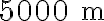 .
.We can also do this for small numbers written in scientific notation. Consider the example:
 . We can write this as normal notation by adding the appropriate number of decimal places to the left of the number to make it a small number. Here, we need to have four decimal places to the left of the decimal in the scientific notation. The value in normal notation is:
  .
. -
-
-
We begin our formal study of physics with an examination of kinematics, the branch of mechanics that studies motion. The word "kinematics" comes from a Greek term that means "motion". Note that kinematics is not concerned with what causes the object to move or to change course. We will look at these considerations later in the course. In this unit, we examine the simplest type of motion, which is motion along a straight line or in one dimension.
Completing this unit should take you approximately 5 hours.
-
A scalar physical quantity is a measurement of quantity that has a magnitude (amount), but not a direction. Examples of scalar quantities include mass and temperature; no direction is associated with these measurements. Distance is also a scalar quantity because it has no direction associated with it.
A vector physical quantity is a measurement that has a magnitude (amount) and direction. Vectors are often depicted as an arrow. The length of the arrow shows the magnitude of the quantity, and the direction of the arrow shows the direction of the vector.
For simple one-dimensional systems, a vector is often written as the magnitude with a (+) or (−) to indicate direction, with (+) going toward the right and (−) going toward the left. Displacement and velocity are examples of vector quantities. For example, 5.5 km/s east. This measurement shows the magnitude of the velocity (5.5 km/s), and the direction (east).
-
-
An instantaneous value is a value measured at a given instant, or time. For example, we can measure the velocity of an object right at high noon as 5.5 km/s east. This is an instantaneous value because we measured it at a given instant in time. A car's speedometer is an example of an instantaneous measurement. Furthermore, velocity does not necessarily stay constant over time, so instantaneous measurements can vary depending on when you take the measurement.
An average value is calculated over a period of time. For example, to calculate average speed, divide the distance traveled by time traveled. For example, if you drive 30 miles in two hours, your average speed is 15 miles/hour. However, as we know from driving, we rarely drive exactly the same speed for two hours. So, the instantaneous value of your speed could vary at any given time, but the average value is still 15 miles/hour.
-
-
Distance describes how much an object has moved. It depends on how the object has moved, that is, the path the object took to get from the starting point to the ending point. The units for distance pertain to length, such as meters. Distance is a scalar quantity because it describes the magnitude of the measurement, but not a specific direction.
Displacement describes an object's overall change in position. It only depends on the starting and ending points of the object. It does not depend on the path taken to get between the two points. Like distance, the units for displacement are also length, such as meters. However, displacement is a vector quantity, which means it has a magnitude and a specific direction associated with the measurement. So, the complete value for displacement must also include a direction.
For an example, consider a four-story building. A person needs to travel on the elevator from the first to the third floor. To accomplish this, the person could take an elevator directly from the first floor to the third floor. In this case, the distance and displacement are the same, because the person went directly from the starting to the ending point.
However, this is not the only way the person could travel from the first to the third floor. They could accidentally hit the fourth floor button when they got on the elevator. In this case, they would travel from the first floor to the fourth floor, and back down to the third floor. In this instance, the displacement is still from the first floor to the third floor. But, the distance is longer, because the person took a detour to the fourth floor before going back down to the third floor.
-
-
Elapsed time,
 , is the change in time. Elapsed time is calculated as
 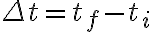 , where
  is final time and
  is initial time. The Greek letter delta, Δ, means change. So, Δt means change in time. You will see this frequently in this course. When calculating elapsed time, we often assume the initial time is zero, to make the subtraction easier.
Average velocity is the displacement divided by the elapsed time:
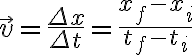 . Here, the line above the
  shows that it is an average quantity. This is the common notation for average quantities. To calculate the average velocity, divide the change in displacement by the elapsed time.
The average velocity is a vector quantity because displacement is a vector quantity. Because we calculate average velocity from a vector quantity, it itself is a vector quantity. This means that average velocity has a direction associated with it. In one-dimensional systems, this means that the average velocity is written with a (+) or (−) sign, depending on the direction of the displacement.
Instantaneous speed is the magnitude of the instantaneous velocity, measured at a given time or instant. Unlike velocity, instantaneous speed is a scalar quantity, so it does not have a direction associated with it. For example, if the instantaneous velocity of an object is −2 m/s in one-dimensional motion, the object's instantaneous speed is simply 2 m/s.
The average speed of an object is the object's distance divided by the elapsed time. This is similar to the average velocity, which is the object's displacement divided by the elapsed time. Recall that distance is a scalar quantity that describes how much an object moved and that it can be very different from the vector displacement. Therefore, the average speed of an object is also a scalar quantity, and it can differ from the average velocity.
-
-
Acceleration (𝑎) is the rate of change of velocity. We can calculate the average acceleration using the following equation:
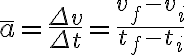
Because velocity is a vector, acceleration is also a vector quantity. Instantaneous acceleration is acceleration measured at a specific instant in time. In most kinematic problems, we assume average acceleration is a constant value.
-
-
Gravity is a force that attracts objects toward the center of the earth, or more generally speaking, massive objects to one another. In the absence of friction or air resistance, all objects fall with the same acceleration toward the center of the earth. This is known as free-fall. The acceleration due to gravity is
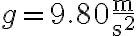 .
.In reality, air resistance affects the acceleration of falling objects. Air resistance opposes the motion of an object in air, and causes falling lighter objects to accelerate less than heavier objects. This is why a feather falls to earth slower than a heavier object like a brick. If there was no air resistance, a feather and brick would fall to earth with the same acceleration due to gravity.
-
-
To perform calculations involving objects in constant acceleration situations, such as free fall, we first need to use the basic definitions of velocity and acceleration to derive useful formulas called "kinematic equations".
We can use kinematic equations for any situation where there is a constant acceleration acting on an object (including zero acceleration), and included with this situation is freefall. In free fall, acceleration (a) equals the acceleration due to gravity (g). For an object falling, we use −g to show the vector's downward direction of free fall.
-
-
When graphing two variables against each other, we generally define the dependent variable as the variable on the vertical axis (y-axis) and the independent variable as the variable on the horizontal axis (x-axis). When plotting a straight line, we use the equation
 , where
  is the slope and
  is the y−intercept of the line.
We define slope as:

The y−intercept is the point where the line crosses the y-axis of the graph.
-
-
-
Most motion in nature follows curved paths rather than straight lines. Motion along a curved path on a flat surface or a plane is two-dimensional and thus described by two-dimensional kinematics. Two-dimensional kinematics is a simple extension of the one-dimensional kinematics covered in the previous unit. This simple extension will allow us to apply physics to many more situations and it will also yield unexpected insights into nature.
Completing this unit should take you approximately 5 hours.
-
Two-dimensional kinematics is surprisingly easy. They are similar to one-dimensional problems, due to our coordinate system. Notice that coordinate systems have perpendicular axes, and motion along the two axes is independent from each other. So, the physics or math that helps us solve for an object's motion in the x−direction does not influence its motion in the y−direction. Solving for two-dimensional motion is like solving for one-dimensional motion twice!
-
-
When adding or subtracting vectors, we can follow many of the rules we learned in math class about non-vector numbers. Vector addition follows the commutative property, which means the order of addition does not matter. Vector addition also follows the associative property, which means it does not matter which vector is first when vectors are being added.
One way to add or subtract vectors is to do so graphically. The graphical method for adding and subtracting vectors is called the head-to-tail method. When adding vectors using this method, use these steps:
1. Draw the first vector starting from the tail, or starting point of the vector, to its head, or ending point (arrow) of the vector.
2. Begin the second vector by putting its tail at the head of the first vector.
3. Finally, draw a line from the tail of the first vector to the head of the second vector.
The vector that results is the resultant vector, or the solution to the vector addition problem. To determine the magnitude of the resultant vector, measure it with a ruler. To determine the direction of the resultant vector, use a protractor to determine the angle from one of the axes. When subtracting vectors graphically, consider the vector that is being subtracted as negative. That means the direction of the vector being subtracted is flipped so it points in the opposite direction. The head-to-tail process is the same as it is for addition. -
-
We can also use analytical methods to add and subtract vectors. Analytical methods use trigonometry to solve vector addition and subtraction. While we still use arrows to represent vectors, analytical methods reduce the measurement errors that can occur with graphical (head-to-tail) methods.
-
-
Often, physics problems occur on the surface of the Earth, such as footballs being kicked, rockets being fired, and daredevils riding their motorcycles off cliffs. This means that the y-component of these two-dimensional motions involve acceleration pointing downward while the x-component does not have any acceleration. We call these types of motion projectile motion.
We define projectile motion as the motion of a thrown object that only feels the acceleration of gravity. The projectile is the object being thrown; the trajectory is the path the object takes when it is thrown.
We need to use the kinematic equations we learned in Unit 2 of this course to calculate projectile motion, for each of the two-dimensions separately. Note that we assume there is no air resistance when we perform projectile motion calculations – so gravity is the only force acting on the projectile. -
-
-
Kinematics is the study of motion. It describes the way objects move, their velocity, and their acceleration. Dynamics consider the forces that affect the motion of moving objects. Newton's Laws of Motion are the foundation of classical dynamics. These laws provide examples of the breadth and simplicity of principles under which nature functions.
Completing this unit should take you approximately 8 hours.
-
Newton's First Law of Motion is also called the Law of Inertia: an object at rest will remain at rest unless an outside force acts upon it. Also, an object in motion with constant velocity will remain in motion with constant velocity unless an outside force acts upon it. The reason for this law is to exemplify the functions of mass.
-
-
As we saw in Newton's First Law of Motion, an object at rest stays at rest unless acted upon by an external force. Also, an object in motion at constant velocity remains in motion unless acted upon by an external force. Again, this is inertia. The only way to overcome inertia is to accelerate the object. Applying a net force to the system to induce acceleration.
Acceleration is proportional to the net external force on a system. That is, the higher the applied force, the bigger the acceleration. We also know that acceleration is inversely proportional to mass. That is, large objects accelerate at a slower rate than smaller objects. We know this from our everyday observations. It is easier to accelerate a light ball than a heavier bowling ball.
Newton's Second Law of Motion relates net external force to acceleration and mass of the system: , where
  is the net force, is mass, and
  is acceleration. Note that force is a vector quantity,
so it has a magnitude and a direction.
is acceleration. Note that force is a vector quantity,
so it has a magnitude and a direction.
The system is whatever we are interested in when calculating a physics problem. The external force is any force that acts upon the system, but is not part of the system. For example, picture pushing a rock up a hill. The system is the rock, and the external force is you pushing the rock.
The unit for force is the Newton, N. The definition of the Newton is .
. -
-
A free-body diagram shows all of the forces acting upon a system. It is a simplified way to visualize what is happening during a physics problem. Drawing the forces as vector arrows in the direction of the force from the center of the system can help us figure out how we need to add or subtract force vectors when determining the net force on an object.
-
-
Newton's Third Law of Motion states that for every force exerted by an object to another object, there is an equal magnitude force exerted on the first object by the second object in the opposite direction. Some call this the Law of Action and Reaction.
In other words, for every action (exerted force), there must be an equal and opposite reaction. This law tells us that forces are always paired. Keep in mind that these forces act on two separate objects in pairs. The forces do not act on the same object being pushed. -
-
There are four common classical forces that will be discussed in the following sections: weight, normal force, tension, and friction. We will discuss each of these forces one at-a-time in each of the following sections.
Weight refers to the force of gravity on an object of a given mass. Because it comes from gravity, the weight force is generally directed toward the earth. The equation that relates the mass of an object to its weight is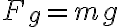 . This equation works only on or near the
surface of the Earth.
. This equation works only on or near the
surface of the Earth.
Let's consider a coffee cup sitting on a table. The coffee cup is experiencing the force of its weight that draws it toward the center of the earth. This "pushes" down on the table. However, because of Newton's Third Law of Motion, there must be an equal magnitude force in the opposite direction also acting on this table to balance the forces. -
-
Weight, in a more general sense, can be given using Newton's Universal Law of Gravitation. This law states that all objects in the universe attract each other in straight force lines between them.
-
-
Otherwise known as the "force of contact", we have the normal force. Here, "normal" essentially means perpendicular. That is, we give it the name normal force to make it obvious that it points perpendicularly to a surface.
For example, normal force balances the weight from a cup of coffee on a table and keeps it from going through the table. This is why we often call normal force the force of contact. In other words, we can say that normal force is the force that prevents two objects from being in the same place. The normal force is often abbreviated as N. Do not confuse the symbol for normal force as the unit of force, Newtons. -
-
Tension is the force along the length of an object. We normally think of tension as a force of the object's strength, such as for a rope. Objects, such as ropes, can only exert forces in the same direction as their length. If a rope is attached to a hanging object, the object's weight exerts a force toward the earth while the rope acts as a tension force in the opposite direction of the weight. Much like the normal force from the table mentioned earlier, this keeps the object from falling down.
-
-
Friction is the force between two surfaces in contact that opposes parallel motion between them. Kinetic friction is the friction between surfaces that are moving or sliding relative to each other. Static friction is the friction that occurs that prevents two surfaces from moving or sliding with respect to each other.
Static friction varies based on how much counter force is needed to prevent two objects from sliding. When a certain amount of force is applied to a stationary object in contact with a surface, static friction serves to counter that applied force in order to keep the object and surface in contact from sliding. The more force that is applied, the more static friction is summoned to counter it.
However, static friction is only so strong. So once the maximum static frictional force is summoned, the object will start to slide and the static friction force will give way to kinetic friction force. Generally, the maximum ability of static friction is higher than the maximum ability of kinetic friction. That is, once the maximum static friction force is met, the object undergoing applied force will jolt forward because the kinetic friction that took over is weaker than the maximum static friction force that held it previously.
Kinetic and static frictional forces are given by the equations:

Note that the static friction force equation is an inequality. That is because static friction only aims to counter potential movement or sliding between two surfaces, which vary based on the magnitude of the applied force. Both equations have a symbol which is called the coefficient of friction and depends solely on the
types of materials that make up the two surfaces. For example, between steel and ice, the coefficient of friction would be very small (perhaps 0.1). However, between rubber and concrete, the coefficient of friction would be rather large (perhaps 0.8).
The coefficient of friction is rarely larger than one.
symbol which is called the coefficient of friction and depends solely on the
types of materials that make up the two surfaces. For example, between steel and ice, the coefficient of friction would be very small (perhaps 0.1). However, between rubber and concrete, the coefficient of friction would be rather large (perhaps 0.8).
The coefficient of friction is rarely larger than one.
We experience friction often in our everyday lives. For example, if you slide a box across a room, the box's motion will eventually stop due to the friction that occurs between the surface of the box and the surface of the floor. A box will slide relatively well across a smooth tile floor because the smooth tile floor provides a lower frictional force. It will slide less well across a floor with a rough carpet because the carpet provides a higher frictional force.
When we walk on a sidewalk our shoes do not generally slip because the static friction between our shoes and the sidewalk opposes the forward force of our shoes. However, we know that icy surfaces are "slippery" when the ice exerts less friction on our shoes than concrete. -
-
-
Now that we have discussed forces and how they manipulate motion, we will begin exploring a particular force that makes objects move in a curved motion. In this unit, we study the simplest form of curved motion: uniform circular motion, or motion in a circular path at a constant speed. In some ways, this unit is a continuation of the previous unit on dynamics, but we will introduce new concepts such as angular velocity and acceleration, centripetal force, and the force of gravity.
Completing this unit should take you approximately 3 hours.
-
A centripetal force is any force that makes an object move in a circular motion. A centripetal force can involve any of the classical or electromagnetic forces, such as gravitational force (weight), normal force, tension, and friction.
For example, gravitational force acts as a centripetal force on a planetary scale because it causes planets to orbit in a circle. However, gravitational force is not a centripetal force on the Earth's surface because gravity makes objects fall straight down toward the Earth's center, not in a circle. A normal force can act as a centripetal force, such when a roller coaster does a loop-da-loop. Friction can act as a centripetal force, such as when it causes cars to turn corners on a road.
The equation for centripetal acceleration is
 , where
  is object speed and
  is radius (distance from center).
 -
-
A dramatic application of centripetal force is the Universal Law of Gravitation. Johannes Kepler (1571–1630), the German astronomer and mathematician, created three laws that pertain to orbital motion during the Renaissance period. At this time, physics and astronomy were two separate fields of study. Kepler developed these three laws independently from the laws of physics we know today.
-
-
In rotational motion, we deal with two-dimensional motion. Unlike with linear motion, we need to define angles and distances associated with circular motion.
-
-
Rotational Kinematics is the study of rotational motion, much like linear kinematics (or just plain kinematics) is the study of linear motion. When solving kinematics problems of rotational motion, we look at the relationships between angular and linear versions of position, velocity, and acceleration.
-
-
-
What do desks, bridges, buildings, trees, and mountains have in common – at least in the eyes of a physicist? The answer is that they are ordinarily motionless relative to the Earth. Consequently, their acceleration, with respect to the Earth as a frame of reference, is zero. Newton's second law states that net F = ma, so the net external force is zero on all stationary objects and for all objects moving at constant velocity. There are forces acting, but they are balanced. That is, the forces are in equilibrium.
Completing this unit should take you approximately 1 hour.
-
When an object is in equilibrium, the forces acting upon the object are balanced. That is, the net force on the object is zero. For this to occur, the object must either not be moving, or it must be moving at a constant velocity.
There are two types of equilibrium: static equilibrium and dynamic equilibrium.
1. Static equilibrium describes a system that is balanced and does not rotate. An example is a seesaw where two children sitting at either end are exactly the same weight. Since the seesaw will not move, it is in static equilibrium.
2. Dynamic equilibrium describes a system that is balanced, but also moving (without any angular acceleration). An example is a planet in perfect circular orbit around its parent star. There is no torque acting on the planet making it orbit faster or slower, but it will keep orbiting for a very long time. The system is in equilibrium, and because it is moving, it is dynamic.
-
-
A system is not in equilibrium when a rotational force is acting on it to make it accelerate in its rotation. We call this rotational force torque. We define torque as the force to turn or twist an object, thus changing its rotational velocity. The unit for torque is the Newton-meter (Nm).
We can write the definition of torque as
 , where
  (the Greek letter tau) is torque, is how far the force is applied from the axis of rotation,
  is the force magnitude, and
  is the angle between the force and radial vector from the axis of rotation and where the force is being applied.
 -
-
When performing calculations, the first step is to determine if the system is, in fact, in equilibrium. Recall from the previous section that two conditions must be met for a system to be in equilibrium: the system must not be accelerating and the torque must be zero. The second step is to draw a free-body diagram of the system. It is important to determine all of the forces acting upon the system. The third step is to solve the problem by applying the relevant conditions of equilibrium: force is zero, and torque is zero.
-
-
-
Energy describes the capacity of a physical system to perform work. It plays an essential role in everyday events and scientific phenomena. You can probably name many forms of energy: from the energy our food provides us, to the energy that runs our cars, to the sunlight that warms us on the beach. Not only does energy have many interesting forms, but it is involved in almost all phenomena and is one of the most important concepts of physics.
Energy can change forms, but it cannot appear from nothing or disappear without a trace. Thus, energy is one of a handful of physical quantities that we say is conserved.
Completing this unit should take you approximately 5 hours.
-
Work is done on a system when a constant applied force causes the system to be displaced or moved in the direction of the applied force. We can describe work using the equation
 , where is force,
  is displacement, and (the Greek letter theta) is the angle between and .
From the equation for work, we can see that the unit for work must be the Newton-meter: the unit for force is the Newton and the unit for displacement (distance) is the meter. We define the Newton-meter as the unit joule. Consequently, we use joules as the unit for work and energy.
-
-
We define kinetic energy as the energy associated with motion. We calculate kinetic energy as
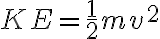 .
.When work is done on a system, energy is transferred to the system. We define net work as the total of all work done on a system by all external forces. We can think of the sum of all the external forces acting on a system as a net force, or
 .
.We can write the equation for net work in a similar way to how we wrote the equation for work earlier:
 , where
  is net work, is net force, is displacement, and is the angle
between force and displacement.
is net work, is net force, is displacement, and is the angle
between force and displacement. -
-
A non-conservative force is a force that depends on the path an object takes. In other words, a non-conservative force depends on how an object got from its initial state to its final state. Non-conservative forces change the amount of mechanical energy in a system. This differs from conservative forces, which do not depend on the path taken from initial to final state, and do not change the amount of mechanical energy in a system.
An important example of a non-conservative force is friction. We know that friction is the force between two surfaces. We see friction when rolling a ball on a carpet versus a hardwood floor. The ball rolls farther on the hardwood floor than it does on a carpet. This is because the fuzzy carpet has more friction than the smooth hardwood. Friction converts some of the kinetic energy of the ball to thermal energy, or heat. As kinetic energy is converted to thermal energy, the balls slows to a stop.
On the other hand, a conservative force is a force which does work that only depends on the beginning point and the end point of the system. The work done by a conservative force does not depend on the path the system takes to get from beginning to end. Conservative forces exist in ideal systems with no friction. An idealized spring that does not experience friction would be an example of conservative forces.
-
-
The Law of Conservation of Energy states that the total energy in any process is constant. Energy can be transformed between different forms, and energy can be transferred between objects. However, energy cannot be created or destroyed. This is a broader law than the conservation of mechanical energy because this applies to all energy, not just energy when only conservative forces are applied.
We can write the Law of Conservation of Energy as
 or as
or as 
In the second equation, the
 ,
,  , and
, and  are initial conditions and
  ,
,  , and
, and  are final conditions. The new term,
  , is other energy. This is a collected term for all forms of energy
that are not kinetic energy or potential energy. Other forms of energy include: thermal energy (heat), nuclear energy (used in nuclear power plants), electrical energy (used to power electronics), radiant energy (light), and chemical energy (energy
from chemical reactions).
, is other energy. This is a collected term for all forms of energy
that are not kinetic energy or potential energy. Other forms of energy include: thermal energy (heat), nuclear energy (used in nuclear power plants), electrical energy (used to power electronics), radiant energy (light), and chemical energy (energy
from chemical reactions).When solving Conservation of Energy problems, it is important to identify the system of interest, and all forms of energy that can occur in the system. To do this, we need to first identify all forces acting on the system. Then, we can plug equations for different types of energy into the Law of Conservation of Energy equation to solve for the unknown in the problem.
-
-
Why do tornadoes spin so rapidly? The answer is that the air masses that produce tornadoes are themselves rotating, and when the radii of the air masses decrease, their rate of rotation increases. An ice skater increases their spin in an exactly analogous way. The skater starts their rotation with outstretched limbs and increases their spin by pulling them in toward their body. The same physics describes the spin of a skater and the wrenching force of a tornado. Clearly, force, energy, and power are associated with rotational motion.
We cover these and other aspects of rotational motion in this unit. We will see that important aspects of rotational motion have already been defined for linear motion or have exact analogs in linear motion.
We can write an equation for the rotational kinetic energy (the energy of rotational motion) as:

-
-
We define power as the rate at which work is done. We can write this as
 , where
  is work and
  is the duration of the work being done. The unit for power is the watt, W. One watt equals one joule per second.
Higher power means more work is done in a shorter time. This also means that more energy is given off in a shorter time. For example, a 60 W light bulb uses 60 J of work in a second, and also gives off 60 J of radiant and heat energy every second.
-
-
-
We use the term momentum in various ways in everyday language. For example, we often speak of sports teams gaining and maintaining the momentum to win. Generally, momentum implies a tendency to continue on course (to move in the same direction) and is associated with mass and velocity. Momentum has its most important application when analyzing collision problems. Like energy, it is important because it is conserved. Only a few physical quantities are conserved in nature, and studying them yields fundamental insight into how nature works, as we shall see during our study of momentum.
Completing this unit should take you approximately 4 hours.
-
We define linear momentum as the product of an object's mass and velocity. It can be written as
 , where
  is linear momentum, is mass, and is velocity.
Linear momentum is a vector quantity because velocity is a vector quantity, and the linear momentum will have the same direction as the velocity. The units for linear momentum are kgm/s.
-
-
In Unit 4 we learned to write Newton's Second Law of Motion as
 . While this is the most common way to write and use this law, it was not how Newton originally wrote it. Newton wrote this law in terms of momentum rather than force and acceleration:
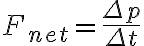
This shows that the net force equals the change in momentum divided by the change in time. This equation certainly appears different from the familiar
 we used in Unit 4.
 -
-
When two or more objects interact physically, we say the objects collide or experience a collision. Here, we consider three types of collisions for solving physics problems. They are all based on the energy transfer in the collisions. By definition, an elastic collision is a collision where the internal kinetic energy is conserved in the interaction. So, in an elastic collision, all the kinetic energy remains kinetic energy. That is, no kinetic energy is converted to heat, friction, or other types of energy.
-
-
When solving problems for elastic collisions, it is important to remember that the kinetic energy is conserved. Therefore, the total kinetic energy at the start of the collision must equal the total kinetic energy at the end of the collision. We can write this as

Moreover, we know that momentum must be conserved in the collision. Therefore, the total momentum at the start of the collision must equal the total momentum at the end of the collision. That is, for two objects (object one and two) colliding, we can write
 . Using conservation of momentum, we can usually set up these problems so we only have to solve for one unknown.
 -
-
We define angular momentum as
 . It is similar to the momentum defined for linear motion. As such, angular momentum in a system is conserved in the same way that linear momentum is conserved. Therefore, we can say that
  , where
 is the initial angular momentum in a system and
  is the final angular momentum in the system. We can also write this as: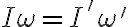
We see conservation of angular momentum in many everyday examples. As you read, pay attention to the example of the spinning figure skater in Figure 10.23. In the first picture, the figure skater is spinning with her arms out on a frictionless ice surface. In the second picture, she pulls her arms in, and her rotational velocity increases. When the figure skater pulls in her arms, she lowers her moment of inertia. Because angular momentum is conserved, because her moment of inertia decreases, her angular velocity must therefore increase.
-
-
-
These study guides will help you get ready for the final exam. They discuss the key topics in each unit, walk through the learning outcomes, and list important vocabulary terms. They are not meant to replace the course materials!
-
Take this exam if you want to earn a free Course Completion Certificate.
To receive a free Course Completion Certificate, you will need to earn a grade of 70% or higher on this final exam. Your grade for the exam will be calculated as soon as you complete it. If you do not pass the exam on your first try, you can take it again as many times as you want, with a 7-day waiting period between each attempt. Once you pass this final exam, you will be awarded a free Course Completion Certificate.
-
Please take a few minutes to give us feedback about this course. We appreciate your feedback, whether you completed the whole course or even just a few resources. Your feedback will help us make our courses better, and we use your feedback each time we make updates to our courses. If you come across any urgent problems, email contact@saylor.org.