2.4: Speed and Velocity
Topic outline
-
Elapsed time,
 , is the change in time. Elapsed time is calculated as
 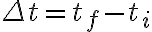 , where
  is final time and
  is initial time. The Greek letter delta, Δ, means change. So, Δt means change in time. You will see this frequently in this course. When calculating elapsed time, we often assume the initial time is zero, to make the subtraction easier.
Average velocity is the displacement divided by the elapsed time:
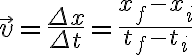 . Here, the line above the
  shows that it is an average quantity. This is the common notation for average quantities. To calculate the average velocity, divide the change in displacement by the elapsed time.
The average velocity is a vector quantity because displacement is a vector quantity. Because we calculate average velocity from a vector quantity, it itself is a vector quantity. This means that average velocity has a direction associated with it. In one-dimensional systems, this means that the average velocity is written with a (+) or (−) sign, depending on the direction of the displacement.
Instantaneous speed is the magnitude of the instantaneous velocity, measured at a given time or instant. Unlike velocity, instantaneous speed is a scalar quantity, so it does not have a direction associated with it. For example, if the instantaneous velocity of an object is −2 m/s in one-dimensional motion, the object's instantaneous speed is simply 2 m/s.
The average speed of an object is the object's distance divided by the elapsed time. This is similar to the average velocity, which is the object's displacement divided by the elapsed time. Recall that distance is a scalar quantity that describes how much an object moved and that it can be very different from the vector displacement. Therefore, the average speed of an object is also a scalar quantity, and it can differ from the average velocity.
-