The Study of Intercultural Communication
- 1a Explain how communication meets various personal needs using the principles of communication and the models of communication (CLO 1, CLO 4)
Communication Principles and Processes
The imperatives help us to organize our personal reasons for studying intercultural communication, but what about the communication process in general? Most of us think that "communication" is important, but it's not something that we are often focusing on so we have a tendency to think that it "just happens". Consciously becoming aware of the communication process and noticing how you communicate is a fundamental goal of this class. Studying the communication process will allow you to understand more of what is going on around you, and this understanding will allow you to become a more competent communicator in intercultural contexts.
If you have taken another communication class, the following sections will be a review of what you have learned previously. If you have never taken a communication class, the following sections are foundational to understanding the basic communication principles and processes so pay close attention. Everything that we learn in this class will be grounded in these principles and processes.

Communication Principles
In this section, we will learn the principles of communication. You are encouraged to note the aspects of communication that you haven't thought about before and begin to identify the principles in the various parts of your communication life.
Communication Meets Needs
Communication is far more than the transmission of information. The exchange of information is important for many reasons, but it is not enough to meet the various needs we have as human beings. The content or message of our communication may help us meet certain physical, instrumental, relational, and identity needs.
Physical needs include needs that keeps our bodies and minds functioning like air, food, water, and sleep. Instrumental needs include needs that help us get things done in our day-to-day lives and achieve short- and long-term goals. Relational needs include needs that help us maintain social bonds and interpersonal relationships. Identity needs include our need to present ourselves to others and be thought of in desired ways.
Communication Is A Process
Communication can be defined as the process of understanding and sharing meaning (Pearson & Nelson, 2000). When we refer to communication as a process, we imply that it doesn't have a distinct beginning and end or follow a predetermined sequence of events. It can be difficult to trace the origin of a communication encounter, since communication doesn't always follow a neat format.
Communication Is Influenced by Culture and Context
Culture and context influence how we perceive and define communication. Cultural values are embedded in how we communicate. All people in all cultures are socialized from birth to communicate in culturally specific ways that vary from context to context.
Communication Is Learned
Most of us are both capable of the capacity and ability to communicate, but we all communicate differently. This is because communication is learned rather than innate. As already discussed in the previous principle, communication patterns are relative to the context and culture in which one is communicating. We are all socialized into different languages, but we also speak different "languages" based on the situations we are in. This idea will become more understandable in the verbal and nonverbal communication chapters.

Communication Influences Your Thinking About Yourself And Others
Humans share a fundamental drive to communicate. You share meaning in what you say and how you say it. On the flip side, your communication skills also help you to understand others—not just their words, but also their tone of voice, their nonverbal gestures. Your success as a communicator is based on your ability to actively listen and actively interpret others' messages.
The Communication Process
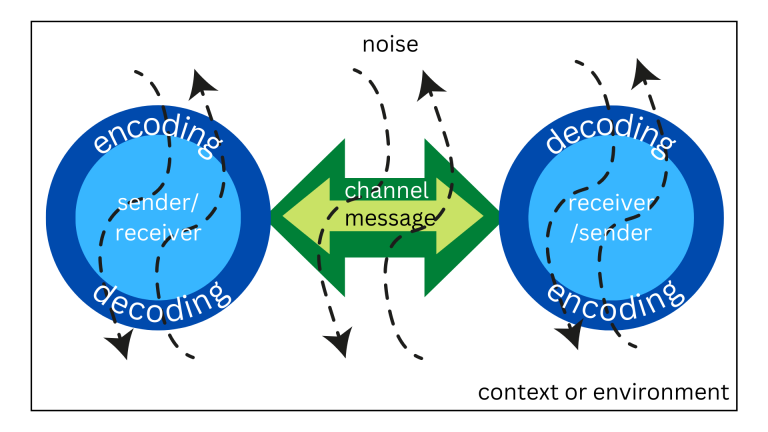
Communication is a complex process, and it is difficult to determine where or with whom a communication encounter starts and ends. Models of communication simplify the process by providing a visual representation of the various aspects of a communication encounter. Models allow us to see specific concepts and steps within the process of communication. Although the three models differ, they all contain some common elements such as senders/receivers, messages, encoding, decoding, and channels. Other elements to remember include feedback and noise.
In all the communication models, the participants are referred to as senders and receivers. Senders initiate the message conveyed through the communication process and receivers are the recipients of the message. The message is the verbal or nonverbal content being conveyed from sender to receiver.
The internal cognitive processes that allow participants to send, receive, and understand messages are known as the encoding and decoding processes. Encoding is the process of turning thoughts into communication. Decoding is the process of turning communication into thoughts. For example, you may realize you are hungry and encode the following message to send to your roommate: "I'm hungry. Do you want to get pizza tonight?" As your roommate receives the message, they decode the message you are expressing and turns it back into thoughts in order to make meaning out of it. Of course, we just don't communicate verbally—we have various options, or channels for communication.
Encoded messages are sent through a channel, or a sensory route on which a message travels, to the receiver for decoding. Communication can be sent and received using any sensory route (sight, smell, touch, taste, or sound). Nor does communication have to be sent using only one route—it can be multi-channeled.
The Linear Model of Communication
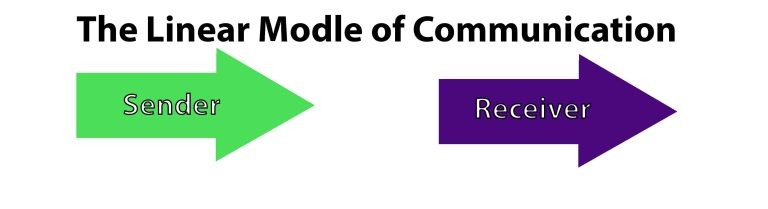
The linear model of communication describes communication as a linear, one-way process in which a sender intentionally transmits a message to a receiver (Ellis & McClintock, 1990). Although the receiver is included in the model, this role is viewed as more of a target or end point rather than a part of an ongoing process. The receiver either successfully receives and understands the message or they do not.
An example of a linear message is listening to the radio in your car. The sender is the radio announcer (the sender) encodes a verbal message that is transmitted by a radio tower (the channel) and eventually reaches your ears (the receiver) via the speakers in order to be decoded. The radio announcer doesn't really know if you receive their message or not, but if everything is working as it should be, there is a good chance that the message has been received.
Most communication situations are more complex than the linear model, but the linear model is always a good place to start as you begin to dissect a communication situation for greater understanding.
The Interactional Model of Communication
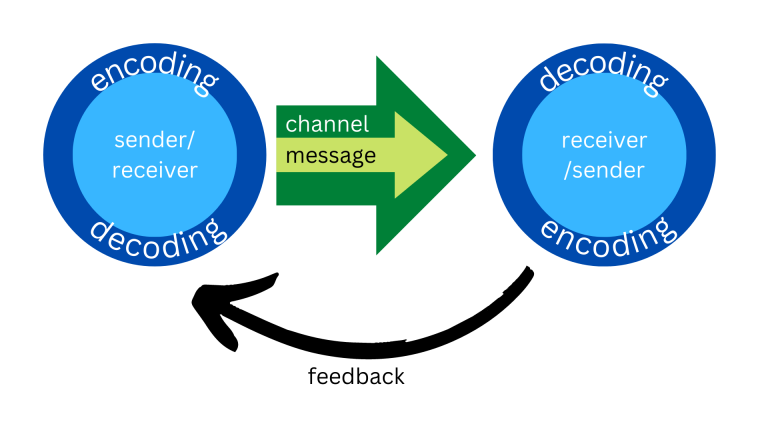
The interactional model of communication describes communication as a process in which participants alternate positions as sender and receiver and generate meaning by sending messages and receiving feedback within physical and psychological contexts (Schramm et al., 1997). Rather than illustrating communication as a linear, one-way process, the interactional model incorporates feedback, which makes communication a more interactive, two-way process. Feedback includes messages sent in response to other messages. The inclusion of a feedback loop also leads to a more complex understanding of the roles of participants in a communication event.
The interactional model is focused on both the message and the interaction. While the linear model is focused on transmitting a message, the interactional model is more concerned with the communication loop itself. Feedback and context help make the interactional model a more accurate illustration of the typical communication process.
The Transactional Model of Communication
Currently, many scholars view communication as more than a process that is used to carry on conversations and convey meaning. People don't send messages like computers, and they don't neatly alternate between roles of sender and receiver as the communication event unfolds. People also can't decide to stop communicating, because communication is more than verbally sending and receiving messages.
The transactional model of communication describes communication as a process in which communicators don't just communicate to exchange messages—people communicate to create relationships, form intercultural alliances, shape self-concepts, and engage with others to create community. In other words, people don't communicate about their reality, communication helps to construct the reality.
The roles of sender and receiver in the transactional model differ significantly from the other models. Instead of being the sender or the receiver, people are both senders and receivers at the same time. Communicators are simultaneously sending messages and receiving messages adapting the message being sent as we are receiving messages from others. Communication is a force that shapes our realities–before and after—communication events, therefore social, relational, cultural and physical contexts frame and influence our social encounters. Context refers to the factors that work together to determine the meaning in communication events. In other words, we learn the norms and rules for communicating through the process of communicating. The norms and rules are different based upon the types of relationships we have, and the cultural expectations of the communicators.
Like the idea of context in the communication process, noise refers to things that influence or block the effectiveness of interpretating communication. Noise can be caused by various things ranging from illness and faulty cell phone reception to stereotyping and poor grammar. While often overlooked as having an impact on the communication process, noise can subtly impact competent communication by acting as a disruption to the message/channel as well as within senders/receivers.