
Starting with Culture
- 1a Explain how communication meets various personal needs using the principles of communication and the models of communication (CLO 1, CLO 4)
- 1b Describe the dimensions of Hofstede's model of intercultural communication (CLO 2)
Foundational Research in Culture
Studying Culture: Values and Dimensions
On this page. This section traces how researchers have tried to make culture measurable. You will work through two foundational frameworks — Kluckhohn and Strodtbeck's Value Orientation Theory and Geert Hofstede's Dimensions of Culture — and see how each one turns broad cultural differences into questions you can actually compare across societies.
As you read, watch for: the five basic concerns every culture must resolve, and Hofstede's dimensions of power distance, uncertainty avoidance, masculinity–femininity, individualism–collectivism, and long- versus short-term orientation. Each is a spectrum, not a label — most cultures sit somewhere in between.
If researchers have a difficult time defining, and figuring out the best ways to examine culture, it's not easy to study either. "Our most cherished traditions [cultures] are only a tiny fraction of the many ways humans have devised for solving basic problems, from how to order society to how to mark the passage from childhood to adulthood (King, p. 11)".
This section will review research from cultural anthropologists to social psychologists and the impact that it has had on informing theories currently accepted within the field of intercultural communication. These theories will generally reflect the structural approach to the study of culture although the discussion of co-cultures and microcultures at the very end of the chapter will be more transactional in nature.
Value Orientation Theory
In an early effort to develop a cross-cultural theory of values, anthropologists Kluckhohn and Strodtbeck (1961) suggested that every culture faces some basic human survival needs and must answer five simple questions. How those questions are answered by different cultures help to form a framework for understanding cultural differences. That framework is called the Value Orientation Theory. The basic questions fall into five categories and reflect concerns about: 1) human nature, 2) the relationship between humans and the natural world, 3) the nature of time, 4) the purpose of human activity, and 5) social relations between humans. Kluckhohn and Strodtbeck hypothesized three possible responses or orientations to each of the questions.
| Basic Concerns | Orientation | ||
|---|---|---|---|
| Human Nature | Evil | Mixed | Good |
| Relationship to natural world | Mastery | Harmony | Submission |
| Time | Past | Present | Future |
| Activity | Being | Becoming | Doing |
| Social relations | Collective | Collateral | Individual |
What is the inherent nature of human beings?
Some societies and/or religions are inclined to believe that people are inherently evil, and that the society must exercise strong measures to keep the evil impulses of people in check. On the other hand, some societies are more likely to see human beings as basically good and possessing an inherent tendency towards goodness. Between these two poles are societies that see human beings as possessing the potential to be either good or evil depending upon the influences that surround them. Societies can also differ on whether human nature is unchangeable and permanent or changeable and able to adapt.
What is the relationship between human beings and the natural world?
Some societies believe that nature is a powerful force in the face of which human beings are essentially helpless. We could describe this as "nature over humans". Other societies are more likely to believe that through intelligence and the application of knowledge, humans can control nature. In other words, they embrace a "humans over nature" position. Between these two extremes are the societies who believe humans are wise to strive to live in "harmony with nature".

What is the best way to think about time?
Some societies are rooted in the past, believing that people should learn from history and strive to preserve the traditions of the past. Other societies place more value on the here and now, believing that people should live fully in the present. Then there are societies that place the greatest value on the future, believing people should always delay immediate satisfactions while they plan and work hard to make a better future.
What is the proper mode of human activity?
In some societies, "being" is the most valued orientation. Striving for great things is not necessary or important. In other societies, "becoming" is what is most valued. Life is regarded as a process of continual unfolding. Our purpose on earth is to become fully human. Finally, there are societies that are primarily oriented to "doing". In such societies, people are likely to think of the inactive life as a wasted life. People are more likely to express the view that we are here to work hard, and that human worth is measured by the sum of accomplishments.
What is the ideal relationship between the individual and society?
Expressed in another way, we can say the concern is about how a society is best organized. People in some societies think it is most natural that a society be organized by groups or collectives. They hold the view that some people should lead, and others should follow. Leaders should make all the important decisions for the group. Other societies are best described as valuing collateral relationships. In such societies, everyone has an important role to play; therefore, important decisions should be made by consensus. In still other societies, the individual is the primary unit of society. In societies that place great value on individualism, people are likely to believe that each person should have control over his/her own destiny. When groups make decisions, they often follow the "one person, one vote" principle.

Developments of the Theory
Kluckhohn and Strodtbeck themselves did not consider their theory to be complete and struggled to develop measures to test some of their own proposed value orientations. However, the theory itself has also generated much further research, which in turn has generated even more theories. Another major researcher that this book focuses on is Geert Hofstede who was heavily influenced by the Values Orientation Theory. As values are central to human thought, emotions and behaviors, Hofstede was able to use values to make between-group cultural comparisons.
Dimensions of Culture Theory
Geert Hofstede, sometimes called the father of modern cross-cultural science and thinking, is a social psychologist who focused on a structural study of culture. Hofstede identified how societies around the world prioritize values such as respect for authority, adaptability to change, whether they respect strength or sympathize with weakness, whether they are progressive or traditional, whether they value freedom to pursue happiness or view happiness as being determined by other factors, or whether they view the world through an individual or a collective lens. While such values may be common throughout all cultures, societies and nationalities may emphasize values differently.
Power Distance
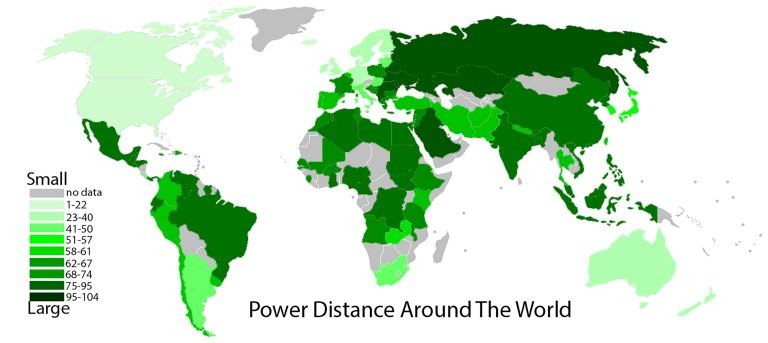
Power distance refers to how openly a society or culture accepts or does not accept differences between people, as in hierarchies in the workplace, in politics, and so on. For example, high power distance cultures openly accept that a boss is "higher" and as such deserves a more formal respect and authority. Examples of these cultures include Japan, Mexico, and the Philippines. In Japan or Mexico, the senior person is almost a father figure and is automatically given respect and usually loyalty without questions.
In Southern Europe, Latin America, and much of Asia, power is an integral part of the social equation. An individual's status, age, and seniority command respect - they are what make it acceptable for the lower-ranked person to take orders. Subordinates expect to be told what to do and won't take initiative or speak their minds unless a manager explicitly asks for their opinion.
At the other end of the spectrum are low power distance cultures, in which superiors and subordinates are more likely to see each other as equal in power. Countries found at this end of the spectrum include Austria and Denmark. To be sure, not all cultures view power in the same ways. In Sweden, Norway, and Israel, for example, respect for equality is a guarantee of freedom. Subordinates and managers alike often have the right to speak their minds.
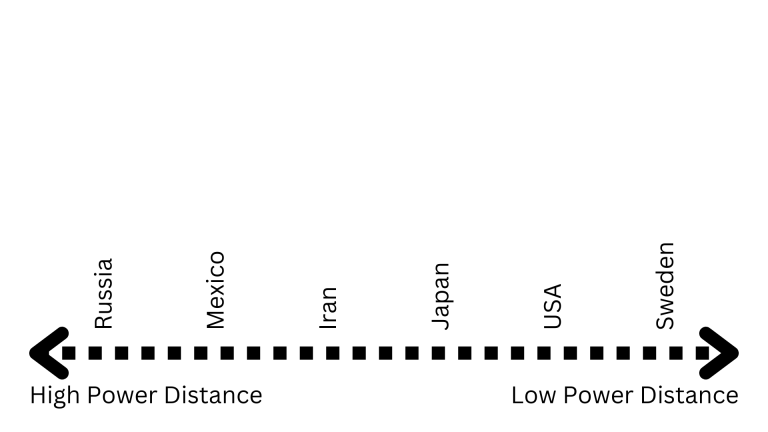
Research indicates that the United States tilts toward low power distance but is more in the middle of the scale than Germany and the United Kingdom. The United States has a culture of promoting participation at the office while maintaining control in the hands of the manager. People in this type of culture tend to be relatively laid-back about status and social standing - but there's a firm understanding of who has the power. What's surprising for many people is that countries such as the United Kingdom and Australia actually rank lower on the power distance spectrum than the United States.
In a high power distance culture, you would probably be much less likely to challenge a decision, to provide an alternative, or to give input. If you are working with someone from a high power distance culture, you may need to take extra care to solicit feedback and involve them in the discussion because their cultural framework may preclude their participation. They may have learned that less powerful people must accept decisions without comment, even if they have a concern or know there is a significant problem.
Uncertainly Avoidance
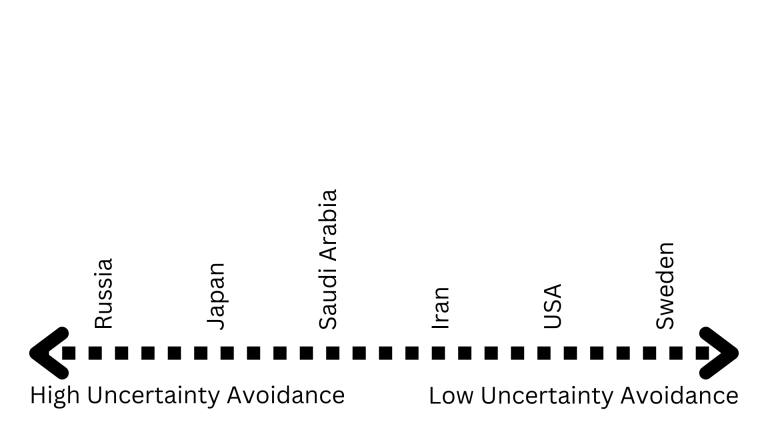
When we meet each other for the first time, we often use what we have previously learned to understand our current context. Our previous knowledge helps to reduce our uncertainty. People who have high uncertainty avoidance generally prefer to steer clear of conflict and competition. They tend to appreciate very clear instructions. They dislike ambiguity. At the office, sharply defined rules and rituals are used to get tasks completed. Stability and what is known are preferred to instability and the unknown.
Some cultures, such as the U.S. and Britain, are highly tolerant of uncertainty, or have low uncertainty avoidance. They tend to accept or embrace change and are willing to take risks. A business negotiator might enthusiastically agree to try a new procedure, while they work out all the details. People from countries with low uncertainty avoidance don't mind it when a teacher says, "I don't know. Let's find out together".
Berger and Calabrese (1975) developed uncertainty reduction theory to examine this dynamic aspect of communication. Here are seven rules of uncertainty:
- There is a high level of uncertainty at first. As we get to know one another, our verbal communication increases, and our uncertainty begins to decrease.
- As nonverbal communication increases, uncertainty will continue to decrease, and we will express more nonverbal displays of affiliation, like nodding one's head to express agreement.
- When experiencing high levels of uncertainty, we tend to increase our information-seeking behavior, perhaps asking questions to gain more insight. As our understanding increases, uncertainty decreases, as does the information-seeking behavior.
- When experiencing high levels of uncertainty, the communication interaction is not as personal or intimate. As uncertainty is reduced, intimacy increases.
- When experiencing high levels of uncertainty, communication will feature more reciprocity, or displays of respect. As uncertainty decreases, reciprocity may diminish.
- Differences between people increase uncertainty, while similarities decrease it.
- Higher levels of uncertainty are associated with a decrease in the indication of liking the other person, while reductions in uncertainty are associated with liking the other person more.
Masculinity versus Femininity
The masculine and feminine orientation refers to the distinctions that exist between women's and men's roles in society. Societies that score higher on the masculinity scale tend to value assertiveness, competition, and material success. Cultures in Japan and Latin American are examples of masculine-oriented cultures.
Societies that score higher on the femininity scale tend to embrace values that are more widely thought of as feminine values, such as modesty, quality of life, interpersonal relationships, and greater concern for the disadvantaged of society. The Scandinavian cultures rank as feminine cultures, as do cultures in Switzerland and New Zealand. Societies high in masculinity are also more likely to have strong opinions about what constitutes men's work versus women's work while societies low in masculinity permit much greater overlapping in the social roles of men and women.
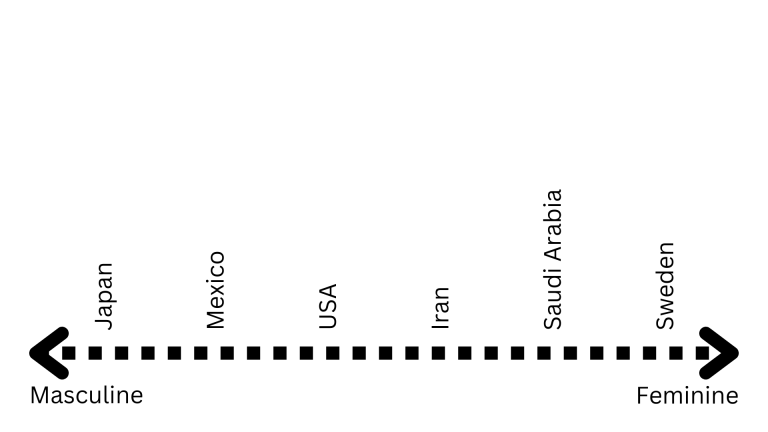
It's important to remember that cultures don't necessarily fall neatly into one camp or the other. The United States is more moderate, and its score is ranked in the middle between masculine and feminine classifications.
Individualism versus Collectivism
Individualism and collectivism might be the most important theory to explain cultural differences that you learn about in this book. Some researchers have speculated that most cultural differences can be explained by this one theory. You might also hear this dimension referred to as "independent" and "interdependent" because it refers to how people define themselves and their relationships with others.
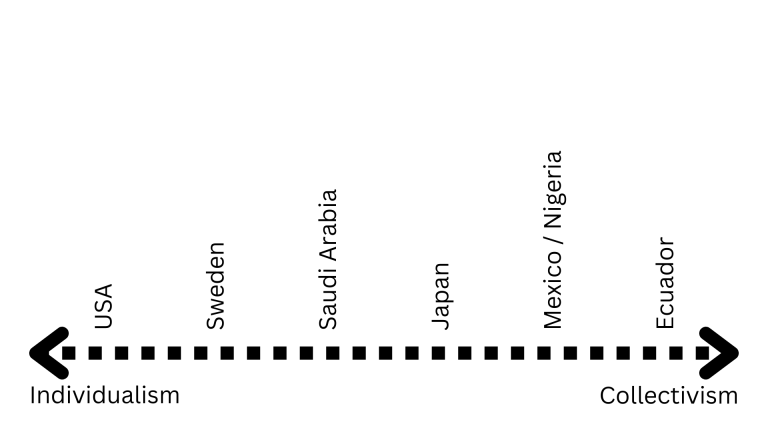
Individualism is just what it sounds like. It refers to people's tendency to take care of themselves and value individual accomplishments. People are defined by what they do, and not by the groups that they belong to. In individualistic cultures the interests of the individual receive more emphasis than those of the group. Personal dreams, goals, and achievements plus the right to make choices and have individual rights is paramount. Personal value is determined by accomplishments. Communication is more direct. Competition is the fuel of success.
In the United States, individualism is valued and promoted - from its political structure (individual rights and democracy) to entrepreneurial zeal (capitalism). Other individualistic countries include the United Kingdom, Australia, and Northern Europe.
Collectivistic cultures put more emphasis on the importance of relationships, loyalty, and working together. Memberships in particular groups, societies or families and working for the common good is incredibly important in defining individual worth and responsibilities. Personal value is based on your place in a system more than your special and unique qualities as a human. Communication is often more indirect in collectivistic societies. Cooperation with other group members is expected. South Korea is considered collectivistic whereas Japan falls close to the middle.

Measuring Time – Long Term versus Short Term
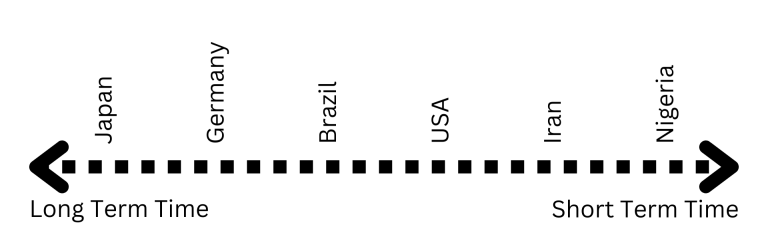
An important values dimension is the measurement of time. This dimension was added by Hofstede after the original four you just read about. It resulted in the effort to understand the difference in thinking between the traditional Eastern cultures and the traditional Western cultures. The long-term orientation is often marked by persistence, thrift and frugality, and an order to relationships based on age and status. A sense of shame, both personal and for the family and community, is also observed across generations. What an individual does reflects on the family and is carried by immediate and extended family members.
The short-term orientation values tradition only to the extent of fulfilling social obligations or providing gifts or favors. While there may be a respect for tradition, there is also an emphasis on personal representation and honor, a reflection of identity and integrity. These cultures are more likely to be focused on the immediate or short-term impact of an issue. Not surprisingly, the United Kingdom and the United States rank high in short-term orientation.
Other Cultural Theories
Today, the Kluckhohn and Strodtbeck's value orientation along with Hofstede's dimensions of culture are joined by many attempts to study human values within structural cultures. Rokeach (1979) and Schwartz (2006) have also produced value concepts that attempt to bring insight into the similarities and differences between human beings from different cultural backgrounds.
Hill (2002) has proposed a number of additional questions and dimensions that one might expect cultural groups to grapple with as well. These include:
- Space – Should space belong to individuals, to groups (especially the family) or to everyone?
- Work – What should be the basic motivation for work? To make a contribution to society, to have a sense of personal achievement, or to attain financial security?
- Gender - How should society distribute roles, power, and responsibility between the genders? Should decision-making be done primarily by men, women, or by both?
- Relationship Between the State and Individual - Should rights and responsibilities be granted to the nation or the individual?
Coming chapters will contain more specific theories that help us explain how cultures apply value orientation and dimensions of culture to the communication processes that we discussed in chapter 1, but first we have two more distinctions to make in our understanding of culture.
Key Takeaways
These frameworks are tools for comparison, not stereotypes. Two ideas are worth carrying forward:
- Value Orientation Theory frames culture as the set of answers a society gives to five shared human questions — about human nature, our relationship to the natural world, time, activity, and social relations.
- Hofstede's dimensions let us place cultures along measurable spectra rather than sorting them into fixed types.
Hofstede's dimensions at a glance:
- Power Distance
- How readily a culture accepts unequal distribution of power and authority.
- Uncertainty Avoidance
- How comfortable a culture is with ambiguity, risk, and the unknown.
- Masculinity–Femininity
- Whether a culture emphasizes competition and achievement or cooperation and quality of life.
- Individualism–Collectivism
- Whether identity rests on the individual or on the group.
- Long– vs. Short-Term
- Whether a culture prioritizes future rewards or present needs and tradition.