
Scandinavian Cultures in the Workplace
- 4c Evaluate the outcomes of interpersonal interactions between people of different cultures (CLO 1, CLO 3, CLO 4)
Culture Makes Communication Possible
Culture is what makes communication possible. We understand each other because we share a joint "store" of meaning with others in similar cultural communities. We use what we have "in store" when we decode and encode the meaning in the messages we communicate. We use verbal and non-verbal signs according to the rules and social norms that apply to our cultural communities. This constitutes the abstract framework for communication and the cultural context.
The challenge is that cultural differences can create misunderstandings when we have different cultural references or codes to create and interpret meaning. A classic model to use to understand communication is the Process Model. The name of the model emphasizes what the model focuses on, the process of communication - meaning how the information is processed from the sender to the recipient. Originally, the Process Model was created to describe how messages were transferred on a technical basis. In 1948, the model became known as a mathematical theory of communication. It was the researchers Shannon and Weaver who created the model. Key concepts in the model include sending, encoding, channeling, decoding, receiving, feedback, and noise in the environment.
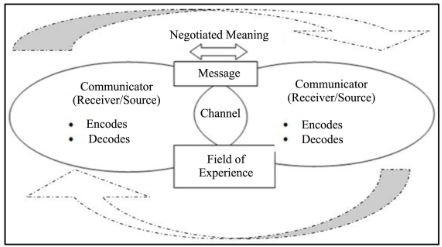
As seen in Figure 1, the communication process between the source and receiver has several factors. The intended message may not always be the same as the negotiated meaning. A person's field of experience and expertise can also play a significant role in the communication process; having experience and knowledge of several different cultures can increase chances of the negotiated meaning being the intended messages.
Noise in communication is about what stands in the way of a message arriving as intended. It can be noise in the form of background music that makes a telephone conversation difficult, bad network that causes the online chat to "lag", a challenging accent on the part of the sender, or a distracting habit that the sender has that makes it difficult to focus on the message. By using concepts from the communication models, we can say that cultural factors can lead to noise in communication. Being able to communicate appropriately with people of different cultural codes than oneself is having intercultural competence. The challenge is to spot which cultural factors influence communication, and what cultural norm one is dealing with. Culture can sometimes feel invisible; it is important to identify whose "water" we're "swimming" in.
Cultural Factors in Communication
Cultural factors vary in different cultural communities. This can affect how we communicate with each other. Cultural factors are important because they largely determine the attitudes, values, and norms that employees, partners, and customers base their behavior and decisions on. Some sociologists claim that our behavior is primarily determined by class ties, sub-cultural conditions, and the integration and control mechanisms that exist there. Published literature points to several critical challenges managers face in multicultural workplaces.
Figure 1. The communication process.
Awareness of cultural factors in communication is crucial for effective communication and building positive relationships with people from diverse backgrounds. Different cultures have different ways of communicating, and understanding these differences is necessary for misunderstandings not to occur. For example, some cultures value indirect communication, while others value direct communication. Being aware of these differences can help avoid misunderstandings and promote clarity in communication. Being aware of cultural factors in communication can help us show respect for the cultural differences of others. Acknowledging and valuing these differences can build stronger relationships and avoid unintentionally causing offense or disrespect.
Effective communication is critical to building trust and relationships with others. By understanding cultural factors, we can communicate in a way that is appropriate and respectful, which can help to establish trust and promote positive relationships. Cultural differences can also include language barriers. By being aware of these barriers, we can find ways to communicate effectively and bridge these gaps. Understanding cultural factors in communication can help us appreciate and celebrate the diversity of our society. We can create a more inclusive and harmonious society by valuing and respecting different cultural perspectives which are the foundational building blocks of effectively managing and leading internationally.
Scandinavian Cultural Factors in Communication
Several cultural factors can affect communication in Scandinavian cultures, including egalitarianism, directness, non-confrontation, informality, and minimalism, to name a few. Scandinavian cultures are known for their strong emphasis on equality and social justice. This value is reflected in communication, where people tend to avoid hierarchical structures and address each other by their first names. This can also be seen in the use of inclusive language, where people often use terms such as "we" or "us" instead of "I" or "me". Scandinavian communication is relatively direct and straightforward, with people expressing their thoughts and opinions openly. This can be attributed to the value of honesty and transparency in Scandinavian cultures and the belief that directness can help avoid misunderstandings and promote efficiency. While directness is valued in Scandinavian communication, people in these cultures also tend to avoid confrontation or conflict. This is partly due to the emphasis on social harmony and consensus-building and the belief that confrontation can be counterproductive and damaging to relationships.
Communication in Scandinavian cultures is often relatively informal, with people using casual language and avoiding overly formal or polite expressions. This can also be seen in humor and sarcasm, which is often used to lighten the mood or defuse tension in social situations. However, Scandinavian communication tends to be relatively minimalist, with people using simple, straightforward language and avoiding excessive or unnecessary details. This can be attributed to the belief that efficiency and clarity are essential in communication and the value of respecting other people's time and attention. Overall, these cultural factors can significantly impact communication in Scandinavian cultures, shaping the style and tone of communication and influencing how people interact with each other.
Communication in China vs. Scandinavia
Communication styles vary across cultural communities. Everything from body language and touch to voice and volume can have different interpretations when we speak (Smith, 2011). It can be challenging to know in advance how someone communicates based on their nationality, but we can use knowledge of variations in communication styles to explore specific situations. Poor communication often leads to conflicts, inefficiency, and a poor working environment. for example, while the Chinese can expect to adapt to formal authorities and sanctions (Zhao, 2008), people from Scandinavia may expect to have an equal voice and for all to be heard. The Chinese and Scandinavian communication styles differ significantly in several ways.
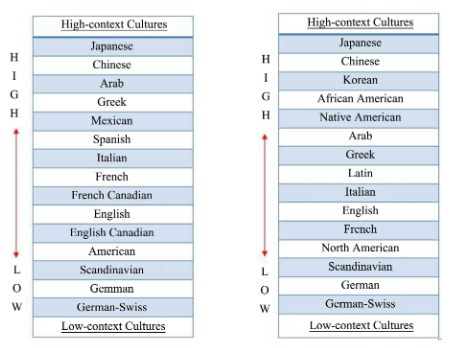
As seen in Figure 2, where the left diagram focuses on the high-context participants' preferences when using government websites, Scandinavia has a lowercontext culture. Similarly, on the right diagram, the focus is on the low-context participants' cultural behavior within their society (Herselman & Greunen, 2011: p. 5). These results did not contradict the literature; Scandinavian countries are found to be of lower context. However, China and Japan are on top, having some of the most high-context cultures, meaning it is the opposite of Scandinavian culture.
Figure 2. Highand low-context nationalities scale according to culture
To pinpoint some differences, the Chinese communication style tends to be more direct, while the Scandinavian communication style is often more indirect. In China, people may be more likely to state their opinions and give feedback directly, while in Scandinavia, people may use more subtle cues and hints to convey their thoughts and feelings. Moreover, in China, there is, as mentioned, a strong emphasis on hierarchy and respect for authority figures. Communication often reflects this, with people addressing others by their title or position. In Scandinavia, there is a greater emphasis on equality, and people tend to communicate more informally and in a relaxed style. Nonverbal communication is an important aspect of communication in both Chinese and Scandinavian cultures, but the styles differ. In China, nonverbal cues such as facial expressions and gestures may be more exaggerated and expressive, while in Scandinavia, nonverbal communication is often more subtle. In China, giving direct criticism is often considered impolite, so people may use more indirect ways to express their disapproval. In Scandinavia, however, direct criticism is often seen as a necessary part of communication, and people may be more straightforward in their feedback. The Chinese tend to have a more long-term time orientation, focusing on long-term goals and relationships. In contrast, Scandinavians tend to have a more short-term time orientation, prioritizing immediate results and efficiency.
While Chinese and Scandinavian communication styles value respect, trust, and harmony, they differ in their approach to directness, hierarchy, nonverbal communication, criticism, and time orientation. These two different communication styles show the importance of understanding cultural differences when communicating.