
Corporate Social Responsibility (CSR)
- 5e Apply the role of culture in organizational responsibility and ethics (CLO 5)
Corporate Ethics and Social Responsibility
What Is Corporate Social Responsibility?
As introduced earlier in this chapter, Corporate Social Responsibility (CSR) "is a self-regulating business model that helps a company be socially accountable—to itself, its stakeholders, and the public. By practicing corporate social responsibility, also referred to simply as social responsibility, companies can be conscious of the kind of impact they are having on all aspects of society, including economic, social, and environmental." Philanthropy is the simplest form of CSR, in which a firm donates funds to a nonprofit organization such as the local volunteer rescue squad or the American Cancer Society. However, CSR can take many forms, all with the end result that society benefits in some way. Environmental efforts might include reducing the company's pollution or helping clean up the plastic that washes up on beaches. Supporting local literacy volunteers by encouraging employees to help adults learn to read and write provides a social benefit.
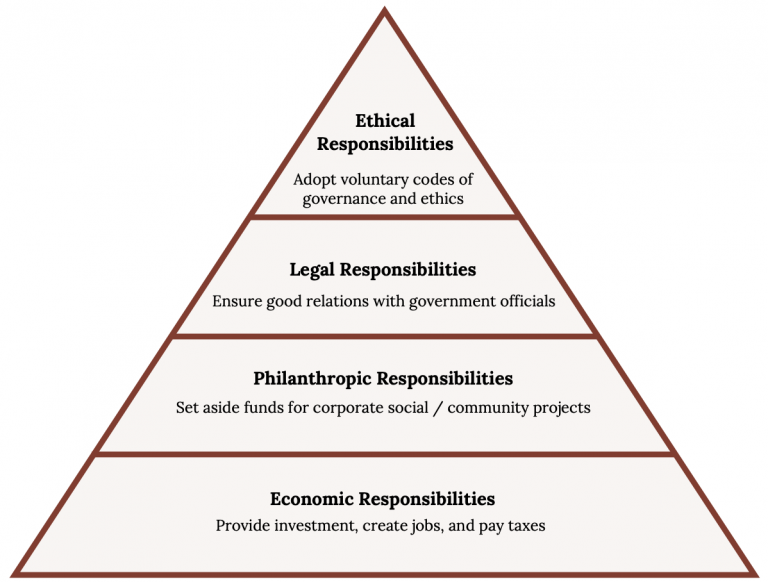
The CSR approach is not without controversy. When CSR was introduced, the famous economist Milton Friedman opposed it on philosophical grounds. He believed, as some others did, that no profits should be diverted to CSR activities: company investors and stockholders took a risk when they invested in the company, so the company's first obligation is to them. Many who practice CSR, on the other hand, believe that CSR activities ultimately do benefit investors and stockholders—a CSR strategy provides good public relations, enhances brand image, and creates loyalty and more sales over the long term. Some consumers, for example, may specifically seek out TOMS shoes because of the firm's "Buy One, Give One" model, feeling that their purchase has a positive social impact.
Some examples of CSR efforts are:
- Reducing its carbon footprint — Coca-Cola
- Ensuring contract manufacturers pay a living wage — Patagonia
- Improving sustainable manufacturing — BMW
- Matching employees' donations to nonprofits — Microsoft and Google
- Reducing carbon emissions — United Airlines
- Promoting literacy among children — Twitter
- Eliminating foam cups — Dunkin'
- Donating employees' hours to children's tutoring — Salesforce
One criticism of CSR is that it is seen as an "add-on" endeavor for firms—often not an ingrained component of a company's philosophy and operations. In response, a relatively new movement emerged to remedy this deficiency. Michael Porter and Mark Kramer suggest that, instead of CSR, wise corporations are shifting to a Creating Shared Value (CSV) model, which argues that firms should address social issues by creating shared value—fundamentally focused on expanding the total pool of social and economic resources. Porter and Kramer re-frame the business proposition by recognizing that "societal needs, not just conventional economic needs, define markets, and social harms can create internal costs for firms."
Creating shared value (CSV) is a business strategy that creates a direct link between the success of the firm and the improvement of society. Generally, CSV can be considered a particular strategic approach within the broader CSR landscape. A key differentiator is CSV's explicit focus on generating positive economic outcomes through its strategic investments: as a company prospers economically, so do those it affects. Both CSV and CSR take a longer-term, rather than short-term, approach to measuring impact. Whole Foods, for example, was one of the most high-profile companies to adopt CSV as a guiding strategy—investing in local schools to ensure a well-prepared workforce and supporting local agricultural communities so it could reliably source produce from local vendors. Whereas one traditional "business as usual" view holds that a company prospers at the expense of the consumer and society, CSV and CSR flip that view.
Section Videos
Business Ethics: Corporate Social Responsibility
This video further explains corporate social responsibility.
Insight: Ideas for Change — Michael Porter — Creating Shared Value
This video focuses on the differences between CSR and CSV.
Measuring Corporate Social Performance
TOMS Shoes' commitment to donating a pair of shoes for every pair sold illustrates the concept of social entrepreneurship, in which a business is created with the goal of improving both business and society. Using a CSR model, firms such as TOMS exemplify a desire to improve corporate social performance (CSP), in which a commitment to individuals, communities, and the natural environment is valued alongside the goal of creating economic value. Although determining the level of a firm's social responsibility is subjective, organizations have addressed this challenge by rating firms on a number of stakeholder-related issues to measure CSP. They conduct ongoing research on the social, governance, and environmental performance of publicly traded firms and report these statistics to institutional investors. The KLD database, for example, provides ratings on numerous "strengths" and "concerns" for each firm along several dimensions of corporate social performance (see Table 11.7, "Measuring Corporate Social Performance"). The results are used to develop the Domini social investments fund, which has performed at levels roughly equivalent to the S&P 500. Some rating firms use an ESG framework—Environmental, Social, and Governance—scoring a company on measures within each of those three dimensions.
Corporate social performance is defined as the degree to which a firm's actions honor ethical values that respect individuals, communities, and the natural environment. Determining whether a firm is socially responsible is somewhat subjective, but one popular approach was developed by KLD Research & Analytics, whose work tracks "strengths" and "concerns" for hundreds of firms over time. KLD's findings are used by investors to screen for socially responsible firms and by scholars interested in explaining corporate social performance. The six key dimensions KLD tracks are illustrated below.
| Dimension | Example strength | Example concern |
|---|---|---|
| Community | Engagement in charitable giving. | Involvement in tax controversies. |
| Product quality / safety | A well-developed quality program. | Receiving fines related to product quality and/or safety. |
| Diversity | Progressive programs for the employment of persons with disabilities. | Fines or civil penalties resulting from an affirmative-action controversy. |
| Employee relations | A no-layoff policy. | Poor union relations. |
| Environmental | Engaging in recycling. | Penalties for air or water violations. |
| Corporate governance | Equitable levels of compensation for top management and board members. | Controversies related to accounting, transparency, or political accountability. |
Assessing the community dimension of CSP involves evaluating community strengths—such as charitable or innovative giving that supports housing, education, or relations with Indigenous peoples, as well as charitable efforts worldwide, including volunteer efforts or in-kind giving. A firm's CSP rating is lowered when it is involved in tax controversies or other negative community actions, such as plant closings that can hurt property values.

CSP diversity strengths are scored positively when a company is known for promoting women and minorities, especially to board membership and the CEO position. Employment of persons with disabilities and the presence of family benefits such as child or elder care also raise the score. Diversity concerns include fines or civil penalties tied to an affirmative-action or other diversity-related controversy, and a lack of women in top management positions—suggesting a glass ceiling—would also negatively affect this dimension.
The employee relations dimension gauges strengths such as notable union relations, profit sharing and employee stock-option plans, favorable retirement benefits, and positive health and safety programs noted by the U.S. Occupational Safety and Health Administration. Concerns include poor union relations and fines for violating health and safety standards. Substantial workforce reductions and concerns about adequate pension funding also count against this dimension.
The environmental dimension records strengths by examining engagement in recycling, pollution prevention, or use of alternative energy; KLD also scores a firm positively if profits derive from environmental products or services. Environmental concerns—such as penalties for hazardous waste or air and water violations, or the production of goods and services that could harm the environment—reduce a firm's CSP score.
Product quality and safety strengths exist when a firm has an established or recognized quality program; concerns are evident when fines related to product quality or safety have been discovered, when a firm has engaged in questionable marketing practices, or when it has paid fines related to antitrust practices or price fixing.
Corporate governance strengths are evident when top management and board compensation are at moderate levels, or when the firm owns a considerable interest in another company rated favorably by KLD; concerns arise when executive compensation is high or when controversies related to accounting, transparency, or political accountability exist.
Key Takeaway
- Many companies have adopted a Corporate Social Responsibility (CSR) philosophy to improve the communities and society in which they operate. CSR is evolving toward a Creating Shared Value (CSV) model that integrates the profit motive with solving social issues. Firms such as KLD provide objective measures of both the positive and negative actions related to corporate social performance.