
Practice Questions: Unit 6
- 6a Describe the strengths and weaknesses of each delivery mode (CLO 9, CLO 10)
- 6b Explain how the characteristics of the physical setting of a speech impact the speaker's preparation (CLO 9, CLO 10)
- 6c Explain effective use of delivery characteristics, including the use of eye contact, vocal qualities, and gesture (CLO 9, CLO 10)
- 6d Discuss the differences between denotative and connotative language (CLO 9)
- 6e Explain examples of appropriate use of language, including vivid language and inclusive language (CLO 9)
- 6f Define the six elements of language (CLO 9)
- 6g Choose the most appropriate type of presentation aid to support the main points in a sample speech (CLO 11)
- 6h Describe the advantages and disadvantages of different presentation media (CLO 11)
- 6i Critique the organization, simplicity, and clarity of presentation aids in a speech (CLO 11)
Speaking Ethically
Jonathan knows he hasn't really prepared for his speech very well. Instead of going to the library, he went to a party over the weekend. Instead of finding supporting evidence, he went to the movies with his best friend.
Two days before he's going to give his speech, Jonathan decides that he won't even bother with the library. Instead, he opts to just write out a quick speech and fill it with lots of "flowery" language. He creates a number of interesting similes and metaphors. He makes sure that his speech has a fun rhythm to it and has some great instances of alliteration.
Upon finishing his preparation, Jonathan thinks to himself, Well, the speech may have no content, but no one will really notice.
- Is it ever ethical to be devoid of content and opt instead for colorful language ?
- Should language ever be a substitute for strong arguments?
- If you were a friend of Jonathan's, how would you explain to him that his behavior was unethical?
End-of-Chapter Assessment
- Which of the following is an accurate statement about oral language ?
- Oral language has more words than written language.
- Oral language has longer sentences than written language.
- Oral language has more qualifying statements than written language.
- Oral language uses fewer interjections than written language.
- Oral language has fewer quantifying terms than written language.
- Jenny
was conversing with Darlene about her pet rabbit. Jenny grew up in the
country and remembers raising rabbits for food for her pet snake,
whereas Darlene remembers having pet rabbits her whole life. How are the
two differing in their understanding of the word "rabbit?"
- Jenny and Darlene have different metaphors for the word "rabbit".
- Jenny and Darlene have different assonance for the word "rabbit".
- Jenny and Darlene have different denotative meanings for the word "rabbit".
- Jenny and Darlene have the same perception of the word "rabbit".
- Jenny and Darlene have different connotative meanings for the word "rabbit".
- Which of the following is not an example of inclusive language ?
- person with disability
- Italian American
- lesbian woman
- handicapped person
- bartender
- During
a speech on the history of Colorado, Alban said, "The early pioneers
came to Colorado by covered wagon, which traveled at a snail's pace".
This phrase contains which form of language ?
- simile
- metaphor
- assonance
- inclusive language
- immediate juxtaposition
- Which of the following phrases is an example of the powerless form of language known as a hesitation?
- "Well, umm, you know that I, err, wish I could go on the trip with you".
- "Well, I may not be a specialist, but I'll be glad to help".
- "I'm really not a pianist, but I can play a few songs".
- "I may be completely off track, but here goes nothing".
- "I think that is a great idea, don't you think so?"
Answer Key
- d
- e
- d
- b
- a
Speaking Ethically
Sam wanted to present a speech on medical errors. He has procrastinated. Two days before the speech, he realized that no matter how hard he worked, his speech would be weak, and he could not do it justice. Instead of choosing a less technical topic or narrowing to one specific kind of medical mistake, he decided to push through it. He could make up for the scant and superficial content by wearing hospital scrubs, borrowed from his brother-in-law, and by sliding his glasses down his nose to make it easier to see his notecards and to match the stereotype of a health care provider.
- Did Sam treat the audience with respect?
- Name several things Sam should have done differently.
- What would you do if you were Sam's instructor?
End-of-Chapter Assessment
- According to Albert Mehrabian, which is the correct breakdown for how humans interpret a speaker's message ?
- 55 percent face, 38 percent vocalics, and 7 percent words
- 93 percent face, 7 percent vocalics, and 0 percent words
- 40 percent face, 40 percent vocalics, and 20 percent words
- 7 percent face, 55 percent vocalics, and 38 percent words
- 38 percent face, 7 percent vocalics, and 55 percent words
- Darlene is preparing a speech for her public speaking class. She goes to the library and does her research.
She then prepares a basic outline and creates five notecards with basic
ideas to use during her speech. What type of delivery is Darlene using?
- impromptu
- extemporaneous
- manuscript
- memorized
- elocutionist
- Which form of vocalics is concerned with the highness or lowness of someone's speech?
- pitch
- rate
- volume
- pauses
- pronunciation
- In
his speech on landscape architecture, Jimmy uses the word "yaad" instead
of the word "yard". What type of articulation problem does Jimmy
exhibit?
- substitution
- omission
- distortion
- addition
- surrogate
- Which of the following is a recommendation for creating and using notes during a speech?
- Include only key words to trigger your memory.
- Read from your notes as much as possible.
- Never show your notes to your audience.
- Write in small letters on your notes so that your audience can't see them.
- Do not rehearse with your notes or your delivery will become "stale".
- Effective speech delivery can be summed up in which term?
- vocalics
- physical manipulation
- self-presentation
- conversational quality
- paralanguage
Answer Key
- a
- b
- a
- a
- a
- c
Speaking Ethically
Janet knew that her argument was really weak. She kept looking at the data trying to find a way around the weakness. Finally, it hit her. She realized that she could hide the weakest part of her argument in a really complex presentation aid. If the people can't understand it, they can't use it against me, she thought to herself.
While she was nervous during her presentation, she was confident that no one would notice what she did. Thankfully, at the end of her presentation everyone applauded. During the question and answer period that followed, no one questioned the weak information. In fact, no one seemed to even remember the presentation aid at all.
- Is hiding weak information in a complex presentation aid ethical?
- Are complex aids that don't lead to audience understanding ever ethical?
- If you were Janet's boss and you found out what she had done, would you think she was an unethical person or just a good, albeit manipulative, speaker?
End-of-Chapter Assessment
- Polly
was in the middle of her speech about the importance of climate change.
The presentation aid she shows is a picture outlining where the hole in
the earth's ozone is located. What aspect of audience understanding is Polly hoping to impact with her aid?
- clarifying
- explaining
- amplifying
- emphasizing
- illustrating
- Benny conducted a simple survey
of his fraternity members to see what their thoughts were on
instituting a no-hazing policy. During his presentation to the group he
used the following aid to discuss his findings. What type of aid is
Benny using?
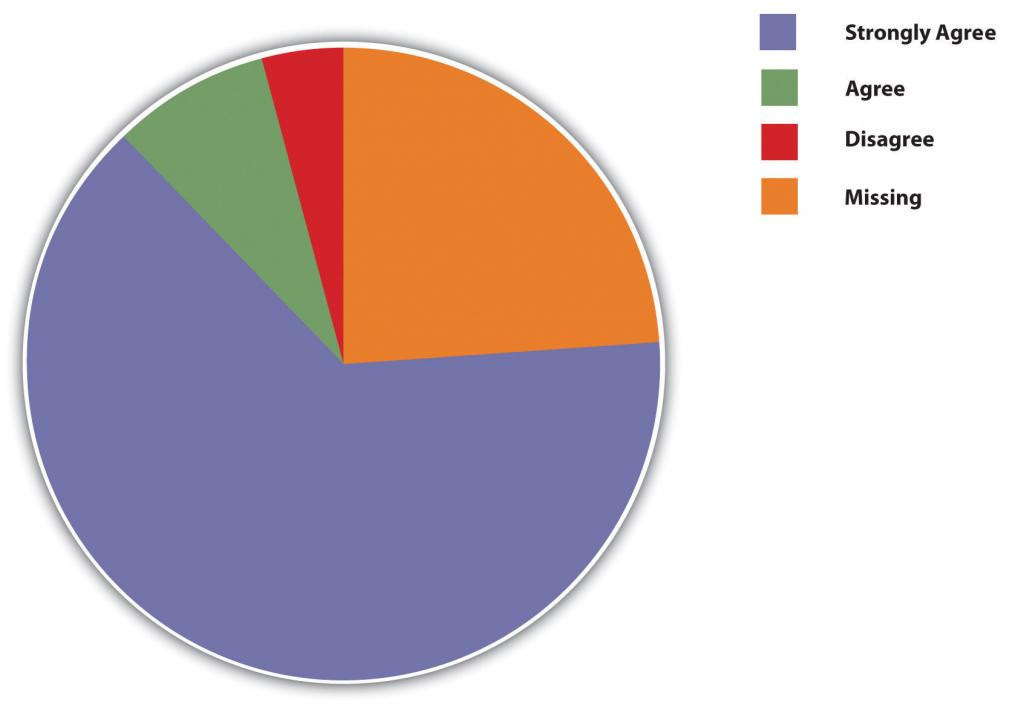
- representation
- object
- graph
- decision tree
- chart
- Which form of presentation aids are drawings that outline and explain the parts of an object, process, or phenomenon that cannot be readily seen.
- representations
- diagrams
- objects
- charts
- graphs
- Which of the following is not true about using black/dry-erase boards as presentation aids ?
- Don't write in complete sentences.
- Never write in cursive.
- Write large enough so everyone in the room can see.
- Make sure your handwriting is legible.
- Black/dry-erase boards are appropriate for every speech context.
- Which of the following is a tip for effectively using presentation aids ?
- Always pass around presentation aids so your audience can view them up close.
- If something happens to your aid, there's no reason to keep going.
- Speakers don't need to worry about presentation aid's aesthetics.
- Aids need to be large enough to be seen by your entire audience.
- Every slide, graphic, and word on a computer presentation should be animated.
Answer Key
- e
- c
- b
- e
- d
Source: University of Minnesota
 This work is licensed under a Creative Commons Attribution 4.0 License.