Unit 8: Momentum and Collisions
Topic outline
-
We use the term momentum in various ways in everyday language. For example, we often speak of sports teams gaining and maintaining the momentum to win. Generally, momentum implies a tendency to continue on course (to move in the same direction) and is associated with mass and velocity. Momentum has its most important application when analyzing collision problems. Like energy, it is important because it is conserved. Only a few physical quantities are conserved in nature, and studying them yields fundamental insight into how nature works, as we shall see during our study of momentum.
Completing this unit should take you approximately 4 hours.
-
We define linear momentum as the product of an object's mass and velocity. It can be written as
 , where
  is linear momentum,
  is mass, and
  is velocity.
Linear momentum is a vector quantity because velocity is a vector quantity, and the linear momentum will have the same direction as the velocity. The units for linear momentum are kgm/s.
-
-
In Unit 4 we learned to write Newton's Second Law of Motion as
 . While this is the most common way to write and use this law, it was not how Newton originally wrote it. Newton wrote this law in terms of momentum rather than force and acceleration:
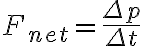
This shows that the net force equals the change in momentum divided by the change in time. This equation certainly appears different from the familiar
 we used in Unit 4.
 -
-
When two or more objects interact physically, we say the objects collide or experience a collision. Here, we consider three types of collisions for solving physics problems. They are all based on the energy transfer in the collisions. By definition, an elastic collision is a collision where the internal kinetic energy is conserved in the interaction. So, in an elastic collision, all the kinetic energy remains kinetic energy. That is, no kinetic energy is converted to heat, friction, or other types of energy.
-
-
When solving problems for elastic collisions, it is important to remember that the kinetic energy is conserved. Therefore, the total kinetic energy at the start of the collision must equal the total kinetic energy at the end of the collision. We can write this as

Moreover, we know that momentum must be conserved in the collision. Therefore, the total momentum at the start of the collision must equal the total momentum at the end of the collision. That is, for two objects (object one and two) colliding, we can write
 . Using conservation of momentum, we can usually set up these problems so we only have to solve for one unknown.
 -
-
We define angular momentum as
 . It is similar to the momentum defined for linear motion. As such, angular momentum in a system is conserved in the same way that linear momentum is conserved. Therefore, we can say that
  , where
 is the initial angular momentum in a system and
  is the final angular momentum in the system. We can also write this as: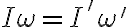
We see conservation of angular momentum in many everyday examples. As you read, pay attention to the example of the spinning figure skater in Figure 10.23. In the first picture, the figure skater is spinning with her arms out on a frictionless ice surface. In the second picture, she pulls her arms in, and her rotational velocity increases. When the figure skater pulls in her arms, she lowers her moment of inertia. Because angular momentum is conserved, because her moment of inertia decreases, her angular velocity must therefore increase.
-
-