Computer-Mediated Communication: UK and Arab Samples
| Site: | Saylor University |
| Course: | [CB DRAFT] COMM311: Intercultural Communication |
| Book: | Computer-Mediated Communication: UK and Arab Samples |
| Printed by: | Guest user |
| Date: | Tuesday, 27 October 2026, 2:34 PM |
Description
- 4c Evaluate the outcomes of interpersonal interactions between people of different cultures (CLO 1, CLO 3, CLO 4)
Abstract
As the transition toward online communication continues globally, the way people interact across cultures is also evolving. Much of the research on communication styles has focused on face-to-face communication, while less attention has been given to how such styles adapt in digital spaces, especially across different cultural groups. This study addresses that gap by examining cross-cultural differences in online communication styles between the UK and Arab Gulf Cooperation Council (GCC) countries. Supported by scenarios and explanations, we surveyed 599 adults (272 from the UK and 327 from Arab GCC countries), assessing their preferences for well-defined communication styles (Direct vs. Indirect, Ordered vs. Unordered, Being-centred vs. Doing-centred, Literate vs. Oral) and their comfort levels with each. Our results indicate that online communication preferences in these cultures are becoming more aligned, as shown by both Arab and UK participants expressing greater preference of direct communication, thus challenging traditional cultural norms. We also observed a trend toward a being-centred communication style in the UK sample and differences in comfort levels with structured communication (ordered or linear) across the cultures. Interestingly, in contrast to face-to-face communication, no differences were found between the cultures in their preferences for literate versus oral communication styles. These findings suggest that digital environments may promote more flexible and adaptive communication, adding new evidence to the Uncertainty Avoidance and Communication Accommodation theories.
Keywords
Communication styles, Computer mediated communication, Culture, Communication preferences, Social Media
Source: Asma Elfadl, Sameha Alshakhsi, Raian Ali, Ala Yankouskaya
View original source.
 This work is licensed under a Creative Commons Attribution 4.0 License.
Introduction
In an increasingly globalised world, communication is more complex than ever before. Today, over 7000 languages are spoken worldwide, and millions of people interact across borders daily, whether in business, education, or through digital platforms. With this vast diversity, effective communication has become both a challenge and an opportunity, requiring a deeper understanding of cultural differences and communication practices.
Communication challenges often arise from the diverse ways individuals express themselves, which are commonly referred to as communication styles. These styles are tied to personal and cultural identities, influencing how individuals send, receive, and interpret messages. It is well established that communication styles are shaped by cultural norms, with different cultures developing distinct styles of communication. For example, Hall (1976) introduced the concepts of high-context and low-context communication, where high-context cultures rely heavily on implicit, nonverbal cues, while low-context cultures emphasize direct, explicit communication. Additionally, cultural backgrounds influence communication behaviours, such as politeness, directness, and the interpretation of nonverbal cues.
To capture the complexity of communication styles, several other dimensions were proposed to classify and assess them. One widely recognized framework introduced the individualism-collectivism dimension. This perspective shows that individualistic cultures often value assertiveness and direct communication, while collectivist cultures tend to favour indirect, harmony-preserving styles. Another framework (Interpersonal circumplex model) offered a categorization of communication along two axes: dominance vs. submission and warmth vs. hostility. Moreover, the Communication Styles Questionnaire (CSQ) was developed to identify several distinct communication styles, including dominant, dramatic, contentious, animated, impression-leaving, relaxed, attentive, open, and friendly. These dimensions of communication styles were further developed by McCallister identifying three predominant types: noble, Socratic, and reflective. Each of these styles represents distinct approaches to communication, particularly in how individuals engage with truth-telling, analytical detail, and interpersonal relations.
Recent research proposed several new dimensions of communication style based on cultural influences. For instance, characterising communication style based on ‘doing' and ‘being' where the ‘doing' orientation places a high value on achievements and productivity measured, for example, by career progression and material wealth. In contrast, ‘being' orientation places a greater emphasis on personal identity, social status, and intrinsic worth with fostering a sense of belonging and community over constant striving for future goals. This distinction also extends to communication styles in oral versus literate societies. Literate societies, which rely on written communication, prioritise factual accuracy, logic, and evidence-based reasoning. In contrast, oral cultures rely more on verbal communication and tend to emphasise the emotional resonance and symbolism. Some researchers distinguish between ordered and unordered communication styles. For instance, ordered communication follows a structured pattern where participants take turns speaking guided by formal rules, as seen in Western culture. Unordered communication, on the other hand, allows for more fluid and spontaneous exchanges, where interruptions and overlapping conversations are common. This style is often found in more collectivist cultures, where maintaining relational ties takes precedence over adherence to formal communication rules.
Taken together, these perspectives demonstrate that communication style is a multidimensional construct shaped by cultural values, interpersonal dynamics, and situational contexts. Dimensions such as directness, formality, emotional expression, and relational orientation interact in complex ways, producing diverse patterns of communication both within and across cultures. Importantly, the frameworks reviewed above were largely developed in the context of face-to-face interaction. Yet as social life increasingly unfolds through digital platforms, the question arises as to how these culturally grounded styles are reproduced, adapted, or transformed in online communication.
Digital communication introduces conditions that challenge these established models. Online interaction is often asynchronous, multimodal, and sometimes anonymous, which complicates distinctions such as direct versus indirect communication. Increasing mobility and intercultural contact also give rise to hybrid styles that draw from multiple cultural traditions. These shifts raise important questions: how do cultural communication styles adapt in digital environments, and to what extent can frameworks developed for face-to-face settings capture the fluidity of online interaction? Empirical evidence to address these questions remains limited. Many proposed dimensions, such as those distinguishing oral and literate societies or ordered and unordered communication, originate from anthropological and sociolinguistic observations, and their applicability in contemporary digital contexts is uncertain. Only a small number of studies have examined cultural differences in communication styles online, and these typically focus on one or two isolated dimensions. As a result, we still lack a comprehensive understanding of how communication styles operate as a multidimensional phenomenon in digital settings.
Theoretical underpinning
One influential framework for understanding these culturally shaped styles is Communication Accommodation Theory (CAT), which explains how individuals adjust their communicative behavior to manage social distance, express identity, or achieve interactional goals. These adjustments can take the form of convergence (adapting towards an interlocutor's style to promote affiliation), divergence (emphasizing difference to reinforce identity), or maintenance (holding one's style constant). Moreover, CAT has been widely applied in intercultural communication to understand how individuals navigate cultural boundaries, both offline and online.
Along with interactional frameworks such as CAT, broader cultural value models also provide insight into the foundations of communication styles. Hofstede's cultural dimensions theory is one of the most widely used frameworks for understanding how cultural values shape communication practices. The model identifies several dimensions of national culture that influence how people exchange information, interpret messages, and build relationships. For example, power distance refers to the extent to which inequality in power is accepted within a society. In high power distance cultures, communication is typically formal and deferential, reflecting hierarchical relations, whereas in low power distance cultures, communication tends to be more informal and egalitarian. Similarly, individualism-collectivism affects communicative preferences: individualistic cultures emphasise autonomy, personal expression, and directness, while collectivist cultures value group harmony, relational obligations, and indirectness. Another important dimension in Hofstede's model is uncertainty avoidance (UA), which captures the degree to which members of a culture feel threatened by ambiguity. High-UA cultures generally prefer explicit, rule-governed, and structured communication, whereas low-UA cultures are more tolerant of ambiguity and favour flexible, exploratory interactional styles. Together, these dimensions illustrate how deep-seated cultural values translate into distinct communication styles across societies.
Beyond Hofstede's model, other cross-cultural frameworks also explain how cultural values influence communication. Trompenaars and Hampden-Turner identified seven dimensions that capture differences in interactional preferences across societies. Of the seven dimensions, several are especially relevant to communication. Universalism versus Particularism contrasts cultures that emphasise rules and consistency with those that prioritize relationships and context. Individualism versus Communitarianism distinguishes cultures that stress personal autonomy from those that emphasize group consensus. Neutral versus Emotional highlights differences in whether emotions are openly expressed or carefully restrained in interaction. These dimensions have been widely applied in international business and management to explain communication challenges in multinational contexts.
The Global Leadership and Organizational Behavior Effectiveness (GLOBE) project further advanced cross-cultural research by surveying managers in 62 societies and identifying nine cultural dimensions. While it shares some overlap with Hofstede's framework, GLOBE placed greater emphasis on organizational and leadership contexts, making it particularly relevant to workplace communication and cross-cultural collaboration. Several of its dimensions directly relate to communicative styles, for example, Assertiveness reflects preferences for direct versus indirect expression, while Humane Orientation highlights the cultural importance of empathy, generosity, and relational focus.
2.1. The present study
The present study takes a step toward addressing this gap by examining eight dimensions of online communication style in a cross-cultural design. To do so, we draw on data from two populations: participants from the United Kingdom and from Arab countries. This choice is grounded in well-documented cultural contrasts. At the level of everyday interaction, cultural values are enacted as communication styles through which individuals signal identity and manage relationships. In high-context traditions, such as those prevalent in Arab societies, communication is often associative, relational, and context-dependent, relying on implicit cues and indirect phrasing. In contrast, communication in the UK aligns with low-context preferences for explicitness, clarity, and direct language. These differences have been consistently observed in offline communication, and converging evidence indicates that they extend to online settings: for example, recent work comparing UK and Arab participants found differences in how misinformation is challenged, with Arab users drawing more on relational and contextual cues. The contrast between these populations is of particular interest because it reflects markedly different cultural orientations toward communication. This makes it possible to examine whether differences in communication styles are reproduced, diminished, or reshaped in digital interaction in both cultures. Moreover, a study shown that technology itself is reshaping Arab communication practices, making this population especially relevant for examining shifts in communication styles.
It has to be noted that we selected the UK and Arab populations as anchor cases that represent distinct communication logics. While our design includes direct between-group comparisons, we treat these contexts primarily as theoretically contrastive anchors that maximize variation on key communication dimensions, enabling us to assess how communication style operates within each culture - an approach that recognizes the interdependent nature of style dimensions and provides a richer understanding of their expression.
Based on the previous studies, we expect the polar differences in the eight dimensions of communication style between these populations (direct vs indirect, ordered vs unordered, being-centred vs doing-centred, oral vs literate). However, with the rise of digital communication, these cultural preferences may shift or blend in response to online environments. For example, studies have shown that online interactions may reduce some of the indirectness in high-context cultures, as written communication often requires more clarity. By comparing these two distinct cultural groups, we can better understand how cultural dimensions like context, directness, and social structure are redefined in the digital age.
Importantly, previous research on communication styles has focused on the use of communication styles largely neglecting an important aspect: the comfort level individuals have with using these styles. The use of a communication style does not necessarily indicate that a person is comfortable or confident with it. For instance, individuals may adopt a direct communication style in professional settings out of necessity, even if they feel more comfortable with indirect communication in personal contexts. The novelty of our study design is assessing both the frequency of use and the level of comfort with communication styles. This approach aims to capture differences that may otherwise be overlooked, which is critical because comfort reflects deeper cultural norms and communication preferences. This leads us to the key research questions addressed in the present study:
-
RQ1: Do Arab and British participants differ in their frequency of use and comfort with various communication styles, including direct versus indirect, ordered versus unordered, being-centred versus doing-centred, and oral versus literate?
-
RQ2: Are there differences between Arab and British participants in both their use of, and comfort with, each of the eight online communication styles?
Methodology
Method: How Communication Styles Were Studied
Overview. This section explains how the study was run: who took part, how the survey was built and translated, the eight communication styles it measured (defined in Table 1), the everyday scenarios used to illustrate them (Table 2), and the statistical models applied to the results.
3.1. Participants and procedure
The study included 599 participants, aged 18 to 60, with 272 from the UK and 327 from Arab Gulf Cooperation Council (GCC) countries. The UK participants represented individuals from England, Scotland, Wales, and Northern Ireland, while the Arab participants were from Saudi Arabia, the United Arab Emirates, Bahrain, and Qatar. Notably, there were no respondents from Oman or Kuwait. Participants were recruited via the TGM online platform, a multi-country online research company. TGM employs a wide range of technology-enabled quality controls, including advanced digital fingerprinting to eliminate duplicate responses, trap questions to detect inattentiveness, bot checks, and extensive geo-location verification. TGM also adheres to ESOMAR regulations, including a double opt-in process for panellists, ensuring both ethical recruitment and data quality. As part of its identity procedures, the platform verifies nationality, which was used in the panel-based preselection of eligible participants. Also, survey access was restricted to individuals physically residing in the selected countries. To add an additional layer of validation, participants' country of birth and country of residence were verified through self-reported identity within the survey itself.
To be eligible, participants had to be 18 years or older, frequent users of social networking platforms (e.g., Facebook, Instagram, Twitter) and messaging services (e.g., WhatsApp, Facebook Messenger) and self-identify as British or Arab based on norms and culture. These criteria were verified through a pre-selection survey, and only those meeting the requirements were invited to complete the full survey. To ensure response quality, attention checks were integrated into the survey, and the time each participant took to complete the survey was recorded. Responses were flagged as fast if they were completed in 50% or less of the median time taken by all participants. To calculate this median time, outliers such as participants who took twice as long as the expected duration, mostly because they completed the survey over multiple sessions, were excluded. The study received ethical approval from the Research Ethics Committee at the first author's institution, and data collection took place between late October 2023 and mid-December 2023. Before starting the survey, participants were required to read an information sheet and provide electronic informed consent. They were also informed of their right to withdraw from the study at any point. Only participants who completed the survey, passed attention checks, and were not disqualified for providing excessively fast or inconsistent responses were compensated for their participation.
3.2. Dataset and study design
The study was administered using SurveyMonkey a web-based survey tool. The research team followed an iterative process to improve the clarity and comprehensibility of the survey questions. The questionnaire was translated from English to Arabic, and the back-translation method was employed to ensure consistency and accuracy. The data collection was part of a larger study that can be found available on the Open Science Framework at the link provided in the Supplementary Material section.
The questionnaire consisted of several primary sections, including an assessment of demographics (i.e., gender, age, and educational level). The study examined the use of the different communication styles for participants as mentioned earlier. A brief definition of each is shown in Table 1.
Each of the eight communication styles examined in the study, paired with a short definition.
| Communication style | Definition |
|---|---|
| Direct | Clearly and explicitly stating one's feelings, needs and wants; the speaker says what they mean. |
| Indirect | Using verbal messages that imply but does not clearly say speakers' true intentions in terms of their wants, needs, and goals in the discourse situation. |
| Ordered (Linear) | Structured communication focusing on one topic at a time, with clear objectives, and limited interaction. |
| Unordered (Non-Linear) | Dynamic communication that can involve multiple focuses and is interactive. |
| Being centered | Focuses more on people, the quality of the social interactions, emotional connection, and interpersonal relationship. |
| Doing centered | Focuses more on the work, results, efficiency, and achieving goals. |
| Literate | Relies on written and relatively formal language through emails, letters, charts and reports. |
| Oral | Involves spoken language through conversations, meetings, presentations, and phone calls. |
| Note: The terms "Linear" and "Non-Linear" from the original reference, have been replaced with "Ordered" and "Unordered" in this study for clarity and ease of understanding of participants. | |
To ensure participants clearly understood each communication style before completing the survey, we provided them with definitions, realistic examples, and follow-up assessment items. A vignette-based approach was used, presenting participants with a series of brief, contextually grounded scenarios that reflected common social and professional interactions. The vignettes were designed to reflect semi-professional and everyday communication contexts, such as seeking help, planning social events with colleagues, or managing everyday transitions. The highly personal or intimate scenarios were intentionally avoided to minimize potential cultural sensitivity. Highly formal corporate communication because formalized professional discourse often follows globally standardized norms that can obscure cultural differences in communication style. By focusing on semi-professional and everyday contexts, the aim was to elicit communication that remains recognizably authentic across cultures while still allowing culturally influenced variation to be observed. This was a deliberate methodological choice, as prior research suggests that every day and relational communication highlights culturally specific norms more effectively than formalized settings, where standardized rules can conceal these differences.
All vignettes were presented in Standard English and Modern Standard Arabic, depending on the language of the survey version. These languages were chosen to ensure accessibility and consistency across participants. The scenarios themselves were not tied to a single digital platform but were presented in a conversational format that mirrors common online and mobile-mediated communication (e.g., messaging, email, WhatsApp groups). This approach allowed us to capture communication practices that are generalizable across commonly used online environments, rather than restricting the focus to one platform. Each vignette illustrated two contrasting communication styles (e.g., direct vs. indirect, oral vs. literate). After reviewing each scenario, participants were asked to identify which communication style was being used, as summarized in Table 2.
Four paired communication-style contrasts. For each pair, a short setup scenario is followed by an example message written in each style, so participants could identify which style was used.
| Communication styles type | Scenario |
|---|---|
| Direct vs. Indirect | Sam is having some difficulty in preparing a C.V (resume) for a new job or course. Sam wants help from friends. Sam talks or writes to friends and contacts, saying: |
| Direct: "I am applying for a new job. I need your help in preparing my C.V (resume) so it looks more competitive". | |
| Indirect: "I am applying for a new job. I am finding it really difficult to prepare my C.V. (resume). I really need this opportunity". | |
| Ordered vs. Unordered | Sam is getting ready to relocate to a different city and is in the midst of planning a move. |
| Ordered: Sam contacts friends who live in the new city twice. In the first, Sam asks them specifically to recommend residential neighbourhoods that are family friendly. In the second, Sam separately asks them specifically if they know of a rental agency that is reliable and not expensive. | |
| Unordered: Sam contacts friends who live in the new city in one general call asking them both for recommending a residential neighbourhood and a rental agency. Sam asks them to contact to talk more on preferences. | |
| Being-centered vs. Doing-centered | Sam is working with a team on a project or an assignment and wants to get updates from others. Sam talks or texts the team saying: |
| Being-centered: "Hey, my dears. I'm sure everyone is working hard on the task. I'm nearly done with my part and will share it with you tomorrow end of the day. Let's meet on Thursday at 10 am and do our best to meet and integrate the parts we have completed so far". | |
| Doing-centered: "Everyone, I am almost finished with my part. I will send it to all of you by tomorrow, Tuesday, 4 pm. Could you please update me on your progress? Let's plan to meet on Thursday at 10 am to integrate our tasks before the deadline". | |
| Literate vs. Oral | Sam is organizing a farewell party for a colleague, Alex, who is relocating outside the country. Sam needs to collect money to purchase a gift to be given to Alex in the farewell party. |
| Literate: Sam emails all team members, except Alex, providing options for the gift and specifying the amount each person should contribute if they wish to be part of the purchase. Sam asks them to reply voting for the options and the amounts. | |
| Oral: Sam creates a WhatsApp group for colleagues in the same team, excluding Alex. Sam sends a voice message to everyone, asking them to suggest and decide on the gift for Alex and the contribution amount each person needs to make. Sam calls those who are not on WhatsApp by phone to discuss the same thing. |
To ensure clarity and cultural relevance, we performed face validation with participants from both target populations. Five participants - two from the UK and three from Arab countries - provided feedback, representing both cultural perspectives. Based on the participants' feedback, several adjustments were made. We standardised the names used in the scenarios to ensure the survey avoided any potential religious or gender connotations. Initially, we employed the names "Sam" and "Noor," but later unified them to "Sam" across all scenarios for consistency. To address concerns about readability issues when presenting multiple communication styles, we used two distinct colours - blue and orange - to differentiate between paired communication styles, with each colour consistently assigned to one style (see details in Supplementary Material).
3.3. Measurements
We collected information about participants' age, gender, and education. To evaluate the use of communication styles, participants responded to two key statements per style: "I use it when communicating with others?" (referred to as 'Self-use') and "Others use it when communicating with me?" (referred to as 'Others-use'). Comfort levels with each style were measured through the following statements: "I feel comfortable using it when communicating with others?" (referred to as 'Comfort_Self-use') and "I feel comfortable when others use it to communicate with me?" (referred to as 'Comfort_Others-use'). All responses were recorded on a 6-point Likert scale, ranging from 1 ("Strongly disagree") to 6 ("Strongly agree").
3.4. Data analysis
Prior to analysis, both datasets were screened for consistency. As there were no Arab participants over the age of 60, UK participants above 60 were also excluded to maintain comparability in age range between the two groups. The data were then examined for missing values and inconsistencies, with only complete and valid cases taken for analysis.
First descriptive statistics (means and standard deviations) were computed for each communication style dimension, separately for the UK and Arab samples. This presented an initial overview of how participants evaluated both their use of each style and their comfort with it.
Next, a correlation analyses (Pearson's r) was run between all communication style ratings and comfort ratings within each group. This step was used to assess whether participants' ratings of different styles were related to each other. Although most of the correlations were modest in size, they were consistent across variables, indicating that the constructs were interrelated. Because of this shared variance, we decided to analyse all ratings together in a single model rather than running separate tests for each dimension.
For this analysis, we employed Linear Mixed Models (LMMs). This method is particularly appropriate for datasets in which each participant provides multiple ratings, as it accounts for repeated measures within individuals. In our models, each rating was characterized by three factors: Mode (whether the rating referred to the use of a style or comfort with it). Person (whether the rating referred to the participant's self-communication or the others) and Condition (the specific type of communication style (Direct, Indirect, Ordered, Unordered, Being-centred, Doing-centred, Literate, Oral)).
Mode, Person, and Condition were treated as fixed effects, allowing us to test their influence on ratings systematically. In addition, a random intercept was included for each participant to account for individual differences in overall response levels (for example, some people may generally rate all styles higher or lower than others). Interaction terms between Mode, Person, and Condition were incorporated to examine whether preferences for particular styles depended on whether participants were rating use or comfort, and whether they were rating themselves or others. Where significant main effects or interactions emerged, post-hoc pairwise comparisons were conducted with Bonferroni correction to adjust for multiple testing.
Finally, to directly test for cultural differences, we fitted additional models that included Country as a factor. These models examined whether Arab and UK participants differed systematically in their reported use and comfort of communication styles, and whether such differences varied depending on whether they were rating themselves or others. All LMM models were estimated using Jamovi version 2.6.2.
Results
Results: Communication Styles in Arab and UK Samples
About these results. This study surveyed UK and Arab participants on how they use different communication styles and how comfortable they feel with them — both for themselves and when observing others. The sections below report the statistical models; Table 3 lists the within-sample post-hoc comparisons, and Figures 1–2 compare the two samples directly.
Key to terms
- Mode
- Use (how often a style is used) vs. Comfort (how at ease the person feels with it).
- Person
- Self (one's own communication) vs. Others (how others communicate).
- Conditions
- The communication-style contrasts compared: Direct/Indirect, Ordered/Unordered, Being-centred/Doing-centred, and Literate/Oral.
- pbonf
- A p value adjusted with the Bonferroni correction; values below .05 indicate a statistically significant difference.
4.1. Participants' demographics
A total of 599 participants completed the online survey, including 272 from the UK (Mean age = 38.81, SD = 11.19, 41.91 % males) and 327 from Arab countries (Mean age = 34.28, SD = 7.97, 45.57 % males).
4.2. Use of and comfort with communication styles
Before conducting the data analysis, we performed a correlation analysis to explore the relationships between all variables for both the Arab and UK samples. The analysis showed that most items assessing communication styles and comfort levels were interrelated. These correlations are visualized as heat maps in the Supplementary Material. Although many of these correlations showed a mild effect size, they were consistent across all variables. Consequently, to account for shared variance, all variables were included in a single model.
4.3. Comparisons of communication styles within Arab and UK samples
Two separate LMM models were performed to test the effects of Mode (Use, Comfort), Person (Self, Other) and Conditions (Being, Direct, Doing, Indirect, Literate, Oral, Ordered, Unordered) on participants’ rating in Arab and UK samples.
In the Arab sample, there was no effects of Mode or Person (F(1, 10,106) = 1.63, p = .202; F(1, 10,106) = 1.76, p = .184, respectively). Additionally, there was no interaction between Mode and Person (F(1, 10,106) = 1.91, p = .167). However, there was a fixed effect of Conditions (F(7, 10,106) = 326.16, p < .001). The omnibus test revealed two interactions: between Mode and Conditions (F(7, 10,106) = 12.86, p < .001), and a three-way interaction between Mode, Person, and Conditions (F(7, 10,106) = 3.40, p = .001). These results suggest that the effect of conditions on the outcome varied depending on both Mode and Person, highlighting the nuanced relationships between these variables. The Post-Hoc tests performed on the three-way interaction indicated a stronger preference for direct communication over indirect, both in their own use and in how they perceived others' use of communication (Table 3). Similarly, the ordered communication style was favoured over unordered in both contexts. Moreover, Arab participants were significantly more comfortable using direct communication than indirect, both when considering their own communication and when reflecting on others’ communication. Similarly, they expressed a greater level of comfort with ordered communication styles compared to unordered ones, in both self-use and others' use (Table 3).
Post-hoc t-tests comparing pairs of communication styles for every combination of sample (Arab, UK), perspective (self-use, others-use), and mode (Use, Comfort). Each cell gives the t value and the Bonferroni-adjusted p value (pbonf). Degrees of freedom are 10,106 for the Arab sample and 8,401 for the UK sample.
| Communication styles | Use | Comfort | ||
|---|---|---|---|---|
| t(df) | pbonf | t(df) | pbonf | |
| Arab — Self-use | ||||
| Direct - Indirect | 17.86 | < 0.001 | 21.25 | < 0.001 |
| Ordered - Unordered | 10.31 | < 0.001 | 13.25 | <0.001 |
| Being-centred – Doing-centred | 7.13 | < 0.001 | 7.03 | <0.001 |
| Literate - Oral | −3.22 | .648 | −2.73 | 1.000 |
| Arab — Others-use | ||||
| Direct - Indirect | 10.73 | < 0.001 | 22.23 | <0.001 |
| Ordered - Unordered | 7.03 | < 0.001 | 13.84 | <0.001 |
| Being-centred – Doing-centred | 4.96 | < 0.001 | 7.86 | <0.001 |
| Literate - Oral | −4.16 | .016 | −3.57 | .181 |
| UK — Self-use | ||||
| Direct - Indirect | 7.64 | < 0.001 | 6.58 | < 0.001 |
| Ordered - Unordered | 2.78 | 1.000 | 5.53 | <0.001 |
| Being-centred – Doing-centred | 4.56 | .003 | 2.70 | 1.000 |
| Literate - Oral | −2.45 | 1.000 | 0.17 | 1.000 |
| UK — Others-use | ||||
| Direct - Indirect | 2.62 | 1.000 | 8.52 | <0.001 |
| Ordered - Unordered | −1.65 | 1.000 | 6.75 | <0.001 |
| Being-centred – Doing-centred | 1.77 | 1.000 | 3.16 | .774 |
| Literate - Oral | −4.01 | .031 | 0.000 | 1.000 |
| Note: The degrees of freedom (df) for all comparisons are 10,106 for the Arab sample and 8,401 for the UK sample. Detailed analysis is presented in the Supplementary Material. | ||||
In the UK sample, there was also no effect of Person (F(1, 8401) = 1.97, p = .161) or interaction between Mode and Person (F(1, 8401) = 1.32, p = .250). However, a fixed effect of Mode (F(1, 8401) = 62.08, p < .001) and of Conditions (F(7, 8401) = 39.04, p < .001) were identified, alongside an interaction between Mode and Conditions (F(7, 8401) = 9.14, p < .001) and the three-way interaction between Mode, Person, and Conditions (F(7, 8401) = 3.52, p < .001). Similar to the Arab sample, the ordered communication style was favoured over unordered in both contexts (Table 3). UK participants also preferred direct communication over indirect, displaying similar levels of comfort in both their own communication and when observing others. Additionally, they favoured ordered communication over unordered styles. However, they showed a more nuanced patterns, with differences emerging depending on whether they were the ones communicating or observing others. For instance, when communicating themselves, they preferred direct over indirect styles and being-centred communication over doing-centred (Table 3).
4.4. Comparisons of communication styles between Arab and UK samples
We compared communication styles between Arab and UK participants by modelling fixed effects and interactions between Country (Arab, UK), Conditions (Being, Direct, Doing, Indirect, Literate, Oral, Ordered, Unordered), and Person (Self, Others) separately for the Use and Comfort modes.
For the Use mode, there were fixed effects for Country (F(1, 597) = 4.51, p = .034) and Conditions (F(7, 8955) = 93.00, p < .001), as well as significant interactions between Country and Conditions (F(7, 8955) = 32.75, p < .001) and between Conditions and Person (F(7, 8955) = 8.76, p < .001). However, the remaining terms were non-significant: Person (F(1, 8955) = 1.68, p = .20), Country*Person (F(1, 8955) = 1.54, p = .21), and the three-way interaction between Country, Conditions, and Person (F(7, 8955) = 0.30).
For the Comfort mode, there were a fixed effect of Conditions (F(7, 8955) = 207.31, p < .001) and an interaction between Country and Conditions (F(7, 8955) = 45.60, p < .001). The remaining terms were non-significant: Country (F(1, 597) = 3.71, p = .055), Person (F(1, 8955) = 1.47, p = .226), Country*Person (F(1, 8955) = 2.13, p = .145), Condition*Person (F(7, 8955) = 0.54, p = .806), and the three-way interaction between Country, Conditions, and Person (F(7, 8955) = 0.32, p = .944).
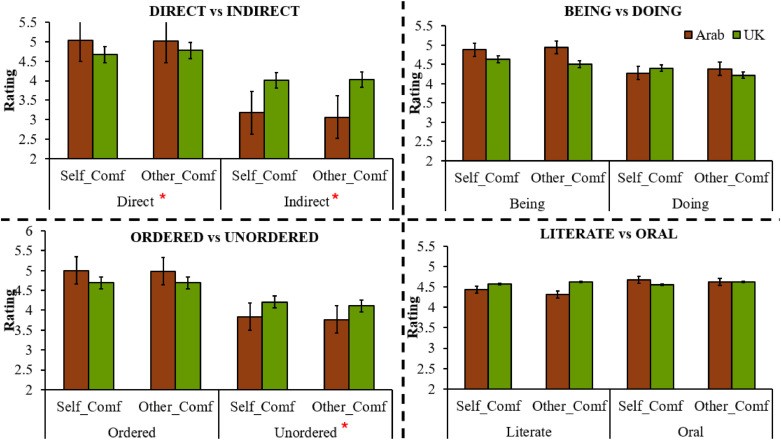
Since there was no interaction between Country and Person in either mode, we re-ran the analysis for each mode and Person, comparing Conditions between countries. The results are summarised in Fig. 1, Fig. 2 (detailed analyses are reported in Supplementary Materials).
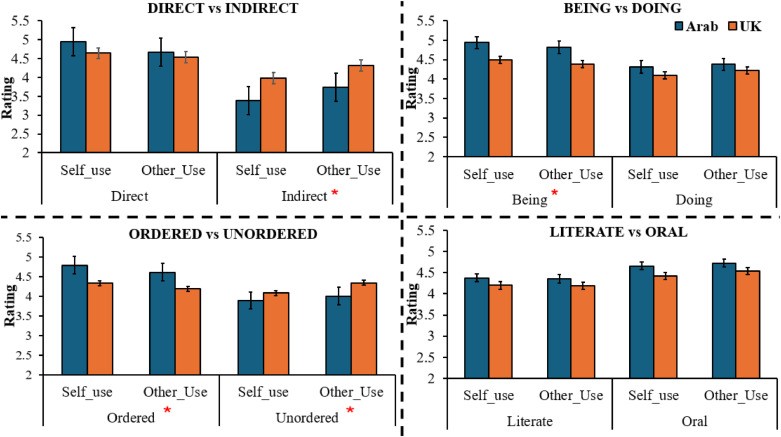
The mean ratings for the use of communication styles between Arab and UK are presented in Fig. 1. In this section, only statistically significant comparisons are discussed and other results are available in Supplementary Materials (Table 4). UK participants significantly showed a higher mean rating for self-use (MD = −0.60, t = −5.91, Pbonf: <0.001) and others use (MD = −0.58, t= −6.13, Pbonf: <0.001) of indirect communication than Arab. Moreover, Arab showed a significant preference than UK in using the ordered communication style in both self-use (MD = 0.46, t = 4.59, Pbonf: <0.001) and others (MD= 0.42, t = 4.46, Pbonf = 0.001). However, UK participants showed significant preference to other use of unordered communication style (MD = −0.34, t = −3.59, Pbonf = 0.04) than the Arab. In addition, Arab participants showed a significant preference for the use of being communication styles, for both self-use and others-use (MD = 0.44, t = 4.30, Pbonf = 0.002) and (MD = 0.44, t = 4.69, Pbonf <0.001), respectively.
As expected, Arab participants indicated the higher comfort levels with the use of direct communication, for self-use (MD = 0.37, t = 3.71, Pbonf = 0.03), compared to UK participants (Fig. 2). Morover, UK participants were more comfortable with using indirect communication themselves (MD = −0.92, t = −9.19, Pbonf = <0.001) and others using it (MD = −0.97, t = −9.75, Pbonf = <0.001) than Arab. UK particpants reported being more comfortable with self use of unordered communication style (MD = −0.37, t = −3.70, Pbonf = 0.03), than Arab, other results are available in Supplementary Materials (Table 4).
Discussion
The present study examined the preferences of use and comfort associated with communication styles in Arab and UK populations in online interactions. The results of our study revealed novel findings in the preferences in online communication style between two cultures that may have theoretical and practical implications for a better understanding of cross-cultural online communication.
5.1. Emerging alignment in the directness of online communication styles between cultures
A key finding of our study is that Arab participants showed a preference for direct communication, which contrasts with the view that Arab cultures generally favour an indirect communication style. This preference for directness in online communication may be partly explained by the influence of globalization and increased exposure to Western cultures, where direct communication is commonly expected. The rise of digital communication via email, social media, and instant messaging, may also play a role to facilitate more direct communications. Further, this might be also attributed to the Online Disinhibition Effect, where individuals feel less constrained by traditional social norms and hierarchies in digital spaces, enabling them to express themselves more directly. In line with this finding, the need for precision and speed in digital exchanges has been noted as a factor influencing communication practices on social media, with Arab speakers increasingly using a more direct approach, particularly in professional or formal contexts.
Not only did Arab participants in our study demonstrate a preference towards direct communication than indirect, but they also reported feeling very comfortable using this style. When individuals feel at ease with a communication approach, they are more likely to experience a sense of security and understanding. For example, Communication Accommodation Theory, suggests that people adjust their style to align with their conversational partner, either by converging to become more similar or diverging to highlight differences. Comfort can be achieved when convergence occurs, as it fosters mutual understanding, trust, and reduces social distance. This alignment helps individuals feel accepted, reducing anxiety and building trust within the interaction.
One key reason individuals may feel more comfortable using online communication, particularly direct messaging, is the sense of anonymity it provides. Anonymity reduces self-awareness and perceived social risk, allowing users to express themselves more freely without fear of judgment. According to the Social Identity Model of Deindividuation Effects (SIDE), anonymity can shift focus from individual identity to group identity, thereby reducing personal accountability and promoting open, uninhibited communication. This effect is particularly evident in direct messaging contexts, where the absence of physical presence lowers emotional exposure and further encourages self-disclosure. In addition to anonymity, the asynchronous nature of many online platforms offers users control over the timing of their communication. This flexibility enables individuals to take more time in constructing thoughtful and deliberate responses. The Hyperpersonal Model supports this by suggesting that such control allows for careful message crafting, which can lead to more socially desirable interactions and a stronger sense of comfort for the communicator.
Our data showed that the UK sample also preferred and felt comfortable with the direct communication style in comparison to indirect, aligning with previous research on Western cultures, where communication tends to be explicit. This preference for directness may also be linked to cultural norms that prioritise efficiency and clarity in professional and social exchanges. Furthermore, the emphasis on transparency and openness in UK communication aligns with the cultural value placed on individualism and autonomy, where being clear and straightforward is seen as essential for fostering effective interactions. An interesting finding is that while individuals in the UK sample prefer directness in their own messages, they are less receptive to directness from others. This may be linked to cultural norms that value politeness and the mitigation of intimidating expressions in social interactions, where being too direct in receiving communication can be perceived as impolite or confrontational.
Taken together, the findings suggest that both Arab and UK participants not only use direct communication styles online but also feel comfortable with them, indicating a growing convergence in communication practices. This shift is likely influenced by digital platforms and globalisation, which may be bridging cultural differences in favour of clarity and efficiency in online interactions. While our findings recommend a convergence in communication styles across cultures, it is important to interpret this convergence within a critical cultural framework. Global digital platforms often reinforce dominant Western norms, particularly through English language dominance and platform design. This can pressure users from non-Western cultures to adopt communication styles that are not integrally their own.
5.2. Contrasting preferences for ordered and being-centred communication between cultures
The preference for an ordered, structured communication style among Arab individuals aligns with concept of high uncertainty avoidance, which characterizes cultures that prioritize predictability and control in social interactions. Our findings further support this by showing that Arabs are not only comfortable with structured communication used by themselves but also prefer it in messages from others. In contrast, while individuals from the UK are comfortable with structured communication, they tend to prefer using a less rigid style in their communication and in the communication by others. This finding can be explained by Communication Accommodation Theory, which suggests that individuals adjust their communication style based on social context and expectations. In cultures with a high level of uncertainty avoidance such as many Arab societies, structured communication is preferred because it helps reduces anxiety and ambiguity. Conversely, in cultures with lower uncertainty avoidance like the UK, flexibility and adaptation may be more valued to maintain conversational harmony and reduce the perception of over-formality.
Our findings show a stronger preference for being-centred communication than doing-centered communication among Arab participants. This finding is consistent with research describing Arab cultures as collectivist, where social relationships, interpersonal connections, and emotional resonance are valued more than task achievement. Moreover, Arab participants reported higher comfort levels with being-centred communication, which focuses on personal identity, social status, and the quality of interpersonal relationships. The preference and high comfort with this style were evident for both self and others, indicating a deep cultural emphasis on maintaining harmony and strengthening social bonds in communication.
UK participants, typically associated with doing-centred communication, also demonstrated a preference for being-centred communication in their online interactions. Notably, this preference was evident only in their self-use, not in others use. Furthermore, this tendency was not accompanied by a greater sense of comfort with being-centred communication. This could be attributed to the UK's individualistic culture, which prioritises task-oriented and efficiency-driven exchanges. In such contexts, people may be more likely to expect others to communicate in a doing-centred way, as it aligns with cultural norms. However, they might allow themselves more flexibility to deviate from this norm in personal or reflective online spaces, where the pressure to conform is lower.
5.3. Convergence of literate and oral communication styles in digital spaces across the cultures
Our findings showed no significant differences in the use of literate (written) and oral communication styles between Arab and UK participants, with both groups reporting similar comfort levels. This indicates that in online environments, written and spoken communication hold equal importance across cultures. The traditional distinctions in communication styles may be fading in digital environments, resulting in a more uniform communicative experience across cultures. For example, written communication in digital spaces often mimics oral conversation by incorporating informal language, emojis, and conversational pacing, which are more characteristic of spoken interaction. Similar, language use across academic disciplines often blends different styles, making it harder to stick to traditional categories. It further supports the argument that digital spaces facilitate the convergence of communication norms. This may lead to textual orality, where users write as they speak. Moreover, earlier studies showed that the brevity, informality, and visual cues like emojis are increasingly common in both personal and professional exchanges, standardising communication practices. These findings support emerging research that positions media literacy as a key facilitator of intercultural understanding in digital environments. Taken together, our data support the more uniform communicative experience across cultures, driven by the flexibility and multimodality of digital platforms, the adaptation of communication styles to suit globalized digital spaces, and the blending of oral and literate features within text-based communication.
5.4. Practical implications of the findings
The findings highlight the importance of culturally responsive communication design in both digital platforms and training environments. Given the preference for direct and ordered communication, particularly among Arab participants, platform developers should implement structured messaging templates, clear message threading, and response sequencing tools. In addition to customizable features such as tone selection, culturally sensitive emojis, and translation options, enhancing user engagement and satisfaction. Technology should also be leveraged to actively support cross-cultural collaboration. For example, communication platforms that accommodate multiple languages, time zones, and work styles through features like real-time translation, video conferencing, and asynchronous messaging, can significantly improve team dynamics. Implementing systems with integrated translation capabilities offers a practical solution for bridging language gaps and fostering more inclusive, effective communication across cultures.
Moreover, the convergence of literate and oral communication styles across cultures highlights the need for flexible, multimodal tools in digital learning platforms. Educators should design online courses that incorporate a blend of text, video, and audio to accommodate diverse cultural preferences, fostering an inclusive and engaging learning environment. For example, online group projects can combine structured tools like turn-taking features or clear discussion prompts, for those who prefer ordered communication, with flexible options. Similarly, educational platforms can support indirect communicators through features such as anonymous posting or private drafting, while giving direct communicators clear guidelines that encourage concise contributions.
The preference for being-centered communication among Arab participants suggests emphasizing interpersonal connections, while UK participants may benefit more from clarity and task-oriented feedback. These insights are essential for creating culturally sensitive and effective online educational content. Our findings also include important implications for workplace communication. Managers and professionals can adapt communication styles more effectively when working internationally by drawing on structured training and technology-enabled tools. For example, social media based training programs have been shown to successfully develop cross-cultural managerial skills by engaging employees in interactive, culturally aware exercises embedded into everyday professional practice. Similarly, case-based and experiential training approaches in organizations help employees recognize and adapt to cultural differences, improving both collaboration and trust across teams.
The preference for being-centered communication among Arab participants suggests emphasizing interpersonal connections, while UK participants may benefit more from clarity and task-oriented feedback. These insights are essential for creating culturally sensitive and effective online educational content. For example, online group projects can combine structured tools like turn-taking features or clear discussion prompts, for those who prefer ordered communication, with flexible options. Similarly, educational platforms can support indirect communicators through features such as anonymous posting or private drafting, while giving direct communicators clear guidelines that encourage concise contributions.
5.5. Limitations and future directions
Despite the strengths of the study design, certain limitations should be considered when interpreting the findings. The samples primarily consisted of frequent social media users who engage in public discussions, which may not fully represent infrequent or passive users. This could potentially affect the broader applicability of our findings. Relying on self-reported measures introduces potential biases such as social desirability and recall bias. To mitigate recall bias, participants were provided with clear definitions of each communication style, accompanied by illustrative short scenario-based examples, resembling a vignette-style experiment. To reinforce comprehension, a short quiz followed, and key terms were color-coded throughout the survey to enhance recognition and maintain consistency. Moreover, our study included samples from two countries with distinct cultural backgrounds, the UK representing individualism, and the Arab GCC representing collectivism. While we defined cultural groups based on panel preselection and self-identified ethnicity, we did not collect detailed information on participants’ residence history or degree of cultural adaptation. Future research could explore how such experiences interact with cultural identity to shape communication styles.
Nevertheless, to enhance the generalisability of our findings, it is important to include diverse cultural contexts and utilise mixed-method approaches. While the study was framed within a cross-cultural lens and participants were recruited based on their self-identification with either Arab or UK cultural norms as a selection criterion. Thus, it did not include direct measures of cultural constructs, limiting our ability to confirm that observed differences are truly cultural in nature. These differences may reflect broader contextual or technological influences. Furthermore, although the two national samples (UK and Arab GCC) provided comparative insight, they were not intended as replication samples, and the lack of a broader cultural sampling further limits generalisability. Future research should incorporate validated cultural scales and diverse cultural contexts to better isolate cultural effects. Longitudinal studies can reveal how online communication styles evolve over time, and examining the impact of emerging technologies like AI and VR can uncover new dynamics in digital communication. Furthermore, investigating communication preferences in professional settings can refine strategies for various domains, thereby enhancing global communication practices. Educational institutions and organisations should prioritise digital literacy and cross-cultural training for individuals engaging in online communication across cultures. Social communication also depends on variables not addressed in this study, including relationship closeness, power and status differences, formality, audience size, synchronicity, anonymity, and platform norms. Future research should extend the analysis to these broader social-communication variables to provide a more comprehensive account.
Conclusion
Our study provides new findings about how communication preferences are shifting among Arab and UK populations in online settings, especially around directness, structure, and the blending of literate and oral styles. The results point to a growing similarity in how people from these cultures communicate online, shaped by the influence of digital platforms and global trends. These changes appear to challenge traditional cultural expectations, showing how communication is becoming more adaptable in response to the need for clarity and efficiency online.
This research has practical relevance for global businesses, educational settings, and cross-cultural teams, pointing to the need for flexible communication approaches that reflect changing preferences across cultures. These findings carry several practical implications. In cross-cultural communication training, they highlight the importance of equipping individuals with skills for direct yet culturally adaptable messaging, while also recognizing Arabs' stronger reliance on structure and relational cues. This can be supported by recent work utilizing AI chatbots to adapt responses based on user cultural cues. In online education, platform design should prioritize clear and structured interaction flows. At the same time, it should incorporate relationship-building features that support Arab learners, while offering the flexibility that matches the comfort of UK learners with less rigid formats. For example, in healthcare education, generative AI tools as chatbots have been shown to enhance learner engagement and communication when used to support communication skills and clinical reasoning practice.
For social media strategies, clarity and inclusivity are essential: features that support ordered replies and direct expression can foster engagement across groups, while also allowing relationally oriented communication. This aligns with recent research exploring participants' requirements for social media design, in which participants emphasized the importance of enhanced communication features and cultural sensitivity. In global teamwork and professional collaboration, protocols that combine explicit task direction with being-centred interactional practices will better accommodate both cultural groups and enhance cross-cultural trust and cooperation. This is linked to our findings, where Arab participants demonstrated stronger comfort with being-centred communication, while UK participants leaned toward doing/task-centred approaches.