BUS501 Study Guide
| Site: | Saylor University |
| Course: | [CB DRAFT] BUS501: Strategic Management |
| Book: | BUS501 Study Guide |
| Printed by: | Guest user |
| Date: | Tuesday, 27 October 2026, 2:34 PM |
Navigating this Study Guide
Study Guide Structure
In this study guide, the sections in each unit (1a., 1b., etc.) are the learning outcomes of that unit.
Beneath each learning outcome are:
- questions for you to answer independently;
- a brief summary of the learning outcome topic; and
- and resources related to the learning outcome.
At the end of each unit, there is also a list of suggested vocabulary words.
How to Use this Study Guide
- Review the entire course by reading the learning outcome summaries and suggested resources.
- Test your understanding of the course information by answering questions related to each unit learning outcome and defining and memorizing the vocabulary words at the end of each unit.
By clicking on the gear button on the top right of the screen, you can print the study guide. Then you can make notes, highlight, and underline as you work.
Through reviewing and completing the study guide, you should gain a deeper understanding of each learning outcome in the course and be better prepared for the final exam!
Unit 1: Introduction to Strategy
1a. Describe strategy in its many forms
- How is strategy defined?
- What strategic contexts should be considered when developing strategy?
- How do a business model, value proposition, and strategic portfolio influence an organization's strategy?
Strategy is defined as the determination of an organization's basic long-term goals and objectives and the courses of action adopted to carry out the goals and objectives – for example, reallocating resources. Key terms related to strategy include business model, which is the overall approach to competing in an industry. Value propositions are the reasons customers choose to do business with one firm rather than other acceptable alternatives. Strategies are sustained and purposeful initiatives in pursuit of specific organizational goals. The strategic portfolio is the market presence created by the sum of a firm's business activities. Strategic contexts are those aspects that impact how strategic decisions are made, which include economic factors, societal factors, internal factors (such as strengths and weaknesses), and external factors (such as industry opportunities and threats). Strategic contexts are important to keep in mind because no organization makes strategic decisions while only considering one context; they must consider multiple contexts to be successful.
Review
To review, see:
- Introduction to Strategic Management
- Identifying Strategy
- The Art, Science, and Craft of Decision-Making
1b. Determine the participants in strategy as a hierarchy
- What are the aspects of a strategic hierarchy?
- How do mission, values, objectives, and metrics relate to the hierarchy?
- What importance do metrics play in the strategic hierarchy?
In simple terms, a strategic hierarchy is a model that illustrates the relationship of corporate strategy to an organization's business units and management strategies. In other words, the organization has several strategies that tie into its overall strategy. For example, Yum! Brands, Inc. is an organization that owns Kentucky Fried Chicken, Taco Bell, and other food chains – these units have different strategic missions and management styles. The aspects of the strategic hierarchy include the global strategy, then the sub-strategies: marketing strategy, financial strategy, human resources strategy, information strategy, material resource strategy, and organizational development strategy. Within each of these, there should be a mission, values, and objectives tied to each strategy and the overall global strategy. There should also be metrics within each strategy that ask how to know if the strategy worked. This is important because when we develop a strategy, we want to be sure we can measure the success of the strategy later.
Review
To review, see:
1c. Analyze market structures
- What are the four types of market structures?
- What elements of each market structure make it different from the rest?
- What company/product examples can you think of that would be considered pure competition?
There are four main market structures: pure competition, imperfect or monopolistic competition (not to be confused with a monopoly), oligopoly, and monopoly. A market structure in economics refers to how different industries are classified based on their degree of competition. Pure competition is a market in which many sellers exist, products are homogeneous, and there is an ease of entry into the market (for example, agricultural products). Imperfect or monopolistic competition is when there are many sellers, the products are differentiated, and there is ease of entry (for example, a hair salon or restaurant) – not to be confused with a monopoly. Oligopoly is when few sellers exist, products are identical, and entry into the market is difficult (because it may be expensive, such as in the oil industry). A monopoly exists when there is only one seller, no close substitutes, and difficult entry into the market (such as an electric company).
Review
To review, see:
Unit 1 Vocabulary
This vocabulary list includes terms you will need to know to successfully complete the final exam.
- business model
- imperfect/monopolistic competition
- market structure
- monopoly
- oligopoly
- pure competition
- strategic contexts
- strategic hierarchy
- strategic portfolio
- strategy
- value proposition
Unit 2: The Strategic Planning Process
2a. Describe how organizational goals are established
- What is the POLC framework?
- What does each step in the POLC framework involve?
- How is the POLC framework used to create the organizational goals?
The POLC framework stands for planning, organization, leading, and controlling. These steps are used to help develop larger organizational goals and determine how resources should be allocated to make these goals a reality. Planning involves setting the mission and vision, strategizing, and setting goals and objectives to help you reach your bigger mission. The organizing aspect revolves around organizational design, culture, and social networks. Leading means making good decisions, communicating well, and motivating your people to reach goals. The controlling aspect means creating systems and processes, and ways you can measure the outcomes of your goals. All areas of the POLC framework are important because they are the steps you will take to set your goals.
Review
To review, see:
- Developing Mission, Vision, and Values
- Developing Vision and Mission Statements
- Strategic Planning and the Final Product
- Strategic Management in the P-O-L-C Framework
2b. Identify internal and external factors that impact strategic planning
- What is SWOT analysis used for?
- What elements of SWOT would be considered internal factors of the organization?
- What elements of SWOT would be considered external factors of the organization?
A SWOT analysis is used ahead of time to help the organization see where its strengths, weaknesses, opportunities, and threats lie within its operating environment. This helps set the stage for the strategic planning that will come later. Strengths and weaknesses are considered internal factors, while opportunities and threats are external factors—both factors could positively or negatively affect your business.
PEST stands for political, economic, social, and technological elements. A PEST analysis is performed before developing the strategic plan to consider external factors that may affect an organization. PESTLE/PESTEL stands for political, economic, sociological, technological, legal, and environmental elements. A PESTLE/PESTEL analysis is used similarly to a PEST analysis but adds legal and environmental elements. Using these tools in conjunction with SWOT analysis is a good basis for strategic planning.
Review
To review, see:
2c. Apply the appropriate strategic management tools based on internal and external analysis
- How might a company use Porter's Five Forces Framework?
- What are the Five Forces associated with Porter's Five Forces Framework?
Porter's Five Forces framework is a strategic tool used to evaluate the competitiveness of an industry by analyzing five key factors: the threat of new entrants, the threat of substitutes, the intensity of rivalry among competitors, and the bargaining power of both buyers and suppliers. To enhance strategic planning, the Five Forces model is often paired with frameworks like PESTEL, which examines political, economic, social, technological, environmental, and legal factors. Additionally, competitive dynamics and competitor profiling are important for understanding evolving market conditions, enabling firms to anticipate rivals' moves and react strategically. These models can help companies determine the best direction to go with their strategy.
Review
To review, see:
Unit 2 Vocabulary
This vocabulary list includes terms you will need to know to successfully complete the final exam.
- controlling
- external factors
- internal factors
- leading
- organizing
- PEST analysis
- PESTLE/PESTEL analysis
- planning
- POLC framework
- Porter's Five Forces Framework
- SWOT analysis
Unit 3: Strategic Development and Creating Competitive Advantage
3a. Describe the main types of business and corporate strategies
- How do you define competitive advantage?
- What generic strategies revolve around larger markets?
- Which generic strategies revolve around narrow markets?
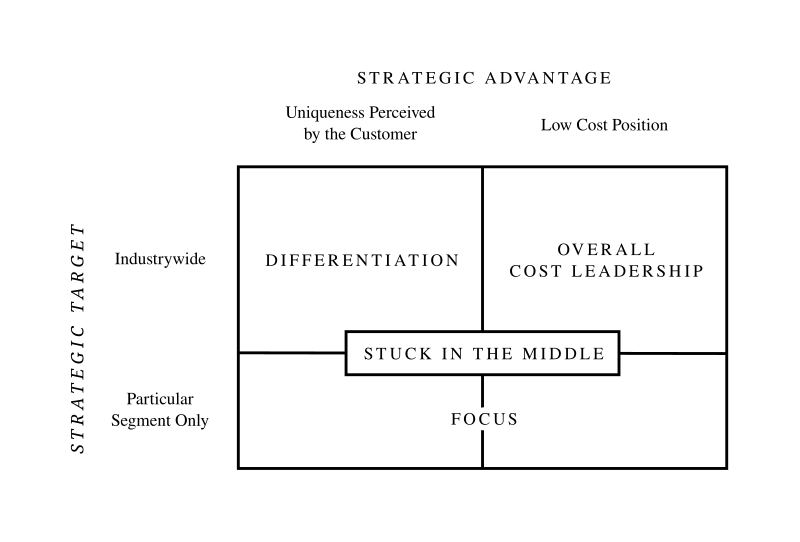
Competitive advantage is the attribute that allows a business to outperform its competitors within an industry, such as access to new technology or rare natural resources. Michael Porter, a professor at Harvard Business School, identified three strategies that businesses can use to tackle competition: overall cost leadership strategy means to be the low-cost provider when compared to competitors; differentiation strategy means to do something innovative that makes people willing to pay more for your product: and, focus strategy means to targets a very narrow market (this strategy can also be called the segmentation strategy). These strategies are summarized in this image.
Review
To review, see:
3b. Determine the methods used to create a competitive advantage
- What is the Delta Model?
- What are the two main ways companies create a competitive advantage?
- How do products along the value chain create a competitive advantage?
- What elements are added to products along each step of the value chain?
The Delta model addresses system lock-in as a source of competitive advantage. This refers to barriers for competitors to compete for customers. In a best product advantage, the focus is on being the lowest cost provider. In a total customer solution strategy, the organization redefines the customer experience. A company has two main ways to create a competitive advantage. First, they can reduce costs, such as production costs, and keep their revenues consistent. Second, they can keep costs constant while increasing revenues by providing more value to consumers – this is achieved through the idea of a value chain. A value chain charts the path by which products and services are created and sold to customers. In other words, as each step in the chain is completed, the product or service becomes more valuable than it was at the previous step. For example, a company that harvests lumber and makes it into boards creates value along the chain by making the tree usable in the form of boards for construction. Another thing that companies can do to create a competitive advantage is through their operations. Using the concept of total quality management, companies can gain competitive advantages by creating high-quality products and reducing their production costs.
Review
To review, see:
- Toward a Dynamic Theory of Strategy
- Porter's Competitive Strategies
- Generic Strategies
- The Delta Model
- Operations Management
- The GE Approach
- Innovation Strategies
Unit 3 Vocabulary
This vocabulary list includes terms you will need to know to successfully complete the final exam.
- best product advantage
- competitive advantage
- customer solution strategy
- differentiation focus
- differentiation strategy
- focus strategy
- overall cost leadership strategy
- segmentation strategy
- system lock-in
- total quality management
- value chain
Unit 4: Executing Strategy
4a. Analyze commonly used execution strategies, such as growth and retrenchment
- When might an organization use horizontal integration?
- What are the advantages of diversification for a company?
- In what situations do you think a company would use a retrenchment strategy?
A growth strategy aims to fuel growth in revenues and earnings. Growth strategies include horizontal integration, which is a merger or acquisition of a new business. They can engage in vertical integration, which occurs when a company integrates successive stages in the production and marketing process. For example, when a gas station acquires an oil refinery. Diversification is a strategy in which a company acquires or establishes a business other than what it currently does. A retrenchment strategy is when an organization shrinks one or more business units. Often this means to lay off employees and, in other words, get smaller. Sometimes companies will also restructure, which can include divestment, which means to sell off parts of a company's assets. They might also liquidate, which means to shut down portions of a company's business.
Review
To review, see:
4b. Analyze organizational design methods to assist in strategy execution
- What is a functional organizational design?
- How are organizational design and strategy related?
When developing and executing a strategy, organizational design should be considered. The way a company is structured, such as using a functional, multidivisional, matrix, or boundaryless approach, directly influences how well it can implement its strategy. A functional structure groups employees by specialty, a multidivisional structure organizes by products or regions, a matrix structure combines functional and project reporting, and a boundaryless structure removes barriers to encourage collaboration across all areas. In addition, the importance of organizational controls, including output, behavioral, and clan controls, which help guide employee actions and ensure strategic goals are met. When considering organizational structure, there is a need for alignment between structure, control systems, and strategy.
Review
To review, see:
Unit 4 Vocabulary
This vocabulary list includes terms you will need to know to successfully complete the final exam.
- boundaryless
- diversification
- divestment
- functional
- horizontal integration
- liquidate
- organizational design
- matrix
- multidivisional
- restructure
- retrenchment strategy
- vertical integration
Unit 5: Factors to a Successful Strategy
5a. Determine the factors that contribute to successful strategy execution
- How does organizational culture impact strategy?
- What elements of a Theory Y management style are most necessary to successful strategy implementation?
- How do international trade concepts impact strategy?
Now that you understand how companies determine their strategies, let's explore what should be considered to successfully apply a strategy. First, you'll want to consider the organizational culture. Organizational culture refers to the beliefs, values, behavior, and material objects that constitute a way of doing business.
It is also important to consider managerial and leadership theories since you will depend on your people to help you execute the strategy. McGregor addresses Theory X and Theory Y in the context of management. Theory X managers believe workers need to be watched and told what to do, in other words, micromanaged. Theory Y managers believe that empowering employees can help meet organizational goals because they assume their employees are self-disciplined, self-motivated, and capable of being committed to the organization. You can see where these theories are important in strategy because you need your people to help you reach organizational goals.
Another important aspect of applying strategic management is the consideration of global operations and international trade. International trade theory relates to what types of products and services countries should produce, based on what they can do well and most efficiently. For example, according to Porter, we need to consider international trade in the context of the market conditions in a particular region or country, look at the demand for the product or service in that country, determine if the country or region has the necessary suppliers to produce the product or service, and the local strategy that will be applied when doing business in that country. Since many organizations are global, international trade and global business may be important in the overall organizational strategy.
Review
To review, see:
- Globalization and Unemployment
- Building Competitive Advantage
- Corporate Governance, Corporate Ethics, and Social Responsibility
- Ethics, Corporate Responsibility, and Sustainability
- HR Management and Diversity
5b. Analyze technology tools used for strategy development
- In what ways can AI be used in hiring, marketing, and strategy development?
- What are the potential downsides to using AI in strategy development?
Artificial intelligence (AI) can enhance hiring by automating resume screening, identifying top candidates, and reducing bias through data-driven assessments. In marketing, it can analyze consumer behavior, personalize content, and optimize campaigns in real time. For strategy development, AI can process vast amounts of data to uncover trends, forecast outcomes, and support decision-making. However, relying too heavily on AI in strategy development can lead to overconfidence in data, overlook human intuition and creativity, and raise ethical concerns. When using AI to develop a strategy, there should be a blend of the use of technology and human input.
Review
To review, see:
Unit 5 Vocabulary
This vocabulary list includes terms you will need to know to successfully complete the final exam.
- artificial intelligence (AI)
- international trade theory
- organizational culture
- Theory X
- Theory Y