
BUS501 Study Guide
Unit 3: Strategic Development and Creating Competitive Advantage
3a. Describe the main types of business and corporate strategies
- How do you define competitive advantage?
- What generic strategies revolve around larger markets?
- Which generic strategies revolve around narrow markets?
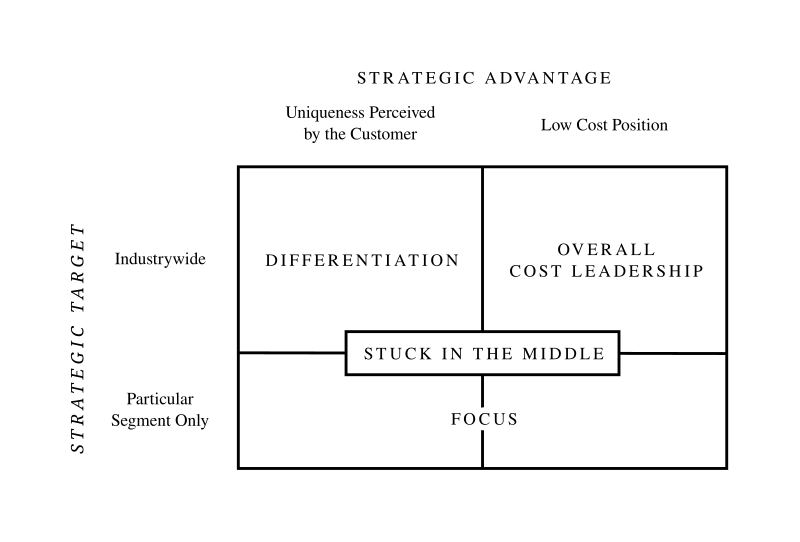
Competitive advantage is the attribute that allows a business to outperform its competitors within an industry, such as access to new technology or rare natural resources. Michael Porter, a professor at Harvard Business School, identified three strategies that businesses can use to tackle competition: overall cost leadership strategy means to be the low-cost provider when compared to competitors; differentiation strategy means to do something innovative that makes people willing to pay more for your product: and, focus strategy means to targets a very narrow market (this strategy can also be called the segmentation strategy). These strategies are summarized in this image.
Review
To review, see:
3b. Determine the methods used to create a competitive advantage
- What is the Delta Model?
- What are the two main ways companies create a competitive advantage?
- How do products along the value chain create a competitive advantage?
- What elements are added to products along each step of the value chain?
The Delta model addresses system lock-in as a source of competitive advantage. This refers to barriers for competitors to compete for customers. In a best product advantage, the focus is on being the lowest cost provider. In a total customer solution strategy, the organization redefines the customer experience. A company has two main ways to create a competitive advantage. First, they can reduce costs, such as production costs, and keep their revenues consistent. Second, they can keep costs constant while increasing revenues by providing more value to consumers – this is achieved through the idea of a value chain. A value chain charts the path by which products and services are created and sold to customers. In other words, as each step in the chain is completed, the product or service becomes more valuable than it was at the previous step. For example, a company that harvests lumber and makes it into boards creates value along the chain by making the tree usable in the form of boards for construction. Another thing that companies can do to create a competitive advantage is through their operations. Using the concept of total quality management, companies can gain competitive advantages by creating high-quality products and reducing their production costs.
Review
To review, see:
- Toward a Dynamic Theory of Strategy
- Porter's Competitive Strategies
- Generic Strategies
- The Delta Model
- Operations Management
- The GE Approach
- Innovation Strategies
Unit 3 Vocabulary
This vocabulary list includes terms you will need to know to successfully complete the final exam.
- best product advantage
- competitive advantage
- customer solution strategy
- differentiation focus
- differentiation strategy
- focus strategy
- overall cost leadership strategy
- segmentation strategy
- system lock-in
- total quality management
- value chain